Key takeaways
- Find the best window plugs for home theater soundproofing and light blocking, with foam panels, mass loaded vinyl, blankets and film kits compared.
The best window plugs for most home theater rooms are layered, removable barriers that fill the window opening, because a single thin layer rarely blocks enough sound or light on its own. For most rooms, start with the TroyStudio Thick Soundproof Blanket for a heavy, ready-to-hang barrier, or build a rigid plug around Trademark Soundproofing mass loaded vinyl if the room faces a busy street and low-frequency noise is the main problem. For a lighter touch, the Duck Brand Indoor 10-Window Shrink Film Insulator Kit seals drafts around the frame, while Lightdesire self-adhesive foam panels and Burdurry wedge panels add absorption to the room-facing side of a plug. A window plug is not a replacement window and it is not a curtain. It is a removable panel or layered assembly that sits in or over the window opening, blocks the view completely while it is in place, and comes out again when daylight or fresh air matters more than quiet.

As an Amazon Associate, we earn from qualifying purchases.
Table of Contents
- What Is a Window Plug
- How to Choose a Window Plug
- 1. TroyStudio Thick Soundproof Blanket
- 2. Trademark Soundproofing Mass Loaded Vinyl 1lb
- 3. Duck Brand Indoor 10-Window Shrink Film Insulator Kit
- 4. Lightdesire Self-Adhesive Sound Proof Foam Panels
- 5. Burdurry Acoustic Panels 50 Pack
- Window Plugs at a Glance
- How to Build and Fit a Window Plug
- Mistakes to Avoid
- Frequently Asked Questions
- Conclusion
- Product and ASIN Reference
What Is a Window Plug
A window plug is a removable barrier that fills a window opening to reduce sound passing through the glass and to block light. In a home theater, the window is usually the weakest surface in the room. Glass is thin and light compared with a framed wall, so traffic noise, voices, lawn equipment, and rain all pass through it more easily than through the surrounding wall. A plug answers that weakness with mass, sealing, and absorption in one removable assembly. The classic do-it-yourself version is a frame cut to fit the window casing, faced with rigid board, filled with insulation or foam, and edged with weatherstripping so sound has no open path around the sides. The ready-made products in this guide supply the layers that make that build work: a heavy blanket that hangs over the opening, dense vinyl that adds mass, shrink film that seals the frame, and acoustic foam that absorbs reflections on the room side.
Window plugs are different from the other products that share part of the name. Banana plugs are small connectors for speaker wire and have nothing to do with windows. Window box planters hold plants on a sill. Window insulation film kits seal a window against drafts but do not add meaningful mass, so they help with comfort and light drafts more than with sound. A plug is defined by fit and by weight: it fills the opening edge to edge, it is heavy enough to resist sound, and it can be lifted out without tools or damage when the room needs daylight again. That removability is the whole point in a living room or a multipurpose media room, where a permanently boarded window would be unacceptable.
The trade-off is total light loss while the plug is in place. A well-fitted plug blocks the view entirely, which is exactly what a projector room wants and exactly what a room used for reading does not. Plan the plug around the way the room is actually used. If the theater runs only in the evening, a plug that lives behind a curtain and slides into place at showtime is ideal. If the room doubles as a home office during the day, a lighter panel that lifts out in seconds matters more than maximum mass. Measure the opening before ordering anything, because every product below is cut, hung, or trimmed to the window it serves, and a plug that leaves even a narrow gap around its edge loses much of its benefit. Sound behaves like water in this respect: it finds the open path, so the seal around the perimeter matters as much as the material in the middle.
How to Choose a Window Plug
Start with the noise
Not all window noise is the same, and the material that helps most depends on what is coming through the glass. High, sharp sounds such as voices, birdsong, and rain respond well to sealing and to absorption, because the gaps around the frame and the hard glass surface carry much of that energy. Low, heavy sounds such as truck engines, bass from a passing car, and aircraft need mass. Mass is the only thing that resists low-frequency sound in a meaningful way, which is why a dense vinyl layer or a heavy blanket outperforms thin foam against road noise. Listen at the window for a few minutes at the noisiest time of day and note whether the intrusion is mostly rumble or mostly sharp sound. A room facing a busy road needs the mass-loaded vinyl or the heavy blanket first. A room facing a quiet street with a barking dog next door can lean on sealing and foam.
Measure the opening twice
A plug works by fit. Measure the width and height of the window casing at three points each, top, middle, and bottom for width, and left, middle, and right for height, then use the smallest measurement in each direction. Window frames are rarely perfectly square, and a plug cut to the largest measurement will not seat. Leave a small margin for the sealing layer around the edge, because weatherstripping or foam tape compresses to fill the last fraction of an inch. Record the depth of the casing too, since a thick layered plug needs enough recess to sit flush or nearly flush with the wall. A plug that sticks far into the room looks awkward and invites knocks from passing elbows. If the window has a crank handle, a lock lever, or a deep sill, account for those protrusions in the depth measurement, or plan to remove the handle while the plug is in place.
Mass, seal, and absorption in that order
Think of a plug as three jobs stacked in one assembly. Mass blocks sound from passing through. The seal stops sound from slipping around the edges. Absorption on the room-facing side calms reflections and echo inside the theater. Many first builds get the order backwards and buy only foam, which absorbs reflections nicely but blocks very little sound coming through the glass, because foam is light. The products in this guide are arranged so the heavy layers come first: the blanket and the vinyl supply mass, the film kit and the edge sealing supply the airtight fit, and the foam panels supply the absorption layer that faces the seats. A plug that combines a mass layer with a tight seal will outperform a thicker plug made of light material alone. When choosing between two products, the heavier option is usually the better sound blocker, provided it still fits the opening and can be lifted safely.
Light blocking and heat
A plug that blocks sound also blocks light, and in a projector room that is a benefit. The heavy blanket and the vinyl layer are both opaque, so a plug built around either one turns a bright afternoon window into a dark wall. That same opacity traps heat in summer, because sunlight that would have passed through the glass now warms the plug itself. If the window faces the afternoon sun, choose a plug with a light-colored or reflective room-facing layer, or hang the plug only for evening viewing and remove it during the day. The shrink film kit takes the opposite approach: it is clear, so it preserves daylight while sealing drafts, and it belongs in rooms where light matters more than silence. Consider the season as well. A plug that is welcome in winter, when it also cuts drafts, can make a room stuffy in summer if the window can no longer open for ventilation. A removable design solves that problem, but only if removal is genuinely easy, with handles and a place to store the panel.
Removability and safety
A window plug must never become a permanent seal on a bedroom window or on the only escape route from a room. Building codes treat bedroom windows as emergency exits, so a plug in a bedroom must lift out in seconds without tools, and everyone in the household should know how to remove it. Handles on the room-facing side are not optional decoration; they are the difference between a panel that comes out calmly and a panel that has to be forced. Keep the plug light enough for one adult to handle comfortably, even if that means splitting a wide window into two narrower panels that stack side by side. Store the plug where it will not warp, lean it flat against a wall rather than standing it on edge, and keep foam layers away from open heat sources such as radiators and portable heaters. Acoustic foam is a plastic product, so check the listing for fire information, keep it clear of hot surfaces, and never mount foam directly against a heat source.
Budget and room size
A single small window can be plugged well with one blanket or one pack of foam panels plus a length of sealing tape. A wall of windows, a wide picture window, or a bay needs more material and more planning, and the cost rises with coverage. The film kit in this guide covers ten windows, which makes it the economical choice for a whole house, while the vinyl roll covers a large area and suits a dedicated theater with several windows. Count windows before ordering, measure each one separately, and remember that a pack of foam panels covers a fixed area: a twelve-pack of one-foot-square tiles covers twelve square feet, so a four-foot by five-foot window needs two packs for a single layer. Buying the second pack at the same time avoids a mismatched batch later, since foam color and density can vary slightly between production runs.
1. TroyStudio Thick Soundproof Blanket
The TroyStudio Thick Soundproof Blanket is the most complete ready-made window plug in this guide, because it arrives as a single heavy barrier that hangs over the opening with no cutting, framing, or assembly. At 37.5 x 86.6 inches it covers a standard door-sized opening, which means it also covers most full-height windows and sliding glass doors in a theater room, and its 0.8 inch thickness and 9.6 pound weight give it real mass for a fabric product. The construction is high-density cotton filler inside an Oxford cloth shell, a combination that blocks light completely and adds enough weight to resist sound better than any thin curtain. It mounts with hooks or hook-and-loop strips, so it goes up in minutes and comes down just as fast, which is exactly the behavior a multipurpose room needs. Hang it from a rod or a set of hooks above the window frame, let it overlap the frame on all sides, and the overlap itself acts as part of the seal, since sound must travel around the edges of a barrier that extends past the opening.
The blanket suits the theater owner who wants results without a woodworking project. It is the pick for a rented room, a room where the window trim cannot be modified, and a room where the plug must disappear between viewings. The weight is the trade-off: at nearly ten pounds, it needs secure mounting hardware, and a single small adhesive hook will not hold it. Use screws into a stud or a properly rated wall anchor, and confirm the rod or rail is rated for the load. The blanket also serves double duty as a thermal layer in winter, since a heavy fabric barrier over glass slows heat loss through the coldest surface in the room. For a home theater, the practical effect is a darker room with less sound leaking in from outside and less sound leaking out to neighbors, which matters late at night when dialogue and effects carry through thin glass.
Where the blanket falls short is at the edges. A hanging barrier seals less tightly than a plug that is pressed into the casing, so a small amount of sound still slips around the sides, especially at the bottom where the fabric meets the sill. Pairing the blanket with foam sealing tape around the frame closes much of that gap, and hanging the blanket inside a recessed frame improves the seal further. The cotton filler can also carry a noticeable new-material odor when first unboxed, so air it out before hanging it in a small room. Even with those caveats, this is the simplest path to a quieter, darker theater, and the one most readers should try first.
Specs
- Product: TroyStudio Thick Soundproof Blanket
- Size: 37.5 x 86.6 x 0.8 inches
- Weight: 9.6 pounds
- Material: Oxford cloth and cotton filler
- Mounting: Hooks or hook-and-loop strips
- Tier: Premium
2. Trademark Soundproofing Mass Loaded Vinyl 1lb
Trademark Soundproofing Mass Loaded Vinyl is the mass layer that turns a light plug into a serious sound barrier. Mass loaded vinyl, usually shortened to MLV, is a dense, flexible vinyl sheet loaded with mineral filler until it weighs one pound per square foot. That density is the point: sound loses energy when it meets mass, and a limp, heavy sheet resists vibration better than a rigid board of the same weight. This roll measures 4 x 25 feet and covers 100 square feet, which is enough vinyl for several window plugs, a full theater wall, or a combination of both. The roll weighs 100 pounds in total, so plan the handling before it arrives, and cut it with a sharp utility knife and a straight edge on a protected floor. A single layer of one-pound vinyl inside a plug frame gives the assembly the weight that foam alone cannot supply, and it is the layer that makes the biggest difference against low-frequency traffic noise.
Building with MLV takes more effort than hanging a blanket, but the result is a plug that can be tuned to the window. Cut the vinyl to the opening, sandwich it between a rigid facing board and a foam absorption layer, seal the perimeter with weatherstripping, and add handles on the room side. The vinyl is flexible enough to follow a slightly uneven frame, and it can be layered: two layers double the mass and improve low-frequency performance further, at the cost of weight and thickness. Because the roll is large, one purchase often covers every window in a theater plus a door, which makes the cost per window reasonable even though the roll itself is a substantial item. Store any leftover vinyl rolled, not folded, since a sharp crease can become a weak line in the barrier.
The vinyl is not a finished surface on its own. It is black, plain, and industrial looking, so a plug built around it needs a facing layer for appearance, and the foam panels in this guide make a natural room-facing finish. It also needs care during installation: the material is heavy and floppy, so a second pair of hands helps when lifting a large cut sheet into a frame, and gloves protect against the sharp edge left by a fresh cut. Keep the vinyl away from prolonged direct sun while it is stored, and do not use it as the only layer in a plug that must also absorb echo, since a bare vinyl face reflects sound back into the room. Used as the dense core of a layered plug, it is the most effective sound-blocking material in this guide.
Specs
- Product: Trademark Soundproofing Mass Loaded Vinyl 1lb
- Size: 4 x 25 feet
- Coverage: 100 square feet
- Weight: 100 pounds per roll
- Material: Vinyl, 1 pound per square foot
- Tier: Premium
3. Duck Brand Indoor 10-Window Shrink Film Insulator Kit
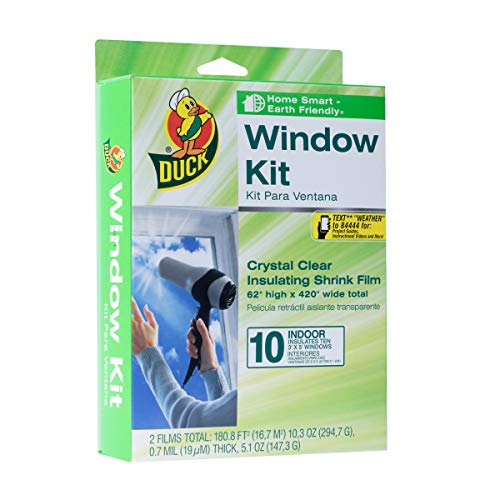
The Duck Brand Indoor 10-Window Shrink Film Insulator Kit is the sealing layer of this guide, and it is the right pick when drafts and light air leaks matter as much as sound. The kit supplies a roll of clear shrink film measuring 62 x 420 inches, enough to cover ten standard windows, plus the double-sided tape needed to fix the film to the frame. Installation is straightforward: apply the tape around the window frame, press the film onto the tape, trim the excess, and shrink the film taut with a hair dryer. The result is a clear, drum-tight second skin over the glass that stops drafts, reduces condensation on cold glass, and preserves the view and the daylight. For a theater room that is used during the day, or for a household that wants every window sealed for winter, this is the most economical option here by a wide margin.
The film kit does not add mass, so it should not be mistaken for a soundproofing panel on its own. What it does is close the air paths that carry a surprising share of high-frequency noise and drafts around a window. A window with worn seals can leak sound through gaps that are easy to miss, and sealing those gaps improves every other layer in the plug. In practice, the film works best as a base layer: seal the window with film first, then hang a blanket or fit a rigid plug over it for the viewing session. The film stays in place all season, the plug comes and goes, and the combination is quieter than either layer alone. The film is also the least intrusive option for a rental, since it removes cleanly and leaves no holes in the trim.
Durability is the limit. Shrink film is thin and can puncture if it is pressed hard or caught on a sharp corner, and a punctured sheet loses its seal until it is patched or replaced. Keep the film away from pets that scratch at windows, trim carefully around locks and handles, and expect to replace the film each cold season rather than treating it as a permanent fixture. The tape can also lose grip on dusty or damp frames, so clean the frame and let it dry fully before applying the tape. For the low cost and the ten-window coverage, those are acceptable trade-offs, and the kit earns its place as the sealing companion to the heavier plugs in this guide.
Specs
- Product: Duck Brand Indoor 10-Window Shrink Film Insulator Kit
- Film size: 62 x 420 inches
- Coverage: Fits up to 10 windows
- Film type: Rolled shrink film, clear
- Included: Double-sided tape
- Tier: Budget
4. Lightdesire Self-Adhesive Sound Proof Foam Panels
Lightdesire Self-Adhesive Sound Proof Foam Panels supply the absorption face of a window plug, and their self-adhesive backing solves the mounting problem that slows down many foam projects. The pack holds twelve panels, each 12 x 12 inches and 2 inches thick, covering twelve square feet in a single layer. Two inches of foam is a substantial depth for a tile, deep enough to absorb midrange and high-frequency reflections that make dialogue sound harsh in a bare room. The wedge profile increases the surface area the sound meets, and the high-resilience foam springs back after compression during shipping, so the tiles arrive flat and usable without a long recovery wait. Peel the backing, press the tile onto the plug frame or the wall beside the window, and the panel stays put without spray adhesive, separate tape, or curing time.
The obvious use is on the room-facing side of a rigid plug: glue or stick the tiles to the board that faces the seats, and the plug gains an absorption layer that keeps the room from sounding boxy once the window is covered. The tiles also work directly on the wall around the window, treating the first reflection points beside the screen, and on the inside of a window reveal where a hard surface would otherwise bounce sound straight back. For a renter, the adhesive backing is a mixed blessing: it is convenient, but it can mark painted surfaces when removed, so test one tile in a hidden spot first, or mount the tiles to a removable board rather than to the wall itself. A board covered in foam tiles becomes a portable absorption panel that leans against the window or hangs from hooks, which is another way to build a plug without modifying the room at all.
The limits are the usual ones for foam. Two inches of foam absorbs reflections well, but it blocks very little sound passing through glass, so these tiles must be paired with a mass layer such as the vinyl or the blanket to form a complete plug. The black color suits a theater but shows dust, and the tiles should be kept away from heat sources and open flames. Check the listing for fire information before mounting foam near any heater, and never place foam against a hot surface. For the absorption job, at a mid-range tier, this twelve-pack is the most convenient option in the guide, because the adhesive backing removes a whole step from the build.
Specs
- Product: Lightdesire Self-Adhesive Sound Proof Foam Panels
- Pack size: 12 panels
- Panel size: 12 x 12 x 2 inches
- Coverage: 12 square feet
- Mounting: Self-adhesive backing
- Tier: Mid-range
5. Burdurry Acoustic Panels 50 Pack
The Burdurry Acoustic Panels 50 Pack is the coverage pick of this guide, and it is the right choice when a theater has several windows, a large window wall, or a whole room that needs absorption. Fifty wedge panels, each 1 x 12 x 12 inches, cover fifty square feet in a single layer, which is enough to face several plug boards, treat the walls around the windows, and still have tiles left for the rear wall. The one-inch wedge profile is the classic studio shape: a series of ridges that break up flat reflections and absorb high-frequency energy before it bounces back to the seats. The panels are lightweight, easy to cut with a sharp blade for a custom fit around a window reveal, and simple to arrange in a grid or a staggered pattern that looks deliberate rather than makeshift.
The large pack changes the economics of a plug build. Instead of rationing tiles, a builder can cover the full room-facing side of every plug in the theater, line the reveals, and treat the wall sections beside the windows where reflections are strongest. That matters because a plug that blocks outside noise but leaves the room echoing has only done half the job. The wedge panels also suit a household that wants to experiment: try a single layer on one window, listen, then add a second layer or extend coverage to the side walls, and the pack is large enough to support that kind of staged approach. Black is the standard color, which disappears against a dark theater wall and keeps the focus on the screen.
One inch of foam is thinner than the two-inch Lightdesire tile, so the Burdurry panels absorb less low-midrange energy, and they need a separate adhesive, since the pack does not include a self-adhesive backing. Budget for spray adhesive or double-sided mounting tape, and plan the layout on the floor before sticking anything to a board, because repositioning foam tiles tears the surface. As with all foam, keep the panels away from heat sources and check the listing for fire information. For bulk coverage at a budget tier, no other pick in this guide matches the fifty-pack, and it is the natural partner to the mass loaded vinyl for a full-room build.
Specs
- Product: Burdurry Acoustic Panels 50 Pack
- Pack size: 50 panels
- Panel size: 1 x 12 x 12 inches
- Coverage: 50 square feet
- Profile: Wedge
- Tier: Budget
Window Plugs at a Glance
| Product | Format | Coverage | Best For |
| TroyStudio Thick Soundproof Blanket | Hanging blanket | One large window or door | Fastest ready-made plug |
| Trademark Soundproofing Mass Loaded Vinyl 1lb | Dense vinyl roll | 100 square feet | Maximum mass against road noise |
| Duck Brand Indoor 10-Window Shrink Film Insulator Kit | Clear shrink film | Up to 10 windows | Sealing drafts while keeping daylight |
| Lightdesire Self-Adhesive Sound Proof Foam Panels | Foam tiles, 2 inch | 12 square feet | Absorption face on a plug |
| Burdurry Acoustic Panels 50 Pack | Foam tiles, 1 inch | 50 square feet | Whole-room coverage on a budget |
How to Build and Fit a Window Plug
A good plug is a sandwich, and the build follows the same order every time: rigid facing, mass layer, absorption layer, and a sealed edge. Start by measuring the window casing at three points in each direction and cutting a rigid board, such as plywood or medium-density fiberboard, to the smallest width and height, minus a small margin for the sealing strip. The board gives the plug its shape and its handling strength. Next, cut the mass loaded vinyl to the same size and fix it to the back of the board, the side that will face the glass, with staples or adhesive around the perimeter. Then fix foam tiles to the front of the board, the side that will face the room, using the self-adhesive backing on the Lightdesire tiles or spray adhesive for the Burdurry wedges. Finally, run foam weatherstripping or a compressible seal around the edge of the board so it presses snugly into the casing, and screw two handles to the room-facing side.
Fitting the plug is a two-person job for a large window. Lift the panel into the casing, press it evenly until the edge seal compresses, and check for light leaking around the sides in a darkened room. Any line of light is a line where sound will also pass, so adjust the seal or add a second strip of tape at that spot. For a window that is wider than one board, build two narrower panels that meet in the middle with an overlapping joint, and handle each half separately. Label each panel with the window it belongs to, since frames differ by small amounts and a panel cut for one window rarely fits another perfectly. Store panels flat against a wall in a dry place, with the foam faces protected by a sheet of cardboard or fabric so the wedges do not crush.
For a no-build option, hang the TroyStudio blanket from hooks above the frame, overlap the frame by several inches on each side, and add foam tape around the frame behind the blanket to close the worst gaps. Seal the window first with the Duck Brand film kit if drafts are part of the problem, since the film stays in place all season while the blanket comes down between viewings. Either route gives a darker, quieter room, and the layered build simply goes further against low-frequency noise. Test the result the same way in both cases: play a familiar scene at the usual volume, step outside, and listen at the window, then stand inside with the plug in place during the noisiest part of the day and notice what remains. The remaining sound usually comes through the gaps, not the middle of the panel, which tells the builder exactly where to improve the seal.
Mistakes to Avoid
The most common mistake is building a plug from foam alone. Foam absorbs reflections, but it is light, and light materials do not block sound. A plug made only of foam looks like a soundproofing project and behaves like a decoration. Always include a mass layer, whether that is the vinyl sheet or the heavy blanket, and treat foam as the finishing layer, not the barrier. The second mistake is leaving gaps. A plug that fits loosely around the edges can be worse than no plug at all in the sense that it raises expectations while letting most of the sound through the perimeter. Measure carefully, use a compressible seal, and check the fit with the lights off.
The third mistake is sealing a bedroom window shut. A plug must be removable without tools, and it must be obvious to everyone in the household how to remove it. Never screw a plug into the frame of a bedroom window, never glue it in place, and never stack furniture in front of it. The fourth mistake is forgetting heat and moisture. A plug that traps humid air against cold glass can grow condensation and mold behind the panel, so remove the plug regularly, wipe the glass and the frame, and let the window air out. The fifth mistake is buying material before measuring. Foam packs cover a fixed area, vinyl rolls are heavy, and a blanket that is too short leaves the bottom of the window exposed. Measure first, count windows second, and order last.
Frequently Asked Questions
Do window plugs really block outside noise?
A well-built window plug reduces outside noise noticeably, because it adds mass and a tight seal to the thinnest surface in the room. The effect is strongest against high and midrange sounds such as voices and rain, and weaker against deep low-frequency rumble, which needs heavy mass to resist. A plug will not make a room silent, but it turns an intrusive street into a distant background, and that change is usually enough for film dialogue to stay clear.
Can I use a window plug in a rented home?
Yes, provided the plug is removable and does not damage the trim. A hanging blanket, a friction-fit panel with foam edge seals, and a shrink film kit all come out without leaving holes or marks, which is what a rental requires. Avoid screws into the window frame, avoid permanent adhesive on painted trim, and test any self-adhesive foam on a hidden spot first. Keep the plug stored flat so it stays true and fits the same way next time.
Will a window plug block all the light?
A plug built around a heavy blanket, vinyl, or a faced board blocks light completely while it is in place, which is ideal for a projector room. A shrink film kit is clear and blocks almost no light, since its job is sealing drafts rather than darkening the room. Choose the blanket or the layered plug for evening viewing, and choose the film kit, or simply remove the plug, when daylight matters more than quiet.
How do I keep a window plug from causing condensation or mold?
Remove the plug regularly and let the window breathe, especially in cold or humid weather. Wipe the glass and the frame dry before refitting the panel, and never leave a plug pressed against a window for weeks without checking behind it. If condensation appears, improve ventilation in the room, dry the frame, and consider using the plug only during viewing sessions rather than leaving it in place around the clock.
Conclusion
A window plug is one of the simplest upgrades a home theater can receive, because it attacks the weakest surface in the room with mass, a seal, and absorption in a single removable panel. Start with the TroyStudio Thick Soundproof Blanket if the goal is a fast, ready-made barrier that hangs in minutes. Build around Trademark Soundproofing mass loaded vinyl if road noise and low frequencies are the problem and a proper framed plug is worth the effort. Seal the frames with the Duck Brand Indoor 10-Window Shrink Film Insulator Kit to close the air paths that carry drafts and high-frequency sound. Finish the room-facing side with Lightdesire self-adhesive foam panels for a quick absorption layer, or cover the whole room with the Burdurry Acoustic Panels 50 Pack when several windows need treatment. Measure the opening, seal the edges, keep the plug removable, and the room will be darker, quieter, and far better suited to film night.
Product and ASIN Reference
| Product | ASIN |
| TroyStudio Thick Soundproof Blanket | B0FX442PNY |
| Trademark Soundproofing Mass Loaded Vinyl 1lb | B007N3356S |
| Duck Brand Indoor 10-Window Shrink Film Insulator Kit | B002GKC2GW |
| Lightdesire Self-Adhesive Sound Proof Foam Panels | B09YLJQJZW |
| Burdurry Acoustic Panels 50 Pack | B07VDTR22R |