Key takeaways
- Table saws with a true 36-inch fence and rip capacity, verified model by model, with guidance on fence systems, motor power, and cabinet saw safety.
As an Amazon Associate we earn from qualifying purchases.
Rip capacity is the specification that decides what a table saw can do with sheet goods. A saw that rips 36 inches to the right of the blade can break down a full sheet of plywood into cabinet sides, wide panels, and shelving without a second tool, while a saw limited to the mid-20s forces you to rough-cut sheets with a circular saw first and use the table saw only for final sizing. If you have settled on the 36-inch class, you have already made the most important decision. The next one is which saw actually delivers it.
That second decision needs care, because the 36-inch figure is quoted loosely across the market. Some listings describe the fence rail length, some describe a fence that can be positioned for a 36-inch cut only with an extension arrangement, and some saws with similar model names ship with 30-inch or 52-inch fence systems instead. This guide covers table saws whose product pages state a 36-inch class rip fence and 36 inches of rip capacity to the right of the blade, verified model by model, and explains the fence, motor, and safety details that separate the options. The verified pool in this class is concentrated in one maker’s cabinet saw line, and the guide says so openly rather than stretching the definition to fill space.
Disclosure: This article contains affiliate links. If you buy through these links, we may earn a commission at no additional cost to you.
How to Choose a Table Saw With a 36-Inch Fence
Verify the rip figure the right way
Look for two numbers on the product page: the fence system name, which on saws in this class usually includes the 36-inch designation, and a stated maximum rip capacity to the right of the blade. The rip capacity is the figure that matters. It tells you the widest board you can cut with the fence locked on the right side of the blade. If a page gives only a rail length or a total table width, keep looking until you find the rip figure itself, because rails extend past the cutting position for support. Also check the left-side rip figure if you ever cut with the fence on the left; on most saws it is much smaller.
Fence design decides daily accuracy
The fence is the part of the saw you touch on every cut, and in the 36-inch class the better systems are T-square style fences that ride on a heavy steel rail and lock parallel to the blade at both the front and, by design, stay square without a rear lock to fuss with. A good fence glides smoothly, locks with a firm cam action, has a readable scale you can trust, and includes a low profile position or a high-low face for supporting tall or thin stock. Fence deflection under side pressure is the enemy of straight rips in thick hardwood, so rail weight and fence body stiffness are real specifications, not marketing color.
Motor power and electrical supply
Cabinet saws in this class come in two broad motor sizes. A 1.75 HP motor wired for a standard 120V circuit suits most home shops and rips hardwood steadily with a sharp blade and a sensible feed rate. A 3 HP motor on a 230V circuit gives more headroom for thick stock, production pace, and wide dado work, and it holds blade speed better in demanding cuts. Neither is wrong; the deciding factors are the circuit you have or can add, and how hard you plan to push the saw. Confirm the plug and circuit requirements on the product page before ordering, because a 230V saw is not a plug-it-in-anywhere purchase.
Safety systems
Every saw in this guide should be judged on its guarding: a blade guard you will actually leave on, a riving knife that rises and falls with the blade to prevent kickback, anti-kickback pawls, and a switch you can bump off with a knee. One maker in this class adds an active injury mitigation system that detects contact with the blade and stops and retracts it in milliseconds, which is a genuinely different level of protection and a major reason that maker’s saws dominate this fence class. Weigh that system alongside the traditional guarding rather than treating any single feature as a substitute for careful technique.
Aligning the fence and trusting the scale
A 36-inch fence only delivers 36 accurate inches if it locks parallel to the blade. Check parallelism at setup and after any move: measure from a single marked blade tooth to the fence at the front of the blade, rotate that same tooth to the back, and measure again; the two figures should match, and small differences are corrected with the fence or rail adjustments the manufacturer provides. Once the fence is parallel, verify the scale by making a test rip, measuring the resulting piece with a tape or caliper, and adjusting the scale cursor to agree. Repeat that check whenever the blade or fence face changes, because a scale that reads a few thousandths off will quietly put that error into every cabinet part you cut. A fence that glides without rocking, locks with one lever motion, and repeats a setting when you move it away and bring it back is the standard to hold any saw in this class to.
Sheet-goods workflow: support on both sides of the blade
Rip capacity describes width, but a full sheet is also eight feet long, and the cut quality depends on support along that whole length. Plan infeed and outfeed support at table height — a roller stand, a shop-built extension, or a second pair of hands for the largest sheets — so the panel stays flat against the table and fence instead of tipping as it passes the blade. A sheet that drops at the outfeed side pulls away from the fence and binds; a sheet supported level feeds straight, which is what makes the wide rip accurate rather than merely possible. Break down oversized sheets in a clear area of the shop, keep the offcut supported as well as the keeper piece, and let the saw’s capacity set the workflow rather than wrestling stock the space cannot handle.
Table, trunnion, and dust collection
A precision-ground cast iron table and wings give a flat reference surface and damp vibration. Cabinet-mounted trunnions, which carry the blade mechanism on the cabinet rather than the tabletop, hold alignment better over years of use. Dust collection through a 4-inch port in the cabinet, ideally with collection at the blade guard as well, keeps the cut line visible and the shop air cleaner. Finally, plan the physical side: these are heavy, stationary machines, so confirm the footprint, the delivery arrangements, and whether a mobile base is available if the saw must move within the shop.
The Best Table Saws With a 36-Inch Fence
SawStop Professional Cabinet Saw 3 HP (PCS31230-TGP236) — the full-power choice
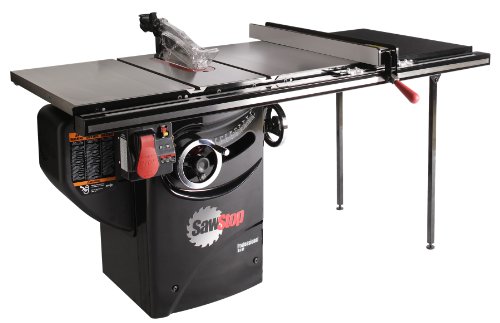
SawStop’s Professional Cabinet Saw in its 3 HP configuration is the strongest verified saw in the 36-inch fence class. Its product page states the configuration directly: a 36-inch Professional T-Glide fence system with a maximum rip of 36 inches to the right of the blade.
- View on Amazon: https://www.amazon.com/dp/B009C7NGTE
The 3 HP motor, running on a 230V circuit, is the heart of this configuration. It holds blade speed through thick hardwood rips, wide panels, and dado stacks without the bogging that forces a slower feed and rougher cut on smaller motors, which makes the saw suited to small production shops and serious home workshops alike. The Professional T-Glide fence is a heavy-gauge steel T-square system built for lockdown without deflection, and it is the component that turns the 36-inch figure from a brochure number into a usable, repeatable cutting width. The cast iron table and cabinet-mounted trunnion provide the flat, stable platform that fence accuracy depends on.
SawStop’s defining feature is its safety system: the blade carries a small electrical signal, and on contact with skin the system fires a brake that stops the blade and drops it below the table in less than 5 milliseconds, turning a potentially devastating injury into a minor one. The saw also includes the standard protective equipment that matters every day: a riving knife, blade guarding, and dust collection through the cabinet. Choose this configuration if you have or can add the 230V circuit, if you cut thick stock regularly, and if you want the most capable saw in this fence class with the strongest safety system available on a cabinet saw.
Comparison Table
| Model | Motor | Fence system | Max rip, right of blade | Power supply | Safety system |
|---|---|---|---|---|---|
| SawStop PCS31230-TGP236 | 3 HP | 36 in Professional T-Glide | 36 in | 230V | Contact-detection brake, riving knife |
Frequently Asked Questions
Is a 36-inch rip capacity enough for a full sheet of plywood?
Yes, for the way sheets are normally broken down. A 4×8 sheet is usually ripped into strips or panels narrower than 36 inches, and crosscuts are handled by rotating the work or using a different tool for the first rough cut. A 36-inch right rip covers cabinet sides, bookcase parts, and wide panels comfortably. Saws with 52-inch systems exist for shops that routinely rip wider than that, at the cost of a much larger footprint.
What is the difference between fence length and rip capacity?
Rip capacity is the distance from the blade to the fence at its widest locked cutting position, and it is the number that limits your cut width. Fence and rail measurements describe the hardware itself, which extends beyond the cutting range for support. Always compare saws on stated maximum rip to the right of the blade, and confirm that figure on the product page of the exact configuration you are ordering.
Do I need a 230V circuit for a saw in this class?
Only for the higher-power configurations. The 3 HP saw in this guide needs a 230V circuit. If your shop lacks 230V service, check any lower-power configuration’s product page carefully before ordering: similar model names in this class ship with different fence systems, and only a stated 36-inch maximum rip to the right of the blade confirms the class.
How does the SawStop brake system work, and what happens after it triggers?
The blade carries a small electrical signal that the system monitors continuously. Skin contact changes that signal, and the system fires an aluminum brake into the blade, stopping it and retracting it below the table in less than 5 milliseconds. A triggered brake and the blade are replaced as a cartridge-and-blade swap, and the saw is designed to be back in service quickly. The system does not replace the guard, riving knife, or safe technique; it is a last layer of protection when something has already gone wrong.
How do I check that my fence is parallel to the blade?
Mark one blade tooth, measure from that tooth to the fence with the tooth at the front of the throat plate, then rotate the same tooth to the back and measure again. Equal measurements mean the fence is parallel; a difference means it toes in or out, which shows up as burning, binding, or cuts that drift from the scale setting. Adjust using the fence or rail hardware the saw provides, and re-check after locking the fence down, since some fences shift slightly as they clamp.
Can these saws cut dadoes and grooves?
Yes. Cabinet saws in this class accept dado stacks for grooves and rabbets, and the fence system supports the repeated, measured cuts that joinery requires. Check the product page for the stated maximum dado width of the configuration you choose, and use a dado insert plate made for the saw.
Conclusion
The 36-inch fence class is narrower than it first appears, because many saws that mention 36 inches are describing rails rather than rip capacity. Verified on its product page, the configuration in this guide delivers the real figure: 36 inches of rip to the right of the blade on a heavy T-Glide fence. Take the 3 HP PCS31230-TGP236 if you have 230V power and want maximum reserve for thick stock. You get a cabinet saw that breaks down full sheets without a preliminary cut, which is the entire point of choosing this class.