Key takeaways
- Compare five jobsite and benchtop table saws for home projects, with rip capacity, fence design, and stand details matched to real garage workshops.
The real decision when buying a first table saw for the home is not raw power, since nearly every saw in this class runs a 15-amp motor. It is how the saw fits your space and your typical material. A homeowner who breaks down plywood sheets for built-ins needs rip capacity above all, while someone building small furniture in a one-car garage needs a saw that folds away flat and sets up without a fight. Fence quality sits between those two concerns, because a fence that drifts out of parallel turns every project into a measuring exercise.
This guide is for DIYers furnishing a garage workshop, homeowners tackling shelving, cabinets, and flooring, and hobbyists moving up from a circular saw and a straightedge. Every model below is a compact or jobsite table saw sold on Amazon, selected from the specifications and features printed on its own product page, so the numbers you see here are the ones the manufacturer publishes for that exact listing.
Quick Picks
As an Amazon Associate we earn from qualifying purchases
| Product | Best for | Key spec from title |
|---|---|---|
| DEWALT DWE7491RS | Breaking down full plywood sheets at home | 32-1/2 inch rip capacity, rolling stand |
| SKIL TS6307-00 | A first saw that stores flat against a wall | 25-1/2 inch rip capacity, integrated folding legs |
| DEWALT DWE7485 | Small garages and benchtop setups | 8-1/4 inch blade, 24.5 inch rip capacity |
| Metabo HPT C10RJS | The widest rips and largest table in this group | 35 inch rip capacity, 28-3/4 x 22 inch table |
| SKILSAW SPT99-11 | Thick stock and torque-heavy ripping | Worm drive, 3-5/8 inch depth of cut |
How to Choose
Rip Capacity Decides Which Sheets You Can Cut Alone
Rip capacity is the widest cut the fence allows to the right of the blade, and it sets the ceiling on your sheet work. Halving a standard plywood sheet takes 24 inches of capacity, so anything above that line handles cabinet sides and shelving panels without a helper or a preliminary circular-saw pass. Saws in the 30-inch class and beyond also let you rip wide boards for tabletops. Measure your most common panel, then buy capacity a few inches past it rather than paying for width you will never use.
The Fence Matters More Than the Motor
Every saw here uses a 15-amp motor, so cutting power is a wash across the group. What separates a frustrating saw from a satisfying one is whether the fence locks parallel to the blade and stays there. Rack-and-pinion fences, fitted to most of these models, move both ends of the fence together on geared rails, which keeps settings repeatable from one session to the next. Cheaper clamp fences can skew slightly each time you lock them, and that skew shows up as burned edges and parts that refuse to fit together.
Match the Stand to Your Storage Reality
A rolling stand sounds like a convenience until you price garage floor space. If the saw must share room with a car, look for a stand that folds and stands upright, or legs that collapse so the saw leans against a wall. Benchtop models skip the stand entirely and sit on a bench or a pair of sawhorses, which works well if you already own a sturdy workbench. Be honest about weight, too: a saw near 100 pounds with its stand is a roll-it tool, not a carry-it tool.
Blade Size, Depth of Cut, and Dado Support
A 10-inch blade is the home-shop standard because it cuts stock up to roughly 3-1/8 inches thick at 90 degrees and accepts the widest range of replacement blades. Compact 8-1/4 inch saws give up some depth, which only matters if you resaw thick lumber or cut 4×4 posts in one pass. Check dado support before you buy if you plan to cut grooves for shelves: some listings state a maximum dado width, while others stay silent, and a dado stack also needs a separate insert plate.
The 5 Best Options
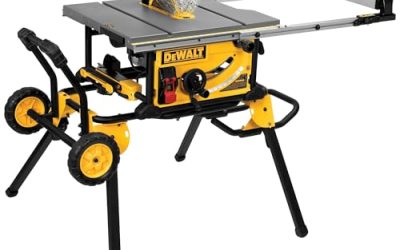
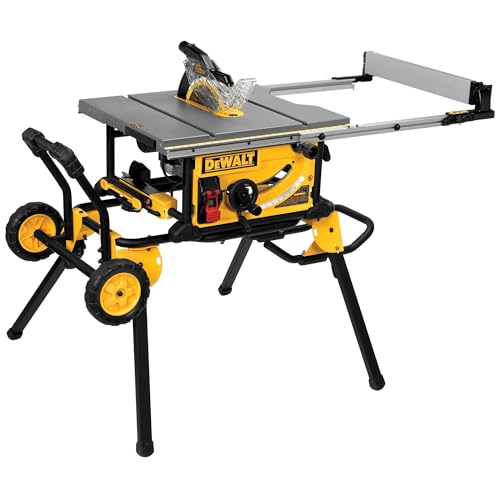
DEWALT DWE7491RS 10-Inch Table Saw with Rolling Stand
For most home workshops, this is the saw that removes the usual compromises. The 32-1/2 inch rip capacity swallows half a plywood sheet with room to spare, the rack-and-pinion fence is the benchmark design in this class, and the rolling stand folds so one person can wheel the saw out, work, and tuck it away again. It suits homeowners planning cabinets, built-ins, or a steady stream of weekend projects who want one saw that stays relevant as the projects grow.
Specs
- Blade diameter: 10 inches, 24-tooth carbide blade included
- Motor: 15 amp, 4,800 RPM no-load speed
- Rip capacity: 32-1/2 inches to the right of the blade
- Depth of cut: 3-1/8 inches at 90 degrees, 2-1/4 inches at 45 degrees
- Fence: Rack-and-pinion telescoping fence rails
- Table size: 21-7/8 x 26-3/8 inches
- Dust port: 2-1/2 inch diameter
- Stand: Folding rolling stand with onboard storage
- Weight: 110 pounds with stand
- Warranty: 3-year limited warranty
Best for: Homeowners who break down full sheets and want a saw that rolls out of the way afterward.
Watch out for: At 110 pounds on its stand, plan a rolling path rather than lifting it into a vehicle, and confirm the listing includes the rolling stand rather than a bare saw configuration.
ASIN: B00F2CGXGG
SKIL TS6307-00 10-Inch Jobsite Table Saw with Folding Stand
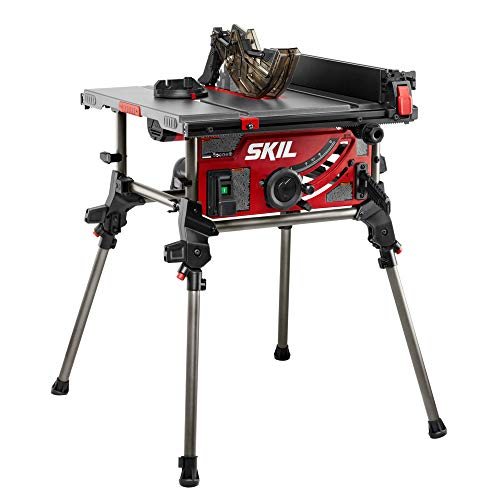
SKIL’s entry covers the essentials a home user actually touches every session: a rack-and-pinion fence, a 10-inch blade with enough depth for 4×4 stock at 90 degrees, and legs that fold into the saw body so the whole unit stores flat. The 25-1/2 inch rip capacity handles half-sheets and most furniture parts, which is the workload of a typical garage shop. It is a sensible first table saw for someone who wants real capability without dedicating permanent floor space to the tool.
Specs
- Blade diameter: 10 inches, 24-tooth carbide blade included
- Motor: 15 amp, 4,600 RPM no-load speed
- Rip capacity: 25-1/2 inches right of blade, 14 inches left of blade
- Depth of cut: 3-1/2 inches at 90 degrees, 2-1/2 inches at 45 degrees
- Bevel capacity: -2 to 47 degrees with positive stops at 0 and 45 degrees
- Maximum dado width: 5/8 inch
- Fence: Rack and pinion fence rails
- Stand: Integrated folding legs
- Weight: 51.2 pounds
- Warranty: 3-year limited warranty
Best for: First-time buyers in small garages who need the saw to fold flat for storage.
Watch out for: The listing’s comparison data shows dado work capped at 5/8 inch width, and the dado insert plate is a separate purchase, so factor that in if you plan shelf grooves.
ASIN: B08F9RFJ2K
DEWALT DWE7485 8-1/4 Inch Compact Jobsite Table Saw

This is the space-saver of the group. DEWALT shrank the formula around an 8-1/4 inch blade, yet kept the two features home users notice most: a rack-and-pinion fence and a full 24.5 inches of rip capacity, enough to halve a plywood sheet. The metal roll cage base sits happily on a workbench, and at benchtop size it disappears onto a shelf when the project ends. Pick it when the workshop is a shared garage bay or a basement corner and every square foot is negotiated.
Specs
- Blade diameter: 8-1/4 inches, 24-tooth carbide blade included
- Motor: 15 amp, 5,800 RPM no-load speed
- Rip capacity: 24.5 inches right of blade, 12 inches left of blade
- Depth of cut: 2-9/16 inches at 90 degrees, 1-3/4 inches at 45 degrees
- Bevel capacity: 0 to 48 degrees
- Fence: Rack and pinion telescoping fence rails
- Table size: 22-3/4 x 14-7/8 inches
- Dust port: 2.5 inch diameter
- Base: Metal roll cage, benchtop configuration
- Warranty: 3-year limited warranty
Best for: Tight workshops where the saw lives on a bench and still needs to rip sheet goods.
Watch out for: The smaller blade limits depth to 2-9/16 inches, so thick stock needs two passes from opposite faces, and 8-1/4 inch blades are a narrower replacement market than 10-inch blades.
ASIN: B0842QDW95
Metabo HPT C10RJS 10-Inch Table Saw with Fold and Roll Stand

Metabo HPT brings the biggest working surface in this roundup, a 28-3/4 by 22 inch table that supports long boards noticeably better than the compact models, plus the widest rip capacity here at 35 inches. Two thoughtful motor features stand out for home use: soft start, which avoids the jolt and breaker trips of an abrupt startup, and an electric brake that stops the blade quickly after a cut. The included 40-tooth blade is also a finer starting blade than the 24-tooth ripping blades most saws ship with.
Specs
- Blade diameter: 10 inches, 40-tooth carbide-tipped blade included
- Motor: 15 amp, 4,500 RPM no-load speed
- Rip capacity: 35 inches right of blade, 22 inches left of blade
- Depth of cut: 3-1/8 inches at 90 degrees, 2-1/4 inches at 45 degrees
- Table size: 28-3/4 x 22 inches with outfeed support
- Motor features: Soft start and electric brake
- Maximum dado width: 13/16 inch
- Dust port: 2-1/2 inch
- Stand: Fold and roll stand with adjustable foot
- Weight: 96 pounds with stand
- Warranty: 2-year limited warranty
Best for: Bigger furniture and cabinet projects where table support and rip width both matter.
Watch out for: Check the exact model suffix on the listing before ordering, since Metabo HPT sells near-identical variants, and confirm the fold and roll stand is the configuration in the box.
ASIN: B086YHDYPW
SKILSAW SPT99-11 10-Inch Heavy Duty Worm Drive Table Saw
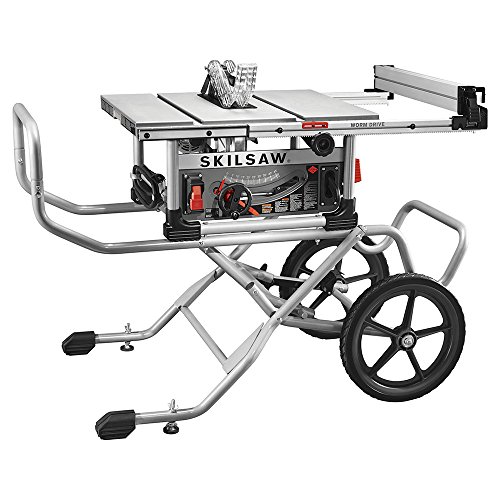
The worm drive drivetrain is the headline here. Where the other saws use direct drive, the SKILSAW’s geared worm drive trades some blade speed for torque, which helps when ripping dense hardwood or pressure-treated lumber that bogs lesser saws down. It also posts the deepest cut in the group, 3-5/8 inches at 90 degrees, enough for a 4×4 in a single pass. The rolling stand rides on 16-inch wheels, so it crosses lawns and thresholds between garage and garden projects without drama.
Specs
- Blade diameter: 10 inches, 24-tooth carbide blade included
- Motor: 15 amp worm drive, 5,000 RPM no-load speed
- Rip capacity: 30-1/2 inches to the right of the blade
- Depth of cut: 3-5/8 inches at 90 degrees, 2-1/2 inches at 45 degrees
- Bevel range: -1 to 47 degrees
- Fence: Rack and pinion fence
- Stand: Rolling stand with 16-inch wheels
- Dust collection: Dust port elbow included
- Weight: 94.3 pounds
- Guard system: Smart Guard System with anti-kickback device
Best for: Heavy ripping, thick stock, and outdoor projects where the saw rolls over rough ground.
Watch out for: Worm drive saws need periodic gear oil checks per the manual, a small maintenance step the direct-drive models skip, and the listing’s dado capacity is narrower than the Metabo HPT’s.
ASIN: B07657FP2G
Which One Fits Your Situation
Your Workshop Is One Bay of a Shared Garage
Choose between the SKIL TS6307-00 and the DEWALT DWE7485 based on how you store things. The SKIL folds its legs into the body and leans flat, suiting a wall-storage habit, while the DEWALT benchtop saw sits on your existing bench and keeps a slightly better fence feel. Both rip half-sheets, so the deciding factor is your storage shape, not cutting ability.
You Are Building Cabinets or Built-Ins From Sheet Goods
Reach for the DEWALT DWE7491RS or the Metabo HPT C10RJS. Their 32-1/2 and 35 inch rip capacities center a half-sheet cut comfortably instead of putting it at the fence’s limit, and their larger tables support the offcut side of a panel. The Metabo’s bigger table helps with long cabinet sides; the DEWALT’s fence system is the one most owners set once and trust.
Your Projects Are Small Furniture, Boxes, and Repairs
The DEWALT DWE7485 is honestly all the saw this workload needs. Its depth of cut covers dimension lumber for stools, frames, and small tables, the fence is accurate enough for joinery-sized parts, and the compact body leaves bench room for assembly. Save the bigger saws for the day your projects outgrow 24.5 inches of rip.
You Rip Thick or Treated Lumber Outdoors
The SKILSAW SPT99-11 was built for this pattern of work. Worm drive torque keeps the blade moving through wet treated stock, the 3-5/8 inch depth clears a 4×4 in one pass for fence and deck projects, and the large wheels roll across grass and gravel that would stop smaller casters. It is the least garage-friendly shape here, so give it a corner of its own.
Common Mistakes
- Buying rip capacity for sheets you never cut, then fighting an oversized saw in a small garage every day.
- Ignoring fence design and judging saws by motor amps, even though every model in this class shares the same 15-amp rating.
- Assuming the included blade suits finish work; most listings ship a 24-tooth ripping blade, so plan a finer blade for plywood and furniture parts.
- Forgetting the dado insert plate, which is sold separately on several of these saws even when the arbor accepts a dado stack.
- Skipping the storage plan: a rolling stand that folds upright and a benchtop saw solve the same problem in completely different footprints.
Frequently Asked Questions
Is a 10-inch saw always better than an 8-1/4 inch saw for home use?
Not always. A 10-inch blade cuts deeper and offers a wider choice of replacement blades, which matters for thick stock. An 8-1/4 inch saw like the DWE7485 still rips half-sheets and handles dimension lumber, and its smaller body stores far more easily. Match blade size to your thickest typical material, not to the biggest number on the shelf.
How much rip capacity do I need to cut plywood?
Halving a 4 by 8 foot sheet lengthwise requires 24 inches of rip capacity, so any saw rated above that line manages the cut in one setup. Capacity in the low thirties adds working room around the fence and covers wide cabinet parts. Below 24 inches, you will break sheets down with a circular saw first, which is workable but slower.
Can these saws cut dadoes for shelves?
Several can, within limits stated on their listings. The Metabo HPT C10RJS lists a maximum dado width of 13/16 inch, and the SKIL TS6307-00 lists 5/8 inch. Each needs a dado insert plate sold separately, and you should confirm stack compatibility on the product page for the exact model, because arbor length is what ultimately decides the question.
Do I need a stand, or is a workbench enough?
A benchtop saw on a solid bench at a comfortable height works perfectly well, and it is the cheapest arrangement if the bench already exists. A folding or rolling stand earns its keep when floor space is shared, when you work outdoors, or when you want the saw stored upright. Decide based on where the saw will live between projects, not during them.