Key takeaways
- Compare three table saws whose listings state an induction motor: two Delta contractor saws and a Shop Fox hybrid, checked by rip, table and voltage.
Choosing a table saw around its motor type changes what you own for the next decade. Most portable saws run universal motors with brushes that wear, scream under load and lose torque as they heat up, while an induction motor has no brushes, starts smoothly and holds speed through thick hardwood. The catch is verification: many listings never name the motor type at all, so a saw only belongs here when its own listing states an induction motor outright.

That filter suits three kinds of buyers. Home woodworkers replacing a jobsite saw get quieter running and a cast iron table, contractors who work in one place get dual-voltage flexibility, and small-shop owners get hybrid capacity without stepping up to a full cabinet saw. Every model below was picked because its Amazon listing or manufacturer specification names the induction motor directly, alongside the rip capacity, table size and electrical requirements printed with it.
Quick Picks
As an Amazon Associate we earn from qualifying purchases
| Product | Best for | Key spec |
|---|---|---|
| Delta 36-5000 Contractor Saw | A fixed home shop that may later add a 240V circuit | 15 amp induction motor, dual voltage 120V-240V |
| Delta 36-725T2 Contractor Saw | Rolling the saw out for weekend projects, then storing it | 1.75 HP, 15 amp induction motor |
| Shop Fox W1837 Hybrid Table Saw | The most cutting capacity on a prewired 120V supply | 2 HP capacitor-start induction motor |
How to Choose
Confirm the Listing Actually Says Induction
Motor type is the whole point of this shortlist, yet it is the detail listings most often leave vague. Plenty of saws advertise horsepower and amperage while staying silent on whether the motor is induction or universal, and a brush motor dressed up with induction-style numbers is a common disappointment. Look for the exact words in the description or specification table: Delta prints “15 Amp Induction Motor” for the 36-5000, and Shop Fox lists the W1837 motor type as capacitor-start induction. If the wording is absent, treat the saw as unverified rather than assuming the better motor.
Match Voltage and Circuit Size to Your Shop
Induction-motor saws in this class are usually dual voltage, and that flexibility only helps if your wiring matches. The Delta 36-5000 runs on 120V or 240V, so it can start life on a household circuit and move to a dedicated line later. The Shop Fox W1837 is prewired for 120V but needs a 20 amp circuit at that voltage, which rules out some older garages with lighter wiring. Before ordering, read the full-load current figure in the listing, check your panel, and plan where a heavy saw will sit permanently.
Weigh Rip Capacity Against the Work You Actually Cut
Rip capacity decides whether sheet goods break down on the saw or on sawhorses with a circular saw first. All three models here offer 30 inches to the right of the blade, enough to halve a standard sheet lengthwise and handle cabinet sides without drama. Left-side capacity matters less often, though the 15 inches on the Delta 36-725T2 and the Shop Fox helps when a fence position feels awkward. Also compare depth of cut: the W1837 reaches 3-1/4 inches at 90 degrees, which covers thick leg and beam stock that shallower saws force you to flip.
Table Material, Wings and How the Saw Moves
A cast iron main table damps vibration and gives a flat reference surface, but the extension wings separate the configurations. The Delta 36-5000 uses steel wings, keeping the package easier to shift, while cast iron wings add mass that serious users value for stability. The 36-725T2 answers the space question differently, with a rolling stand that folds the saw into a corner between sessions. Hybrid designs like the W1837 park cabinet-mounted trunnions under the table on an open stand with casters, trading a little enclosure for easier access and positioning.
The 3 Best Options
Delta 36-5000 10-Inch Left Tilt Contractor Saw with 30-Inch RH Rip
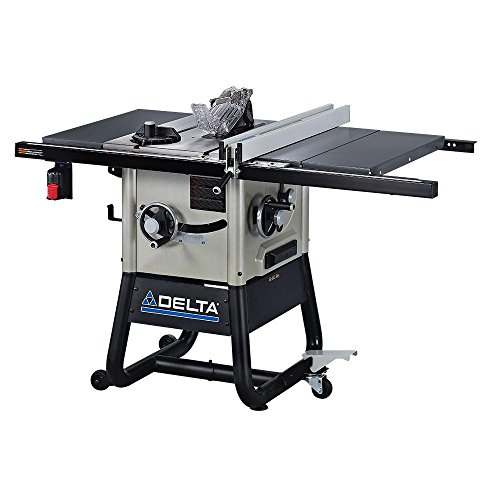
This is the straightforward contractor-saw answer for a shop that wants induction power without hybrid bulk. Its listing states the 15 amp induction motor plainly, pairs it with dual-voltage wiring and wraps it in a cast iron table that grows to 50 inches wide with the steel wings fitted. Left tilt keeps the blade angled away from the fence for bevel rips, and the 30-inch right-hand rip capacity covers sheet breakdown. Woodworkers building furniture at home, where the saw stays in one bay and runs for hours at a stretch, will feel the benefit most.
Specs
- Blade: 10 in., left tilt
- Motor: 15 amp induction motor, 1 PH, 60 Hz
- Voltage: dual voltage 120V-240V
- Rip capacity: 30 in. to the right of the blade
- Table: cast iron, 20 in. x 27 in.; 50 in. x 27 in. with wings
- Extension wings: steel
- Dado capacity: 13/16 in. x 8 in. stacked dado
Best for: A permanent home-shop station that may be rewired to 240V later
Watch out for: Confirm which voltage the saw is wired for before its first start, and allow floor space for the full wing width
ASIN: B00LHUWA50
Delta 36-725T2 Contractor Table Saw with 30-Inch Rip Capacity
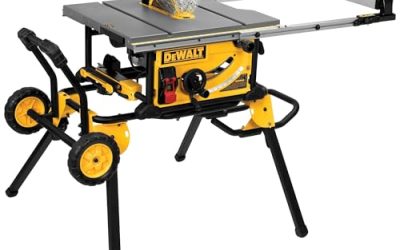
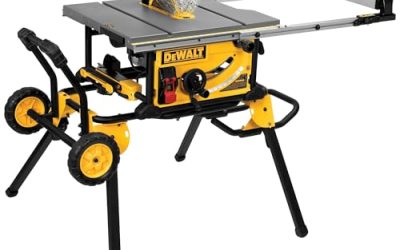
Delta aimed this model at professionals who need a real induction motor in a saw that still rolls away. The listing describes a 1.75 HP, 15 amp induction motor with belt drive, a combination that runs far more calmly than direct-drive portable saws when ripping hardwood. A cast iron main table, T-Square fence and 30 inches of right rip capacity make it a genuine furniture-capable machine, while the rolling stand suits garages that double as parking. It fits the woodworker whose shop assembles on Saturday morning and disappears again by Sunday night.
Specs
- Blade: 10 in.
- Motor: 1.75 HP, 15 amp induction motor
- Drive: belt drive
- Rip capacity: 30 in. right, 15 in. left
- Table: cast iron main table, 20 in. x 27 in.
- Fence: T-Square fence system
- Stand: rolling stand included
Best for: A shared garage where the saw must move out, work hard, then store away
Watch out for: Check current availability on the listing before planning a purchase around it, as stock for this model has been intermittent
ASIN: B083XLLZPP
Shop Fox W1837 10-Inch 2 HP Open-Stand Hybrid Table Saw
The W1837 is the capacity pick, built around a 2 HP capacitor-start induction motor that the manufacturer specification names directly. Cabinet-mounted cast iron trunnions hold alignment under the 40-1/4 inch table, the arbor turns at 3,450 RPM, and the saw arrives prewired for 120V while remaining convertible to 240V. Depth of cut reaches 3-1/4 inches at 90 degrees, and a 4-inch dust port connects to proper extraction rather than a shop vacuum adapter. Choose it when the work is moving toward cabinetry and thick hardwood, but a full cabinet saw still feels like a step too far.
Specs
- Blade: 10 in.; arbor 5/8 in.
- Motor: 2 HP capacitor-start induction motor, single-phase
- Electrical: 120V or 240V, prewired 120V; 15A at 120V, 7.5A at 240V
- Arbor speed: 3,450 RPM
- Rip capacity: 30 in. right, 15 in. left
- Table: 40-1/4 in. x 27 in. with extension wings fitted
- Maximum depth of cut: 3-1/4 in. at 90 degrees, 2-1/4 in. at 45 degrees
- Dust port: 4 in.
- Trunnions: cabinet-mounted cast iron
Best for: A small shop ready for hybrid capacity on an ordinary prewired 120V circuit
Watch out for: The listing specification calls for a 20 amp circuit at 120V, so verify your shop wiring before delivery day
ASIN: B01987G1K8
Which One Fits Your Situation
Your Shop Has Only Standard Household Power
Start with the Shop Fox W1837, provided a 20 amp circuit is available where the saw will live. It arrives prewired for 120V, delivers the strongest motor in this group and still leaves the 240V conversion open if the shop gets rewired. Renters and garage woodworkers avoid panel work entirely, yet nothing about the arrangement limits rip capacity or depth of cut on the projects most home shops actually tackle.
The Saw Shares Space With a Car
Pick the Delta 36-725T2 and let its rolling stand solve the storage problem. It wheels out, locks down and cuts with the same 30-inch rip capacity as the stationary models, then tucks away when the vehicle comes back. The trade is a smaller motor than the Shop Fox, although 1.75 HP of induction power remains a large step beyond any folding jobsite saw for hardwood ripping and dado work during a weekend build.
You Want One Saw for the Next Decade
The Delta 36-5000 suits the buy-once approach. Dual-voltage wiring means the saw grows with the shop, the cast iron table provides a stable reference that does not date, and the induction motor has no brushes to schedule around. Add the stacked dado capacity for joinery and the wide wing-supported surface for panels, and it covers the full arc from first bookcase to fitted cabinetry without asking to be replaced.
Thick Stock and Cabinet Work Are Becoming Normal
Go straight to the Shop Fox W1837. Its 3-1/4 inch depth of cut at 90 degrees handles heavy leg stock in a single pass, the cabinet-mounted trunnions resist the alignment drift that shows up under repeated load, and the 4-inch dust port keeps pace with long ripping sessions. Among these three, it is the configuration that behaves most like a small cabinet saw while still running from a prewired 120V supply.
Common Mistakes
- Assuming every belt-drive saw has an induction motor, when some listings never state the motor type at all
- Ordering a dual-voltage saw without checking whether it arrives wired for 120V or 240V
- Ignoring the minimum circuit size, then tripping breakers because a 120V saw needed a 20 amp line
- Comparing rip capacity only, while overlooking depth of cut for thick hardwood legs and beams
- Planning the shop layout around the bare table size instead of the full width with extension wings fitted
Frequently Asked Questions
Why choose an induction motor over a universal motor in a table saw?
An induction motor has no brushes to wear out, so it runs quieter, starts without a jolt and holds blade speed steadier when a cut gets demanding. Universal motors suit light portable saws that prize low weight. For a stationary saw expected to rip hardwood for years, the induction design is the longer-lived and calmer-running choice.
Can these saws run on a normal household outlet?
Mostly, yes, with one condition. The Delta models work on standard 120V power, and the Shop Fox W1837 arrives prewired for 120V as well. However, the Shop Fox specification requires a 20 amp circuit at that voltage. Check the breaker and outlet capacity in your shop before assuming any heavy induction saw is plug-and-play.
What does dual voltage actually let me change later?
A dual-voltage motor can be rewired from 120V to 240V when your shop gains a suitable circuit. The saw itself does not gain extra rated power from the change, but the higher-voltage supply draws half the current for the same work, which eases strain on wiring during long cuts. Both Delta models and the Shop Fox offer this flexibility.
How do I verify a listing really has an induction motor before buying?
Read the description and specification table for the exact term rather than relying on the title or photographs. Delta prints the motor line directly in the 36-5000 listing, and Shop Fox publishes the W1837 motor type as capacitor-start induction. When a listing gives only horsepower and amps with no motor type named, treat that saw as unverified.