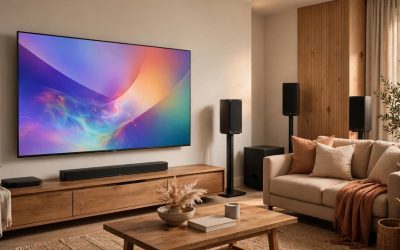
Key takeaways
- Compare the best soundbars for TVs by channel count, Dolby Atmos and DTS:X support, subwoofer type, eARC and HDMI passthrough for movies and sports.
The best soundbar for most TVs is the Samsung HW-Q990F, because it is a complete 11.1.4 system with 23 speakers across a soundbar, a wireless subwoofer and two wireless rear speakers, and it decodes Dolby Atmos and DTS:X without asking the TV to do any of the work. The Sony BRAVIA Theater Bar 9 is the pick when the bar has to stand alone, using 13 speaker units and 360 Spatial Sound Mapping to draw phantom speakers around the room, with an HDMI 2.1 input that passes 4K at 120Hz and 8K. The JBL Bar 1000 splits the difference, a true 7.1.4 system whose rear speakers detach and run on batteries for up to 10 hours, the Bose Smart Ultra is the single-bar dialogue specialist with A.I. Dialogue Mode and ADAPTiQ calibration, and the Yamaha SR-B30A is the budget bar, a 2.1 design with built-in subwoofers and virtual Atmos processing.
What separates these five is architecture, not volume. A system with physical rear speakers and a separate subwoofer, like the Samsung and the JBL, places surround and height effects with real drivers behind and above the seating position. A single bar, like the Sony, Bose and Yamaha, synthesizes that field from one cabinet, each with different tools: spatial mapping, up-firing dipole transducers and virtual processing respectively. The connection matters just as much. Dolby Atmos and lossless audio reach a soundbar over HDMI eARC or through the bar’s own HDMI inputs; optical tops out at 5.1 Dolby Digital and stereo PCM. Every figure below comes from the maker’s published data. As an Amazon Associate, we earn from qualifying purchases.
Table of Contents
- How to Choose a Soundbar for Your TV
- Quick Comparison
- 1. Samsung HW-Q990F 11.1.4 Soundbar System
- 2. Sony BRAVIA Theater Bar 9 (HT-A9000)
- 3. JBL Bar 1000 7.1.4 Soundbar System
- 4. Bose Smart Ultra Soundbar
- 5. Yamaha SR-B30A Soundbar
- Before You Buy: eARC, Passthrough and Phantom Channels
- FAQ
- Conclusion
- Product and ASIN Reference
How to Choose a Soundbar for Your TV
Start with the connection your TV offers. A TV with an HDMI eARC port can send Dolby Atmos, Dolby TrueHD and DTS-HD Master Audio to a soundbar over a single cable. A TV with plain ARC sends the same compressed formats as optical, Dolby Digital and DTS at up to 5.1. Every bar here has an eARC connection; the Yamaha, JBL and Samsung also keep an optical input for older sets, while the Sony Bar 9 drops optical entirely. If the TV lacks ARC altogether, that rules the Sony out before sound quality enters the discussion.
Next, decide whether surround sound should be physical or synthesized. Physical systems put real speakers behind you: the Samsung ships with two wireless rear speakers carrying front, side and up-firing drivers, and the JBL’s rear speakers detach from the ends of the bar and run on internal batteries. Both still need the rears placed and, in the Samsung’s case, plugged into power outlets. Synthesized systems keep everything in one cabinet: the Sony renders phantom speakers with its 360 Spatial Sound Mapping, the Bose fires two transducers upward at the ceiling and upmixes stereo and 5.1 content with TrueSpace, and the Yamaha applies virtual Atmos processing to a 2.1 signal. Synthesized height and surround are placement effects, not discrete channels, and the gap shows most in precise overhead cues.
Then count HDMI inputs against your sources. A console or 4K Blu-ray player plugged into the soundbar gets its audio decoded directly and its video passed to the TV, sidestepping any format limits in the TV’s eARC implementation. The JBL offers three HDMI inputs with 4K Dolby Vision passthrough, the Samsung two inputs with 4K at 120Hz passthrough, and the Sony one input at full HDMI 2.1 bandwidth. The Bose and the Yamaha have no HDMI input at all: every source plugs into the TV, and the TV’s eARC port becomes the single route for sound, so the TV’s own format support sets the ceiling.
Finally, settle the subwoofer question. A separate wireless subwoofer, the 10 inch unit in the JBL system and the compact dual-driver cube in the Samsung system, moves air that no bar cabinet can. Built-in subwoofers, the twin 3 inch drivers inside the Yamaha, keep the footprint to one box and the bass to what a slim enclosure allows. The Sony and Bose bars ship with none and sell wireless ones as additions.
Quick Comparison
| Product | Channels | Subwoofer | TV Connection | Video Passthrough | Tier |
|---|---|---|---|---|---|
| Samsung HW-Q990F | 11.1.4, 23 speakers | Wireless, dual 8 in drivers | HDMI eARC, optical | 4K at 120Hz via 2 HDMI inputs | Premium |
| Sony BRAVIA Theater Bar 9 | 7.0.2, 13 speakers | None included, wireless subs optional | HDMI eARC | 4K at 120Hz, 8K via 1 HDMI input | Premium |
| JBL Bar 1000 | 7.1.4 | Wireless, 10 in | HDMI eARC, optical | 4K Dolby Vision via 3 HDMI inputs | Mid-range |
| Bose Smart Ultra Soundbar | 9 speakers, 2 up-firing | None included, bass modules optional | HDMI eARC, optical | None, no HDMI input | Premium |
| Yamaha SR-B30A | 2.1 | Built in, dual 3 in drivers | HDMI eARC, optical | None, no HDMI input | Budget |
1. Samsung HW-Q990F 11.1.4 Soundbar System
The HW-Q990F is Samsung’s flagship system and the most complete package here: a soundbar, a wireless subwoofer and two wireless rear speakers carrying a true 11.1.4 channel layout with 23 speakers in total. The bar itself is 48.5 x 2.8 x 5.4 inches and 16.1 lb. The rear speakers are configured as 4.0.2, with front, side and up-firing drivers in each, so height effects arrive from behind the seating position as well as from the bar, and the system decodes Dolby Atmos and DTS:X natively. Wireless Dolby Atmos connects the bar to a compatible Samsung TV over Wi-Fi, and Q-Symphony lets a Samsung TV’s own speakers play alongside the system instead of muting.
The subwoofer is the design change in this generation: a compact cube of 9.8 x 9.9 x 9.8 inches and 18.3 lb with dual opposing 8 inch drivers. SpaceFit Sound Pro calibrates the system to the room, and Active Voice Amplifier Pro lifts dialogue against background noise in the program itself. Two HDMI inputs pass 4K at 120Hz, so a current console and a disc player can both connect through the bar, with the eARC output feeding the TV. The full set weighs 52.5 lb, and each rear speaker still needs its own power outlet despite the wireless audio link. For a large TV in a room that can take rear speakers, this is the reference system of the five.
Specs
- Channels: 11.1.4, 23 speakers across bar, subwoofer and rears
- Audio formats: Dolby Atmos, DTS:X, Dolby TrueHD, Dolby Digital Plus
- Subwoofer: Wireless cube, dual opposing 8 in drivers, 9.8 x 9.9 x 9.8 in, 18.3 lb
- Rear speakers: Wireless, 4.0.2 configuration, 5.1 x 7.9 x 5.5 in each
- HDMI: 2 inputs, 1 output with eARC, 4K at 120Hz passthrough
- Other inputs: Optical
- Wireless: Wi-Fi, Bluetooth 5.3, Apple AirPlay 2, Alexa built in
- Room calibration: SpaceFit Sound Pro
- TV pairing features: Q-Symphony, Wireless Dolby Atmos with compatible Samsung TVs
- Dimensions (bar): 48.5 x 2.8 x 5.4 in
- Item weight (bar): 16.1 lb
- Total power output: Not stated
- Warranty: Not stated
- Model: HW-Q990F/ZA
- Tier: Premium
2. Sony BRAVIA Theater Bar 9 (HT-A9000)
The Theater Bar 9 is Sony’s flagship single bar, built around 13 speaker units in a 7.0.2 layout driven by a 13 channel S-Master HX amplifier, with total output rated at 585 W in Sony’s listing data. Its defining technology is 360 Spatial Sound Mapping: after Sound Field Optimization measures the room through the BRAVIA Connect app, the bar renders phantom speakers where no physical speaker sits, widening the front stage and adding height and surround cues from the one cabinet. It decodes Dolby Atmos and DTS:X, carries IMAX Enhanced certification, and handles high-resolution audio and 360 Reality Audio. Voice Zoom 3 sharpens dialogue with a compatible BRAVIA TV, and the S-Center output lets a BRAVIA TV’s screen speaker work as the center channel under Acoustic Center Sync.
Its one HDMI input is full HDMI 2.1, passing 4K at 120Hz and 8K, Dolby Vision, VRR and ALLM, so a current console loses nothing by routing through the bar, and the eARC output handles the TV’s own apps and tuner. The trade-offs are in what is missing: there is no optical input, so a TV without ARC or eARC cannot connect by wire at all, and there is no subwoofer in the box. Sony sells the SA-SW5 and SA-SW3 wireless subwoofers and SA-RS5 and SA-RS3S wireless rears as additions. The cabinet is the widest here at 51.25 x 2.5 x 4.5 inches and 12.1 lb, a match for TVs of 65 inches and up. For any large TV where one bar must do everything, this is the pick.
Specs
- Channels: 7.0.2, 13 speaker units
- Total power output: 585 W per Sony listing data
- Audio formats: Dolby Atmos, DTS:X, IMAX Enhanced, Dolby TrueHD, DTS-HD Master Audio
- Spatial processing: 360 Spatial Sound Mapping, Sound Field Optimization
- Subwoofer: None included, Sony SA-SW5 and SA-SW3 wireless subwoofers optional
- Rear speakers: None included, Sony SA-RS5 and SA-RS3S wireless rears optional
- HDMI: 1 input, 1 output with eARC, HDMI 2.1, 4K at 120Hz and 8K passthrough, VRR, ALLM, Dolby Vision
- Other inputs: S-Center output for BRAVIA TVs, no optical input
- Wireless: Wi-Fi, Bluetooth 5.2, Apple AirPlay 2, Spotify Connect
- Dialogue feature: Voice Zoom 3 with compatible BRAVIA TVs
- Dimensions: 51.25 x 2.5 x 4.5 in
- Item weight: 12.1 lb
- Warranty: 1-year limited warranty per Sony
- Model: HT-A9000
- Tier: Premium
3. JBL Bar 1000 7.1.4 Soundbar System
The Bar 1000 solves the rear speaker problem differently from Samsung: its surround speakers are the ends of the bar itself. Docked, the system is a single 47 inch bar; pull the ends off and they become two battery-powered wireless surround speakers, each with a tweeter and an up-firing full-range driver, good for up to 10 hours of playtime per charge. Placed behind the seating position, the system is a true 7.1.4, decoding Dolby Atmos and DTS:X across 15 speaker units with 880 W of total output, split as 440 W to the bar, 300 W to the 10 inch wireless subwoofer and 70 W to each surround. PureVoice lifts dialogue in busy scenes.
Connectivity is the most generous here. Three HDMI inputs accept a console, a disc player and a streaming box with 4K Dolby Vision passthrough, alongside the eARC output and an optical input. Wi-Fi streaming covers Apple AirPlay, Chromecast built-in and Alexa Multi-Room Music, with Bluetooth 5.0. The main bar section measures 34.8 x 2.2 x 4.9 inches without its ends, each surround is 6.1 x 2.2 x 4.9 inches and 1.55 lb, and the subwoofer is 12 x 17.3 x 12 inches, with the full system at 33.7 lb per JBL. The compromise is the ritual: surround sound lasts as long as the batteries do, and the rears spend the rest of their life docked. For rooms where speaker cable and rear power outlets are both impossible, it asks for neither.
Specs
- Channels: 7.1.4, 15 speaker units
- Total power output: 880 W (bar 440 W, subwoofer 300 W, surrounds 2 x 70 W)
- Audio formats: Dolby Atmos, DTS:X, Dolby TrueHD, DTS-HD Master Audio
- Subwoofer: Wireless, 10 in driver, 12 x 17.3 x 12 in
- Rear speakers: Detachable from the bar, battery powered, up to 10 hours playtime, 6.1 x 2.2 x 4.9 in and 1.55 lb each
- HDMI: 3 inputs, 1 output with eARC, 4K Dolby Vision passthrough
- Other inputs: Optical
- Wireless: Wi-Fi, Bluetooth 5.0, Apple AirPlay, Chromecast built-in, Alexa Multi-Room Music
- Dialogue feature: PureVoice
- Dimensions (bar center section): 34.8 x 2.2 x 4.9 in, 47 in with surrounds docked
- Item weight (system): 33.7 lb per JBL
- Warranty: Not stated
- Model: JBLBAR1000PROBLKAM
- Tier: Mid-range
4. Bose Smart Ultra Soundbar
The Smart Ultra is the single-bar specialist for living rooms that will never take a subwoofer or rears as a first step. Nine speakers sit in the 41.14 x 2.29 x 4.21 inch cabinet, including a center tweeter and two upward-firing dipole transducers, and Bose renders Dolby Atmos from that array while TrueSpace upmixes ordinary stereo and 5.1 content into the same spatial presentation. A.I. Dialogue Mode balances voice against effects scene by scene, and ADAPTiQ calibration tunes the bar to the room’s reflections. Alexa is built in, the bar works with Google Assistant through a linked speaker, and streaming covers Wi-Fi, Apple AirPlay 2, Chromecast built-in and Spotify Connect, plus SimpleSync pairing with Bose headphones.
The limits are connection and format support. There is exactly one HDMI port, an eARC connection to the TV, with an optical input as the fallback, and no HDMI input for sources: a console or disc player connects to the TV, and the TV forwards the audio. Atmos only arrives over eARC, since the optical input tops out at stereo PCM and 5.1 Dolby Digital. Bose does not decode DTS in any form, so DTS and DTS:X discs fall back to whatever the TV converts them to. Expansion stays inside the Bose family: Bass Module 500 and 700 subwoofers and Surround Speakers 700 rears. For a mid-size TV where dialogue clarity and a single unobtrusive bar matter more than discrete surround, it earns its premium tier on focus rather than channel count.
Specs
- Channels: 9 speakers including center tweeter and 2 up-firing dipole transducers
- Audio formats: Dolby Atmos, Dolby TrueHD and Dolby Digital over eARC, no DTS decoding
- Spatial processing: Bose TrueSpace upmixing, ADAPTiQ room calibration
- Subwoofer: None included, Bose Bass Module 500 and 700 optional
- Rear speakers: None included, Bose Surround Speakers 700 optional
- HDMI: 1 eARC connection to the TV, no HDMI input or passthrough
- Other inputs: Optical, Ethernet
- Wireless: Wi-Fi, Bluetooth, Apple AirPlay 2, Chromecast built-in, Spotify Connect
- Voice control: Alexa built in, works with Google Assistant
- Dialogue feature: A.I. Dialogue Mode
- Dimensions: 41.14 x 2.29 x 4.21 in
- Item weight: 12.68 lb
- Warranty: Not stated
- Model: 882963-1100 (Black)
- Tier: Premium
5. Yamaha SR-B30A Soundbar
The SR-B30A is the budget bar, and its specification is honest about what a single slim cabinet can do. It is a 2.1 design with six drivers: four 1.8 inch cone drivers and two 1 inch dome tweeters across the front, and two 3 inch subwoofers built into the cabinet firing down, driven by 120 W in total, split 30 W per front channel and 60 W to the subwoofers. Dolby Atmos is handled by virtual processing rather than up-firing drivers, so height effects are a widening of the front field rather than sound from above, and Yamaha backs the everyday job with Clear Voice for dialogue and a Bass Extension mode that reinforces the low end.
Connections are the simple set: an HDMI eARC output to the TV, an optical input, Bluetooth for phones, and a subwoofer pre-out, the thoughtful inclusion at this tier, since an external powered subwoofer can be added later without replacing the bar. There is no Wi-Fi and no HDMI input, so streaming comes from the TV or a phone, and format support stops at the Dolby family: Yamaha’s data lists no DTS decoding, a real limit for disc collections. Control runs through the Sound Bar Remote app or the TV remote over HDMI CEC. At 35.8 x 2.6 x 5.2 inches and 8.6 lb it suits TVs from 43 to 55 inches. For a smaller room or a second TV, it covers the core job, with an upgrade path for bass.
Specs
- Channels: 2.1, 6 drivers
- Total power output: 120 W (30 W x 2 front, 60 W built-in subwoofers)
- Drivers: 4 x 1.8 in cones, 2 x 1 in dome tweeters, 2 x 3 in built-in subwoofers
- Audio formats: Dolby Atmos via virtual processing, Dolby Digital family, no DTS decoding per Yamaha
- Subwoofer: Built in, plus a subwoofer pre-out for an external powered subwoofer
- HDMI: 1 output with eARC, no HDMI input or passthrough
- Other inputs: Optical
- Wireless: Bluetooth, no Wi-Fi
- Dialogue feature: Clear Voice, plus Bass Extension mode
- Sound modes: Stereo, Standard, Movie, Game
- Dimensions: 35.8 x 2.6 x 5.2 in
- Item weight: 8.6 lb
- Warranty: 2 years parts and labor per Yamaha
- Model: SR-B30A
- Tier: Budget
Before You Buy: eARC, Passthrough and Phantom Channels
Three limits decide how these bars behave after installation. The first is the audio return channel. Plain ARC and optical carry the same payload, stereo PCM and 5.1 Dolby Digital or DTS, and neither can carry Dolby Atmos in its lossless form or any DTS-HD track. eARC removes that ceiling, which is why every bar here leads with eARC. A TV with only plain ARC can still feed all five bars, but a system like the Samsung or JBL will decode the same compressed formats as the budget Yamaha until the TV is replaced.
The second limit is passthrough, and it only matters to sources with video. A bar with HDMI inputs, the Samsung, Sony and JBL here, decodes the audio itself and passes the picture onward, so its passthrough ceiling becomes the system’s ceiling: the Sony and Samsung pass 4K at 120Hz, the JBL passes 4K with Dolby Vision. A bar without inputs, the Bose and Yamaha, is never in the video path, which hands the whole job to the TV’s eARC port and the TV’s format support instead. Neither design is wrong; they put the deciding component in different places.
The third is the difference between physical and phantom channels. The Samsung’s 11.1.4 and the JBL’s 7.1.4 are counts of real drivers in real positions, including behind the listener. The Sony’s 360 Spatial Sound Mapping and the Bose’s TrueSpace build their surround and height cues from processing in a single cabinet, and Yamaha’s virtual Atmos works the same way at 2.1. Phantom channels are convincing for width and ambience but cannot place a discrete effect behind the seating position the way a physical rear speaker does. Brand pairing draws one more line: Q-Symphony and Wireless Dolby Atmos need a Samsung TV, and Acoustic Center Sync and Voice Zoom 3 need a BRAVIA, so they count for nothing on a mixed-brand setup.
FAQ
Does a soundbar need eARC, or is ARC or optical enough?
For Dolby Atmos, lossless Dolby TrueHD and DTS-HD, eARC is required, because plain ARC and optical carry only stereo PCM and 5.1 Dolby Digital or DTS. All five bars here connect by eARC. On an ARC or optical connection they still work, but the Samsung, Sony and JBL systems are limited to the same compressed formats as any basic bar, and the Bose loses Atmos entirely on optical.
What does an 11.1.4 or 7.1.4 channel count actually mean?
The numbers read as main channels, subwoofer channels and height channels. An 11.1.4 system like the Samsung HW-Q990F has eleven ear-level channels, one subwoofer channel and four height channels, and in the Samsung and JBL systems those are physical speakers, including rears behind the seating position. A single bar quoting a wide field, such as the Sony Bar 9 with its 7.0.2 speaker layout, is describing its driver arrangement plus phantom channels its processing renders, which is different from discrete speakers around the room.
Can I add a subwoofer or rear speakers to a single soundbar later?
On three of the five, yes, within the same brand’s family. The Sony Bar 9 accepts Sony SA-SW5 and SA-SW3 wireless subwoofers and SA-RS5 and SA-RS3S wireless rears, and the Bose Smart Ultra accepts Bose Bass Module 500 and 700 subwoofers and Surround Speakers 700 rears. The Yamaha SR-B30A takes any powered subwoofer through its pre-out, though it has no rear speaker option. The Samsung and JBL systems ship with subwoofer and rears included.
Should a game console plug into the soundbar or into the TV?
Into the soundbar, when the bar has an HDMI input that passes the console’s full format: the Samsung HW-Q990F and Sony Bar 9 pass 4K at 120Hz, the JBL Bar 1000 passes 4K with Dolby Vision, and the bar decodes the audio directly. With the Bose Smart Ultra or Yamaha SR-B30A there is no choice, since neither has an HDMI input: the console plugs into the TV, and the TV’s eARC port carries the audio to the bar.
Conclusion
Soundbar buying starts with the room, not the specification sheet. Where rear speakers can be placed and powered, the Samsung HW-Q990F is the complete answer, a true 11.1.4 system with a compact dual-driver subwoofer and 4K at 120Hz passthrough, and the JBL Bar 1000 reaches true 7.1.4 surround in rooms that cannot wire or power rears at all, at the cost of recharging its detachable surrounds. Where the bar must stand alone, the Sony BRAVIA Theater Bar 9 brings the widest synthesized field and the best console passthrough of the single bars, and the Bose Smart Ultra trades inputs and DTS support for dialogue clarity and the simplest setup here. The Yamaha SR-B30A closes the list for smaller TVs and rooms, with built-in subwoofers, Clear Voice and a subwoofer output that leaves the door open to more bass. Match the connection to the TV’s eARC port, and count physical speakers before phantom ones.