Key takeaways
- Find the best recessed lighting for kitchens, living rooms, and home theaters. Compare canless, retrofit, gimbal, and smart downlights before you buy.
The best recessed lighting for most homes is a 6-inch canless LED wafer light with selectable color temperature. It fits the widest range of ceilings, needs no bulky metal can, and lets you tune the light from warm white to daylight after the fixture is already in the ceiling. If your home already has recessed cans, a retrofit trim is the faster and cleaner upgrade, because it drops into the housing you own. If you want to aim light at artwork, a fireplace, or a reading chair, a gimbal downlight is the right call. And if you want color, scenes, and voice control in a home theater, a smart downlight earns its place.
Our top pick for most rooms is the Sunco 6-inch ultra-thin wafer light, a straightforward canless fixture with a fixed 5000K daylight output that suits kitchens and workspaces. For rooms where you want to choose the warmth of the light, the Ensenior gimbal and the Halo retrofit trim both offer five selectable color temperatures. The Torchstar retrofit is the simplest fix for an existing can that still holds an old bulb, and the Lumary smart downlight is the one to buy when the room doubles as a home theater and you want color control from an app or a voice assistant.
As an Amazon Associate, we earn from qualifying purchases.
Table of Contents
- How to Choose Recessed Lighting
- Our Top 5 Recessed Lighting Picks
- Sunco 6-Inch Ultra-Thin LED Recessed Ceiling Light
- Ensenior 6-Inch 5CCT LED Eyeball Gimbal Recessed Light
- Torchstar 6-Inch Dimmable LED Retrofit Recessed Downlight
- Lumary Smart Recessed Lighting 6-Inch
- Halo RL 5/6-Inch LED Recessed Light Trim
- Installation and Layout Tips
- Frequently Asked Questions
- Conclusion
- Product and ASIN Reference
How to Choose Recessed Lighting
Recessed lighting looks simple from below, which is exactly why it is easy to buy the wrong fixture. The light you see is only the trim. The decisions that matter are the size of the hole, the type of housing, the brightness, the color temperature, and the rating for the room. Get those five right and the rest is trim style.
Size and Cutout
Six inches is the standard size for general room lighting, and it is the size every pick in this guide uses. A 6-inch fixture puts out enough light to space fixtures four to six feet apart in a normal eight-foot ceiling, and the trim is large enough to look intentional rather than lost in the drywall. Four-inch fixtures suit hallways, small bathrooms, and accent lighting, while eight-inch fixtures suit tall ceilings and large open rooms. Measure the hole before you order. A canless wafer light needs a round cutout of the stated size, and the spring clips grip the drywall from above. A retrofit trim needs a can of the matching size, and the trim ring must cover the edge of the old housing. If you are cutting new holes, make a template from cardboard first and hold it against the ceiling to check spacing against joists, beams, and ceiling fans.
Canless or Retrofit
Canless wafer lights, also called can-killer downlights, are the fixture and the junction box in one slim package. They wire directly into the ceiling, need only a couple of inches of clearance above the drywall, and suit new work, remodels, and ceilings with shallow plenums. Their weakness is that the driver and the LED board are built into one unit, so a failure means replacing the whole fixture. Retrofit trims are the opposite trade. They screw or clip into an existing can, reuse the housing and the socket, and install in minutes with no drywall work. Their weakness is that they only fit cans of the right size and depth, and an old can with a damaged socket will still need an electrician. Choose canless when you are cutting fresh holes or replacing a flush-mount fixture. Choose retrofit when the cans are already there and in good shape.
Brightness and Color Temperature
Brightness for recessed lighting is measured in lumens, and a single 6-inch downlight in the 800 to 1300 lumen range is right for general lighting in a standard room. Kitchens and home offices want the brighter end of that range, because task work needs more light than conversation. Bedrooms and home theaters want the dimmer end, because the lights spend most of their time turned down low. Color temperature is measured in Kelvin. Warm white at 2700K feels like an incandescent bulb and suits living rooms and bedrooms. Neutral white at 3500K to 4000K suits kitchens and bathrooms. Daylight at 5000K suits garages, laundry rooms, and task lighting. Selectable color temperature, often labeled 5CCT, puts a small switch on the junction box or the trim that lets you pick from five temperatures, which removes the guesswork when you are lighting a room you have not lived in yet.
Dimming
Almost every modern recessed LED dims, but not every dimmer works with every LED. Check the fixture listing for dimmer compatibility before you buy, and expect the smoothest results from a dimmer made for LED loads. A fixture that dims from a faint glow to full brightness is worth more in a living room or a home theater than one that jumps from dark to bright in a few steps. Dim-to-warm fixtures go further, shifting toward a warmer color as they dim, which mimics the way an old incandescent bulb behaved and flatters a room at low light. If your room has a smart switch or a smart dimmer already, confirm that the fixture plays well with it, because a mismatch shows up as flicker at low settings.
Ratings That Matter
Three ratings decide whether a fixture belongs in a given room. IC rated means the fixture can touch insulation without overheating, which matters in insulated ceilings. Airtight rated means the fixture limits air leaks into the attic, which matters for energy use and for keeping dust out of the beam. Damp rated means the fixture can handle bathroom humidity, while wet rated means it can sit directly over a shower or a tub. A damp-rated light over a shower is a code problem, not a preference, so read the rating on the listing rather than the marketing copy. Certifications such as ETL and UL listings show the fixture was tested by an independent lab, and an energy-efficiency-certified fixture meets a recognized efficiency standard. Keep the paperwork for any fixture installed in a bathroom or a kitchen, because an inspector may ask for the rating.
Where Each Type Works Best
Kitchens want bright, neutral to daylight fixtures spaced evenly over counters and islands, with a dimmer for evening use. Living rooms want warm, dimmable fixtures that can drop low for movies. Bathrooms want damp-rated fixtures in the main ceiling and wet-rated fixtures over the tub or shower. Home theaters want warm, fully dimmable fixtures, and a smart downlight adds color scenes that a fixed fixture cannot match. Hallways and closets want small, bright fixtures on a simple switch. Match the fixture to the room first, and the trim style second, because a beautiful trim on the wrong fixture still lights the room badly.
Our Top 5 Recessed Lighting Picks
The five fixtures below cover the main ways people buy recessed lighting: a straightforward canless wafer for new holes, an aimable gimbal for accent light, a retrofit for existing cans, a smart downlight for a home theater, and a wet-rated retrofit trim for bathrooms. Each one is a 6-inch class fixture, so the spacing and layout advice in this guide applies to all of them.
1. Sunco 6-Inch Ultra-Thin LED Recessed Ceiling Light

Tier: Budget
The Sunco 6-inch ultra-thin wafer is the simplest way to add recessed lighting to a room that has none. It is a canless fixture, so there is no metal can to fit between joists and no deep housing to clear. The junction box attaches to the fixture, the spring clips grip the drywall, and the whole unit sits nearly flush with the ceiling. The fixed 5000K daylight output is the right choice for kitchens, laundry rooms, home offices, and garages, where a crisp white light helps with reading labels, chopping, folding, and working. At 850 lumens on 14 watts, it is bright enough for general lighting in a standard room, and it replaces a 100-watt incandescent can while drawing a small fraction of the energy.
What makes this fixture a good first pick is how little can go wrong with the installation. The 6-inch cutout is the most common size in residential work, the IC rating means it can sit against insulation, and the ETL listing covers the safety testing. The dimmable driver works with most LED-rated dimmers, so the same fixture that lights a kitchen at full brightness can drop low for an evening. The trade-off is the fixed color temperature. Five thousand Kelvin is daylight, and in a bedroom or a living room it can feel clinical after dark. If the room is a place where people relax, pair this fixture with a dimmer and use it alongside warmer lamps, or choose one of the selectable color temperature picks below instead. The 12-pack format suits a whole room or a whole floor at once, which is how most people actually buy wafer lights, and it keeps every fixture in the room matched, which matters more than most buyers expect. Mismatched fixtures in one ceiling show up as uneven color from one side of the room to the other, and a matched set avoids that entirely.
This is the fixture to buy when the job is straightforward: new holes, a standard ceiling, and a room that needs bright, clean light. It is also the right pick for a rental refresh or a first remodel, where the budget matters and the installer wants a fixture that goes in fast and looks neat. Skip it only when the room needs warm light or selectable color, or when you are lighting a shower, because this is a general-purpose wafer rather than a wet-rated fixture.
Specs
- Size: 6 inch
- Dimensions: 6.9 x 2.4 x 6.9 inches
- Wattage: 14 watts
- Brightness: 850 lumens
- Color temperature: 5000K daylight
- Dimming: Dimmable
- Installation: Canless wafer with attached junction box, IC rated
- Certification: ETL listed
- Pack: 12
- ASIN: B07VVMP8VH
2. Ensenior 6-Inch 5CCT LED Eyeball Gimbal Recessed Light

Tier: Mid-range
The Ensenior gimbal is the fixture to buy when the light needs to point somewhere specific. The eyeball head tilts and rotates, so one fixture can wash a wall of art, highlight a fireplace, or aim at a reading chair, and the beam moves with the room rather than locking into a straight-down pool of light. At 1300 lumens on 12 watts it is the brightest fixture in this guide, which matters for accent lighting, because an aimed beam needs enough output to read clearly from across the room. The five selectable color temperatures, from 2700K warm white to 5000K daylight, are set with a switch on the junction box, so you can tune each fixture to the room before the trim goes on, and change it later if the room changes.
The gimbal design also solves a layout problem that fixed downlights cannot. A straight-down fixture over a sofa lights the top of the sofa. A gimbal aimed at the wall behind the sofa lights the wall, and the reflected light fills the room more softly. In a kitchen, a gimbal aimed at a backsplash turns a flat wall into a feature. In a hallway, a row of gimbals aimed at art turns a passage into a gallery. The aluminum housing and the powder-coated finish give the fixture a solid feel, and the high color rendering index, rated above 90, means colors under this light look closer to how they look in daylight, which matters for art, wood, and fabric. The canless design needs only a small amount of clearance above the ceiling, and the junction box is included, so the install is the same as any wafer light with the added step of aiming the head.
The trade-off is that a gimbal is a more complex fixture than a flat wafer, and the moving head is one more part to keep clean and free of dust. It is also a 4-pack, which suits a single accent wall or a small room rather than a whole house. Buy it for living rooms, dining rooms, hallways with art, and any room where the light should land on something rather than on the floor. Skip it for a plain grid of general lighting, where a fixed wafer does the same job with fewer moving parts.
Specs
- Size: 6 inch
- Dimensions: 6.9 x 6.9 inches trim, fits a 6-inch cutout
- Wattage: 12 watts
- Brightness: 1300 lumens
- Color temperature: 2700K, 3000K, 3500K, 4000K, and 5000K selectable
- Color rendering index: Above 90
- Dimming: Dimmable
- Installation: Canless gimbal with junction box
- Certification: ETL and FCC listed
- Pack: 4
- ASIN: B0CD77SP8D
3. Torchstar 6-Inch Dimmable LED Retrofit Recessed Downlight

Tier: Budget
The Torchstar retrofit is the fixture for a home that already has recessed cans. It drops into an existing 6-inch housing, screws into the socket or clips to the can, and turns an old incandescent or compact fluorescent can into a modern LED downlight in minutes, with no drywall cutting and no new wiring. At 1200 lumens on 18 watts, it is a bright retrofit, and the 5000K daylight output suits kitchens, basements, garages, and laundry rooms where the old cans are most common. The energy-efficiency certification and the UL listing cover the efficiency and safety testing, and the five-year warranty is longer than most fixtures in this class carry.
Retrofit fixtures earn their keep in older homes. A house built between the mid-nineties and the mid-twenty-tens often has dozens of 6-inch cans, and replacing every can with a new fixture is a large job. A retrofit trim reuses the housing, the wiring, and the ceiling hole, so the upgrade is a trim swap rather than a remodel. The Torchstar trim fits the standard 6-inch can, and the baffle trim softens the edge of the beam, which cuts glare when the fixture is viewed from across the room. Dimming works with most LED-rated dimmers, including the common Lutron Caseta style controls, so the same fixture can run bright for cleaning and low for an evening.
The trade-off is the fixed 5000K color temperature, which is daylight and can feel cool in a living room or a bedroom. It is also a retrofit, so it only fits cans that are in good condition, and a can with a damaged socket or a bent housing still needs a repair before the trim goes in. Buy it when the cans are already there and the room needs bright, clean light. Skip it when you are cutting new holes, where a canless wafer is the better tool, or when the room needs warm or selectable light.
Specs
- Size: 6 inch
- Dimensions: 6 x 6 inches, fits a standard 6-inch can
- Wattage: 18 watts
- Brightness: 1200 lumens
- Color temperature: 5000K daylight
- Dimming: Dimmable
- Installation: Retrofit into an existing 6-inch can
- Certification: Energy-efficiency-certified and UL listed
- Warranty: 5-year warranty
- ASIN: B00JUNY2D4
4. Lumary Smart Recessed Lighting 6-Inch
Tier: Premium
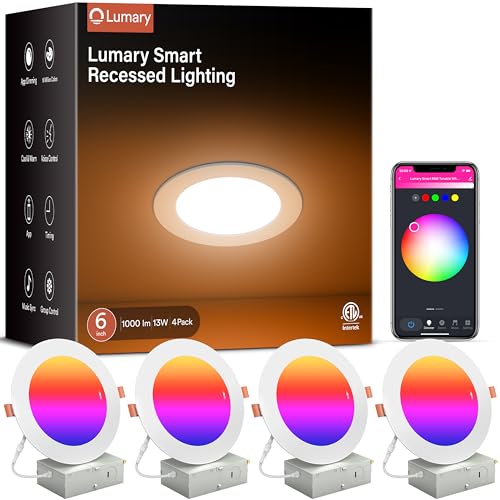
The Lumary smart downlight is the fixture for a room that doubles as a home theater. It is a canless wafer with a junction box, like the Sunco, but the driver connects over Wi-Fi and Bluetooth, so the light joins an app, a voice assistant, and a remote control with no hub. The white light tunes from 2700K warm white to 6500K cool white, and the color engine adds a full range of RGB color, with preset scenes for movies, gaming, parties, and reading. At 1000 lumens on 13 watts, it is bright enough for general lighting, and it dims from a faint glow to full brightness, which is exactly what a theater room needs when the screen is on.
Smart recessed lights earn their keep in rooms that change purpose through the day. A home theater is a living room by day, a screening room at night, and a gaming room on the weekend, and one fixed color temperature cannot serve all three. The Lumary fixture shifts from cool white for daytime use to warm white for an evening film, then to a deep color wash for a game night, and the change takes a voice command or a tap rather than a ladder. The app adds timers and schedules, so the lights can fade on before a film and fade off after, and groups let one command control the whole ceiling at once. The ETL listing covers the safety testing, and the canless design means the fixture fits the same shallow ceilings as any wafer light.
The trade-off is that a smart fixture depends on a stable wireless network, and the 2.4 GHz connection it uses is the band most home routers run, so it works in most homes but needs a router that keeps that band available. It also costs more per fixture than a fixed wafer, and the app is one more thing to maintain. A smart fixture is also only as good as its software, so keep the app updated and keep one fixture on a plain switch as a fallback if the network goes down. Buy it for a home theater, a gaming room, a bedroom, or any room where the mood changes often. Skip it for a hallway, a closet, or a laundry room, where a plain switch and a fixed color temperature do the job with less to manage.
Specs
- Size: 6 inch
- Dimensions: 6 x 6 inches, fits a 6-inch cutout
- Wattage: 13 watts
- Brightness: 1000 lumens
- Color temperature: 2700K to 6500K tunable white plus full RGB color
- Control: Wi-Fi and Bluetooth, app, voice assistant, and remote
- Dimming: Dimmable from a faint glow to full brightness
- Installation: Canless with junction box
- Certification: ETL listed
- Pack: 4
- ASIN: B0F246HD1L
5. Halo RL 5/6-Inch LED Recessed Light Trim

Tier: Premium
The Halo RL trim is the fixture for a bathroom, and for any room where the light sits over water. It is a retrofit trim that fits both 5-inch and 6-inch housings, which covers the two most common can sizes in older homes, and it carries a wet location rating, which means it is listed for direct use over a shower or a tub. That rating is the difference between a legal bathroom install and a problem, because a damp-rated fixture over a shower is not enough. The selectable color temperature runs from 2700K to 5000K in five steps, and the dim-to-warm behavior shifts the light warmer as it dims, which flatters a bathroom mirror at low light and keeps the room calm in the evening.
Halo is a long-standing name in recessed lighting, and the RL trim shows it in the details. The baffle trim cuts glare, the 600-lumen output is right for a bathroom, where the light works with a mirror rather than alone, and the trim covers the edge of the old can cleanly, so a retrofit looks like a new install rather than a patch. The energy-efficiency certification covers the efficiency testing, and the trim installs with the same clip and socket connection as any retrofit, so the job is a trim swap rather than a rewire. The five color temperatures mean one trim serves a warm master bath, a neutral guest bath, and a bright laundry room, and the setting can change if the room is repainted or the mirror is replaced.
The trade-off is brightness. At 600 lumens, this trim is dimmer than the wafer and retrofit picks in this guide, and a large bathroom will need more fixtures to reach the same overall light level. It is also a single-fixture trim rather than a multi-pack, so outfitting a whole ceiling means buying several. Buy it for bathrooms, showers, and any room where the fixture sits over water, and for older homes where the cans are a mix of 5-inch and 6-inch sizes. Skip it for a kitchen or a living room that needs high output, where a brighter wafer or retrofit does more work per fixture.
Specs
- Size: Fits 5-inch and 6-inch housings
- Dimensions: 6 x 6 inches nominal, fits 5-inch and 6-inch cans
- Brightness: 600 lumens
- Color temperature: 2700K, 3000K, 3500K, 4000K, and 5000K selectable
- Dimming: Dimmable with dim-to-warm behavior
- Location rating: Wet location rated
- Installation: Retrofit trim for existing cans
- Certification: Energy-efficiency-certified
- ASIN: B0C7QPLBV5
Installation and Layout Tips
A good layout matters more than a good fixture, because even the best downlight looks wrong when the spacing is uneven. Start by sketching the room on paper and marking the joists, the beams, the ceiling fan, and the furniture. Space 6-inch fixtures four to six feet apart in a standard eight-foot ceiling, and keep the first fixture about three feet from the wall so the beam washes the wall rather than pooling on the floor. In a kitchen, center fixtures over the counters and the island rather than over the middle of the room, because light over the work surface is worth more than light over the walkway. In a living room, keep fixtures away from the television wall, because a downlight above or beside a screen reflects in the glass and distracts from the picture. In a home theater, put the fixtures on a dimmer and keep them off the screen wall entirely.
Cut one hole first and test the fixture before cutting the rest. Joists hide where you least expect them, and a test hole finds them before the ceiling looks like a grid of mistakes. Use a stud finder and a template, and check above the ceiling for pipes, ducts, and wiring before the saw goes in. Turn off the breaker for the circuit, not just the wall switch, and test the wires with a non-contact tester before touching them. If the ceiling is insulated, use IC-rated fixtures and keep the insulation clear of the junction box vents. If the ceiling is a fire-rated assembly, check the local code for the fixture rating, because some assemblies need a specific fire-rated housing or cover.
Wire the fixtures in a logical order and label the circuit at the panel when the job is done. A dimmer that buzzes or flickers usually means a mismatch between the dimmer and the driver, so check the fixture listing for a compatible dimmer list before replacing the dimmer. A fixture that will not turn on at all usually means a loose wire nut or a tripped breaker, so check the simplest causes first. If the work involves a new circuit, a panel change, or anything beyond a direct swap, hire a licensed electrician, because the cost of the call is small next to the cost of a wiring fault hidden above a ceiling.
For a home theater, add the smart fixtures last, after the fixed lighting is aimed and dimmed correctly. A smart downlight adds scenes and color, but it cannot fix a bad layout, and a room with even, warm, dimmable light plus a few color scenes will always beat a room with uneven light and a fancy app. Keep the smart fixtures on the same circuit and the same dimmer type as the rest of the room where possible, so the whole ceiling behaves as one system rather than two.
Frequently Asked Questions
How many recessed lights do I need in a living room?
A standard living room with an eight-foot ceiling usually needs four to six 6-inch fixtures, spaced four to six feet apart, with the first fixture about three feet from the wall. Start with the seating area and the walking paths, then add a fixture over a reading chair or a side table if the room still has dark corners. A dimmer makes the count more forgiving, because fixtures that are too bright can turn down, while fixtures that are too few cannot turn up.
Can recessed lights go in a shower?
Yes, but only a fixture with a wet location rating belongs directly over a shower or a tub. A damp-rated fixture suits the main bathroom ceiling, where it faces humidity but not direct spray, and a general-purpose fixture belongs nowhere near water. The Halo trim in this guide carries a wet location rating, which is the rating to look for, and the rating should appear on the listing and on the fixture itself before installation.
Do I need a can for canless recessed lights?
No. A canless wafer light is the fixture and the junction box in one slim unit, and it wires directly into the ceiling with no metal can. The spring clips grip the drywall, and the junction box sits above the ceiling. Canless fixtures suit new holes and shallow ceilings, while retrofit trims suit homes that already have cans. If your ceiling already has cans in good condition, a retrofit is usually the faster upgrade.
What color temperature is best for a home theater?
Warm white at 2700K to 3000K is the best starting point for a home theater, because it flatters skin tones and keeps the room calm when the screen is on. A dim-to-warm fixture improves on that by shifting warmer as it dims, and a smart downlight adds color scenes for gaming and parties. Avoid fixed daylight at 5000K in a theater, because it fights the picture and makes the room feel like an office after dark.
Conclusion
The best recessed lighting is the fixture that matches the ceiling you have and the room you live in. A 6-inch canless wafer with selectable color temperature covers the most situations, and the Sunco wafer in this guide is the simplest version of that idea, bright and clean for kitchens and workspaces. The Ensenior gimbal earns its place wherever light should land on something specific, the Torchstar retrofit is the fastest fix for a home full of old cans, the Lumary smart downlight turns a home theater into a room that changes with the evening, and the Halo wet-rated trim is the right answer for any bathroom with a shower. Measure the cutout, check the rating for the room, confirm the dimmer, and buy a matched set for the whole ceiling. Do that, and the light will look like it was always part of the house.
Product and ASIN Reference
| Product | ASIN |
|---|---|
| Sunco 6-Inch Ultra-Thin LED Recessed Ceiling Light | B07VVMP8VH |
| Ensenior 6-Inch 5CCT LED Eyeball Gimbal Recessed Light | B0CD77SP8D |
| Torchstar 6-Inch Dimmable LED Retrofit Recessed Downlight | B00JUNY2D4 |
| Lumary Smart Recessed Lighting 6-Inch | B0F246HD1L |
| Halo RL 5/6-Inch LED Recessed Light Trim | B0C7QPLBV5 |