Key takeaways
- Find the best home theater blinds for total darkness, from cordless blackout rollers to motorized zebra shades and cellular options that fit any window.
The best home theater blinds are cordless blackout roller shades and motorized blackout shades that block outside light, mount inside or outside the window frame, and let you darken the room in seconds. For most home theaters, a cordless blackout roller shade is the simplest pick, while a motorized roller or zebra shade is the better choice when the screen sits far from the window or you want the room to go dark without leaving your seat.
As an Amazon Associate, we earn from qualifying purchases.
Table of Contents
- Why Blackout Blinds Change a Home Theater
- How to Choose Home Theater Blinds
-
- LazBlinds Cordless Blackout Roller Shades
-
- SmartWings Motorized Blackout Roller Shade
-
- Yoolax Motorized Zebra Blinds
-
- Changshade Blackout Roller Shades With Cassette Valance
-
- Redi Shade Cordless Cellular Blackout Shade
- Measuring and Installing Your New Blinds
- Keeping Blinds Clean and Working Well
- Frequently Asked Questions
- Conclusion
- Product and ASIN Reference
Why Blackout Blinds Change a Home Theater
A home theater lives or dies on light control. Even a small amount of daylight washing across a screen can flatten contrast, wash out dark scenes, and pull your eyes away from the movie. Curtains help, but they leave gaps at the edges and they do little for a window that sits beside or behind the screen. Blinds sit close to the glass, cover the opening edge to edge, and give you a flat, dark surface that keeps stray light out of the room.
Blinds also solve a problem that many theater rooms share: windows in awkward places. A narrow basement window, a wide sliding door, or a tall window beside a sectional all need different coverage, and a blind can be trimmed, sized, or ordered to fit the exact opening. When the blind is down, the room reads as a theater. When it is up, the room goes back to being a living room, a den, or a spare bedroom.
The other advantage is speed. A movie night should not start with a ten-minute routine of adjusting drapes and taping up blankets. A cordless roller shade drops with one pull. A motorized shade drops with one press of a remote. That matters most on weekend afternoons, when the sun is high and the room needs to go dark fast.
There is also a comfort angle that gets overlooked. A blackout blind adds a layer of insulation at the window. In a dark room with a projector running, that layer helps the space hold a steady temperature, and it keeps the glare off a television screen during daytime viewing. The best setups pair blinds with the rest of the room: dark walls, soft seating, and a screen placed away from direct window light.
Before buying, think about how the room is used. A dedicated theater with one small window needs a different blind than a multi-use living room with a wall of glass. A room with children or pets needs cordless operation. A room with a smart home setup benefits from a motorized shade that joins the same routines as the lights. The five blinds below cover those cases: two cordless manual rollers, two motorized options, and one cellular shade, all built around blackout fabric.
How to Choose Home Theater Blinds
Light blocking comes first
Opacity is the single most important spec for a theater room. A blackout fabric is designed to block outside light rather than filter it, which is what keeps a projected image rich and a television screen free of haze. Room-darkening fabrics sit a step below blackout and still let a soft glow through, which can be fine for casual viewing but falls short when the goal is a cinema feel. Light-filtering fabrics are the wrong tool for a theater window, since they are made to soften daylight, not stop it.
Edge gaps matter as much as fabric. Light leaks around the sides of a blind that is too narrow, so measure the opening and decide between an inside mount and an outside mount. An inside mount sits within the frame and looks tidy, but it leaves a small gap on each side. An outside mount covers the frame and overlaps the wall, which blocks more light and suits windows with shallow frames. For a theater, the outside mount usually wins on darkness, while the inside mount wins on looks.
Color plays a supporting role. Dark fabrics absorb more stray light and blend into a dark room, while pale fabrics reflect light back into the space when the blind is down. That does not mean every theater blind must be black. A deep gray, a warm charcoal, or a dark beige can match the room while still keeping the light out. What matters is that the fabric itself is blackout-rated, not just dark in color.
Roller, cellular, and zebra styles
Roller shades are the workhorse of the category. A single sheet of fabric rolls up onto a tube, drops flat, and disappears when raised. They are simple, they fit narrow and wide windows, and they give the cleanest dark surface when lowered. Most of the picks in this guide are rollers because they are the most direct answer to the light problem.
Cellular shades, also called honeycomb shades, use folded cells that trap air. That structure adds insulation and a soft, textured look that rollers do not have. A blackout cellular shade blocks light well and suits rooms where the window is large and the blind stays down for long stretches. The trade-off is that the folded fabric can hold dust, and the shade is bulkier when raised than a roller.
Zebra blinds alternate bands of sheer and blackout fabric on a single loop. Slide the bands one way and the room gets filtered daylight. Slide them the other way and the blackout bands overlap to darken the space. That flexibility is useful in a room that doubles as a living space, since you can keep the view during the day and close the room down for a movie. The trade-off is that a zebra blind never seals quite as flat as a single-sheet roller, so a small amount of light can find its way through the seams.
Cordless and motorized operation
Cordless blinds are the safer and simpler choice for most rooms. A spring or free-stop mechanism lets you raise and lower the shade by hand, with no hanging cord to manage. That is a real advantage in a room where children play or pets roam, and it keeps the wall beside the window clean. Cordless shades also suit renters, since many install with clips or adhesive and come down without a trace.
Motorized blinds add convenience at a higher level of complexity. A remote, a voice assistant, or a scheduled routine can lower every shade in the room at once, which is ideal when the screen is mounted far from the window or when the room has several windows. Rechargeable motors remove the need for wiring, and many can charge from a wall outlet or a solar panel. The trade-off is that a motorized shade needs charging or fresh batteries from time to time, and the initial setup takes longer than hanging a manual shade.
Measuring and mounting
Measure twice and order once. For an inside mount, measure the width at the top, middle, and bottom of the frame and use the narrowest number. Measure the height on the left, center, and right and use the longest number. For an outside mount, measure the full width of the frame plus the overlap you want on each side, and measure from the top of the mounting point to the sill.
Some blinds in this guide can be trimmed at home to fit the window, which is useful when the opening is an odd size or when you are matching several windows that are not quite identical. Trim-to-width shades save a custom order, but they still need careful measuring, since a shade cut too narrow cannot be widened. If the window is very wide or very tall, check the size range before ordering, since each model covers a different span.
Mounting hardware varies by model. Some shades use brackets and screws, some use adhesive strips or clips, and some use a mix of both. Renters often prefer the no-drill options, while a permanent theater room may be better served by screwed brackets that hold a heavy shade firmly. Check the depth of the window frame before choosing an inside mount, since a shallow frame may not hold the brackets.
Fabric, care, and safety
Blackout fabric is usually polyester with a coated backing. It wipes clean, resists fading, and holds its shape when rolled and unrolled many times. Thicker fabrics block light better and hang flatter, while thinner fabrics roll tighter and take up less space at the top of the window. A valance or cassette at the top covers the roller and gives the finished install a cleaner look.
Safety deserves a direct mention. Window covering cords have a documented hazard for young children, and safety guidance consistently points toward cordless operation in rooms where children spend time. Every blind in this guide is cordless or motorized, with no long operating cord to manage. Keep remotes and chargers out of reach, and move cribs and low furniture away from windows as an extra step.
Matching the blind to the room
A small basement theater with one window is the easiest case. A single cordless blackout roller, mounted outside the frame, will darken the room and cost the least effort to install. A living room theater with two or three windows benefits from matching shades in the same fabric, so the room looks intentional when the blinds are down.
A room with a smart home setup is the natural home for a motorized shade. Pairing the blinds with the lights and the screen means one command sets the scene. A room that serves as both a theater and a daytime workspace benefits from a zebra blind, which can shift between filtered light and full darkness without a second window treatment.
Budget is the last filter, not the first. A manual cordless roller is the most affordable way to darken a room, a cellular shade sits in the middle, and a motorized shade costs more but adds daily convenience. Think about how often the blind will move. A shade that goes up and down twice a day earns a motor. A shade that stays down all weekend earns a simple cordless roller.
1. LazBlinds Cordless Blackout Roller Shades

LazBlinds is the straightforward pick in this guide, and that is a compliment. This is a cordless blackout roller shade that installs without tools or drilling, trims to fit the window at home, and drops into place with clips that raise and lower the fabric. It is the shade to buy when the goal is a dark room with the least fuss.
The fabric is polyester with a blackout backing, made to block outside light for privacy and a darker room. The listing describes it as suited to bedrooms, children’s rooms, and movie rooms, which is exactly the use case here. Thermal insulation is part of the design, so the shade adds a layer between the glass and the room, and the fabric is described as offering UV protection as well.
Installation is the headline feature. The shade mounts with no tools and no drilling, using the included clips, and it can be trimmed to a custom width at home for an inside or outside mount. That makes it a strong choice for renters and for anyone who wants the theater dark tonight rather than after a weekend project. The cordless design keeps the wall clean and removes the hanging cord entirely, which is a safety plus in a family room.
The shade comes in several sizes and colors, including a 36-inch-wide by 72-inch-high option in cream and a matching black option. Darker colors suit a theater best, since they blend into a dim room and absorb stray light at the edges. The fabric is spot clean only, so a quick wipe is the maintenance routine.
Where this shade fits best is a dedicated theater or a media room with one or two windows. It does not have a motor, a remote, or smart home support, so it will not join an automated movie-night routine. What it does is darken a room reliably, install quickly, and stay out of the way when raised. For many rooms, that is the whole job.
Specs
- Material: Polyester fabric with blackout backing
- Operation: Cordless, with clips to raise and lower
- Opacity: Blackout
- Mounting: Inside mount or outside mount, no tools, no drilling
- Width: Trimmable at home for a custom fit
- Sizes: Includes 36 inches wide by 72 inches high
- Special features: Thermal insulated, UV protection, privacy
2. SmartWings Motorized Blackout Roller Shade

SmartWings is the pick for a theater that already runs on voice commands and routines. This is a motorized blackout roller shade with a remote, a rechargeable battery, and support for Alexa, HomeKit, and Google, so the blinds can lower with the lights and the screen in a single step. It is custom sized, which suits windows that do not match standard sizes.
The motor is the core of the design. The battery recharges and is listed as lasting several months per charge, with charging available from a solar panel, a USB plug, or a power bank. That flexibility matters in a theater, where an outlet may not sit beside every window. The remote gives direct control, and the smart home support means the shade can join a routine that dims the lights and starts the projector.
The fabric is a blackout roller material in a light neutral tone, and the shade is built to order in the size the window needs. Custom sizing is a real advantage when the theater window is wide, tall, or set in a frame that standard shades do not match. The shade mounts inside the window frame, and the motor housing sits at the top where it stays out of sight when the shade is raised.
This is the most capable shade in the guide, and it is also the one that asks the most of the owner. A motorized shade needs charging on a schedule, and the initial setup includes pairing the remote and linking the smart home platform. Once that is done, the daily experience is the simplest of the five: press a button or speak a command and the room goes dark.
SmartWings suits a living room theater with several windows, a dedicated theater with a smart lighting setup, and anyone who wants the room to change state without crossing the room. It is the premium option here, and the convenience is the reason.
Specs
- Material: Blackout roller fabric
- Operation: Motorized, with remote control
- Opacity: Blackout
- Mounting: Inside mount, custom size
- Power: Rechargeable battery, with solar panel, USB, or power bank charging
- Smart home: Compatible with Alexa, HomeKit, and Google
- Special features: Custom automatic sizing, electric operation
3. Yoolax Motorized Zebra Blinds
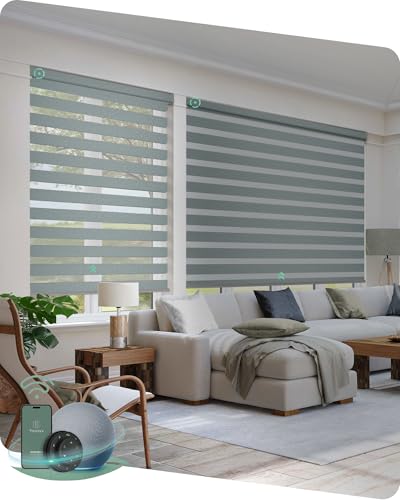
Yoolax takes a different approach to the same problem. Instead of a single sheet of fabric, this is a motorized zebra blind that alternates bands of blackout polyester and sheer fabric. When the blackout bands overlap, the room darkens for a movie. When the sheer bands align, daylight filters in for everyday use. That two-in-one behavior makes it the most flexible blind in the guide.
The motor is remote controlled and works with Alexa, so the shade can be part of a voice-controlled theater routine. The shade is cordless, with no hanging cord, and it is custom sized to the window. The color in the listing is a dark charcoal with a subtle pattern, which suits a theater wall and keeps the blind looking intentional when it is lowered.
Zebra blinds suit rooms that change roles during the day. A living room that hosts video calls in the afternoon and movies at night needs a window treatment that can shift without a second layer. The zebra design does that with one shade. The trade-off is that the overlapping bands never seal as completely as a single-sheet roller, so a small amount of light can pass at the seams in very bright conditions. In a room with a bright projector or a television, that difference is rarely noticeable, but in a room with a dim projector and a large window, a roller may darken the space more fully.
Build quality is part of the appeal. The fabric pairs a blackout layer with a sheer layer, and the motor moves the loop smoothly between positions. The shade is rechargeable, so there is no wiring to run, and the remote keeps control simple for anyone in the room.
Choose Yoolax when the theater shares space with daily life and the windows need to work in both modes. It is the best pick in this guide for a multi-use room.
Specs
- Material: Blackout polyester with sheer fabric bands
- Operation: Motorized, with remote control
- Opacity: Blackout bands with sheer alternating bands
- Mounting: Inside mount, custom size
- Power: Rechargeable motor
- Smart home: Compatible with Alexa
- Special features: Cordless, zebra band design for light control
4. Changshade Blackout Roller Shades With Cassette Valance

Changshade is the pick for a theater where the finished look matters as much as the darkness. This is a cordless blackout roller shade with a cassette valance, which is a slim housing that covers the roller at the top of the window. The valance gives the install a clean, built-in appearance and hides the hardware that a bare roller leaves visible.
The shade is cordless with a free-stop system, so it holds its position wherever you leave it. That is useful in a theater, where you may want the shade fully down for a movie, half down for a game, or up for cleaning. The fabric is blackout-rated and thermal insulated, with UV protection, and the shade is made for bedrooms, living rooms, and offices as well as media spaces.
Installation is described as easy, and the shade fits an inside or outside mount. The 30-inch-wide by 72-inch-high size in black is a natural fit for a narrow theater window or a basement window, and the dark fabric blends into a dim room. The cassette valance is the detail that sets this shade apart from a plain roller: it turns a functional shade into a finished piece of the room.
Changshade suits a theater where the windows are visible and the room is meant to look polished even when the blinds are up. It is also a good match for a room where the blinds stay down for long stretches, since the valance keeps the top edge tidy and the fabric hangs flat.
Specs
- Material: Blackout fabric, thermal insulated
- Operation: Cordless, free-stop system
- Opacity: Blackout
- Mounting: Inside mount or outside mount
- Size: 30 inches wide by 72 inches high
- Special features: Cassette valance, UV protection, easy install
5. Redi Shade Cordless Cellular Blackout Shade

Redi Shade is the simplest and most forgiving pick in the guide. This is a cordless cellular blackout shade that trims at home to fit the window, with an easy-lift design and no tools needed for install. It is made for windows from 19 inches to 36 inches wide, which covers the narrow windows found in many basement theaters and spare rooms.
The cellular structure is the key feature. The folded honeycomb fabric traps air, which adds insulation at the window and gives the shade a soft, textured look that a flat roller does not have. The fabric is blackout-rated, so it blocks outside light, and the cordless lift keeps the operation simple and safe. The shade is white, which suits a light room, though a white shade in a dark theater will show more at the edges than a dark fabric.
Trim-at-home sizing is the practical advantage. Measure the window, trim the shade to width, and mount it without brackets or screws. That makes it a strong choice for a renter, for a first theater setup, or for a room with several narrow windows that are not quite the same size. The shade is lightweight and easy to handle, and it raises into a compact stack at the top of the window.
The trade-off is size range. A window wider than 36 inches needs a different shade, and a tall window may need a longer model. For the narrow windows this shade is made for, though, it is the quickest path to a dark room. It is also the easiest shade in the guide to replace or adjust, since the install is fully reversible.
Specs
- Material: Cellular blackout fabric
- Operation: Cordless, easy lift
- Opacity: Blackout
- Mounting: No tools, trim at home
- Size: 36 inches wide by 64 inches long, fits windows 19 to 36 inches wide
- Special features: Thermal insulated, noise reduction, easy install
Measuring and Installing Your New Blinds
Start with a steel tape measure and a notepad. Measure the width of each window at the top, middle, and bottom, and write down all three numbers. Measure the height on the left, in the center, and on the right. Windows are rarely perfectly square, especially in older homes, so the smallest width and the longest height are the numbers that matter for an inside mount.
Decide the mount before ordering. An inside mount looks neat and keeps the blind within the frame, but it needs enough depth to hold the brackets and it leaves a small light gap on each side. An outside mount covers the frame and overlaps the wall, which blocks more light and suits a shallow frame. For a theater, the outside mount is usually the better choice for darkness, while the inside mount is the better choice for a clean look.
Trim-to-width shades need a careful hand. Mark the cut line with a pencil, cut slowly, and test the fit before mounting. A shade that is trimmed too narrow cannot be fixed, so measure twice and cut once. For motorized shades, charge the battery fully before the first install, pair the remote, and test the full travel of the shade before fixing the brackets in place.
Mounting hardware varies, so read the included instructions before drilling. No-drill shades use clips or adhesive strips, and they need a clean, dry surface to hold. Bracket-mounted shades need a level, a drill, and the right screws for the wall material. A second pair of hands helps with wide shades, since the fabric and roller are awkward to hold level on your own.
Once the blinds are up, test the room at the brightest time of day. Lower every shade, turn on the screen, and look for light leaking at the edges. Small gaps can be closed with a wider outside mount or with side channels, which are narrow tracks that hold the edges of the fabric against the frame. Side channels are an optional add-on for a dedicated theater and they make a real difference on a sunny afternoon.
Keeping Blinds Clean and Working Well
Blackout blinds need little maintenance, but a regular routine keeps them working smoothly. Dust the fabric with a soft cloth or a vacuum with a brush attachment, working from the top down. Spot clean marks with a damp cloth and mild soap, and let the fabric dry fully before rolling it up. Avoid soaking the fabric or using harsh cleaners, which can damage the blackout coating.
Roller shades last longest when they roll straight. If the fabric starts to drift to one side, lower the shade fully, adjust it by hand so it sits square on the roller, and raise it slowly. A shade that telescopes to one side is usually a sign that the brackets are not level, so check the mounts before adjusting the fabric.
Motorized shades need charging on a schedule. A shade that moves slowly or stops partway is usually low on battery rather than broken. Keep the remote in a consistent place, and keep spare charging cables near the theater so the shades are ready for movie night. For cellular shades, a gentle vacuum keeps dust out of the cells, and a soft brush reaches the folds without crushing them.
Cordless mechanisms can stiffen over time if dust builds up in the roller. A light wipe of the roller and the bottom rail keeps the motion smooth. If a shade will not stay in position, check that the mechanism is clean and that the fabric is not catching on the frame. Most issues come from dust or a misaligned bracket rather than a failed part.
Frequently Asked Questions
Do blackout blinds make a real difference for a projector?
Yes. A blackout blind blocks the daylight that washes out a projected image, which keeps dark scenes rich and colors vivid. The difference is largest in a room with a window beside or behind the screen, where even a small amount of light can flatten contrast. A television benefits too, since glare drops and the screen stays readable in daylight.
Should I choose an inside mount or an outside mount for a theater?
An outside mount blocks more light because it covers the frame and overlaps the wall, so it is the better choice when darkness is the priority. An inside mount looks tidier and sits within the frame, but it leaves a small gap on each side. If the frame is shallow or the window is an odd size, an outside mount is usually the simpler and darker option.
Are cordless blinds safe for a room where children play?
Cordless blinds remove the hanging operating cord, which is the main hazard identified in window covering safety guidance. Every blind in this guide is cordless or motorized, with no long cord to manage. Keep remotes and chargers out of reach, and move cribs and low furniture away from windows as an extra precaution.
Can one blind cover a very wide theater window?
It depends on the model. Most roller and zebra shades in this guide are available in wide sizes or custom sizes, while the trim-at-home cellular shade is made for windows up to 36 inches wide. Measure the opening first, then check the size range for the model you want. For a very wide opening, two matching shades mounted side by side often look better and operate more smoothly than one oversized shade.
Conclusion
The best home theater blinds are the ones that make the room dark quickly, stay out of the way when raised, and match how the room is used. A cordless blackout roller is the simplest answer for most theaters, a motorized shade is the right call for a smart home or a room with several windows, a zebra blind suits a space that changes roles during the day, and a cellular shade adds insulation to a narrow window.
Start with the windows. Measure each opening, decide on an inside or outside mount, and pick the operation that fits the room. A dedicated theater with one window needs little more than a cordless roller and a dark fabric. A living room theater with a smart setup earns a motorized shade that joins the movie-night routine. Either way, the payoff is the same: a room that goes dark on demand, a screen that holds its contrast, and a movie night that feels like a theater instead of a living room with the lights dimmed.
Product and ASIN Reference
| Product | ASIN |
|---|---|
| LazBlinds Cordless Blackout Roller Shades | B0BJDJR4VL |
| SmartWings Motorized Blackout Roller Shade | B09M3QLDBV |
| Yoolax Motorized Zebra Blinds | B0DK8J7K5N |
| Changshade Blackout Roller Shades With Cassette Valance | B0DGXVCSQ7 |
| Redi Shade Cordless Cellular Blackout Shade | B0126EWY9W |