Our Short List of 3

- Best for: Spot-treating scattered moss patches without loading a spreader
- Form: Ready-to-use granules in a shaker jug
- Weight: 4.59 lbs
- Coverage: Treats up to 1,250 sq ft
- Formula: Moss control granules with fertilizer to green grass

- Best for: A whole-lawn treatment that feeds grass while clearing moss
- Form: Granules for spreader application
- Weight: 25 lbs
- Coverage: Covers up to 5,000 sq ft
- Formula: Moss killer combined with lawn fertilizer

- Best for: Moss-heavy lawns in wet climates that need iron greening without fertilizer
- Form: Ready-to-use granules
- Weight: 20 lbs
- Coverage: Covers up to 5,000 sq ft
- Active ingredient: 32.0 percent ferrous sulfate monohydrate
All 4 Picks at a Glance
| Product | Specs | Action |
|---|---|---|
| Scotts MossEx Shaker Jug |
| Check price on Amazon |
| Scotts Turf Builder with Moss Control |
| Check price on Amazon |
| Lilly Miller Moss Out Lawn Granules |
| Check price on Amazon |
 Bonide MossMax Granules |
| Check price on Amazon |
Key takeaways
- Compare four granular moss killers for lawns by bag weight, coverage and iron content, from a shaker jug for patches to full bags for whole-lawn treatment.
Moss in a lawn is rarely a whole-yard problem at first. It starts where shade, damp soil, and thin grass meet, and the real decision is how much of the yard you need to treat and what else you want the product to do. A shaker jug handles scattered patches without any equipment. A full bag through a spreader treats the entire lawn in one pass, and some bags feed the grass at the same time while others rely on iron alone.
This roundup is for homeowners choosing between those routes: patchy shade moss, a thin lawn that needs feeding as it clears, moss that returns every wet winter, and small yards where beds and shrubs sit close to the turf. Every pick below is a granular product sold for lawns, chosen from its Amazon listing by form, bag weight, stated coverage, and active ingredient, so the comparison rests on what each maker prints rather than on impressions.
Quick Picks
As an Amazon Associate we earn from qualifying purchases
| Product | Best for | Key spec from title |
|---|---|---|
| Scotts MossEx Shaker Jug | Spot patches in shade | 4.59 lb jug treats 1,250 sq ft |
| Scotts Turf Builder with Moss Control | Whole lawns that also need feeding | 25 lb bag covers up to 5,000 sq ft |
| Lilly Miller Moss Out Lawn Granules | Wet-climate moss without fertilizer | 20 lb bag, 32.0 percent ferrous sulfate monohydrate |
| Bonide MossMax Granules | Small lawns beside flower beds | 6 lb container covers up to 1,500 sq ft |
How to Choose
Match Coverage to the Area You Will Actually Treat
Start with the area, not the bag. Measure the lawn or the mossy part of it, then compare that figure with the coverage printed on each listing. The Scotts MossEx jug treats 1,250 square feet, which suits patches and small yards. The big Scotts and Lilly Miller bags each cover up to 5,000 square feet at their standard rate. Heavy moss changes the math: Lilly Miller drops to 4,000 square feet per bag at its heavy rate, and Bonide MossMax doubles its rate, so one container covers far less ground than the headline number suggests.
Decide Whether Fertilizer Belongs in the Bag
Two of the products here kill moss and feed grass in the same pass. Scotts builds fertilizer into both of its granules, which helps thin turf thicken into the space the moss vacates. Lilly Miller Moss Out takes the other path: no fertilizer at all, so the deep green comes from iron and the grass does not surge into extra mowing afterward. Bonide MossMax also works as a straight moss treatment rather than a feeding program. Choose a blend when the lawn is hungry and thin; choose an iron-only granule when the lawn is already fed on its own schedule.
Read the Active Ingredient Before the Brand
Nearly every granular lawn moss killer runs on iron, usually ferrous sulfate monohydrate, which scorches moss on contact while grass tolerates it. The share of active ingredient still varies a lot. Lilly Miller prints 32.0 percent ferrous sulfate monohydrate on its listing, balanced with calcium carbonate, which eases soil acidity. Blended products divide their weight between fertilizer and moss control, so their iron share runs lower and the greening leans on feeding instead. A higher iron share blackens moss faster, but it also raises the staining risk on concrete, stone, and decking, so handling care matters more with the strong mixes.
Time the Application to Moist Turf and Active Moss
Granules only work where they land and stay, so timing and surface moisture decide more than brand does. Makers direct these products at winter and spring, when moss grows actively and grass can fill in behind it. Apply to a moist lawn so granules settle onto the moss instead of bouncing off dry blades, and mow first if the grass stands tall enough to shield the moss. Keep granules off sidewalks and patios, sweep up strays at once, and give the treated moss time to blacken and dry before raking it out and reseeding bare soil.
The 4 Best Options
Scotts MossEx Shaker Jug
- Best for: Spot-treating scattered moss patches without loading a spreader
- Form: Ready-to-use granules in a shaker jug
- Weight: 4.59 lbs
- Coverage: Treats up to 1,250 sq ft
- Formula: Moss control granules with fertilizer to green grass
Spot-treating scattered moss patches without loading a spreader
The jug empties quickly on larger areas; whole-lawn jobs need a bag and a spreader instead
Scotts MossEx in the shaker jug suits lawns where moss shows up in scattered patches rather than wall to wall. The jug format removes the spreader from the job: you carry it to the patch, shake the granules over the moss, and move on, which makes it practical for shaded corners, strips beside fences, and the damp ring under trees. The formula pairs the moss control granules with fertilizer meant to green the grass around the patch, so the treated area fills back in instead of staying thin. Scotts directs it at winter or spring use, applied while the lawn is moist so the granules settle onto the moss.
Scotts Turf Builder with Moss Control
- Best for: A whole-lawn treatment that feeds grass while clearing moss
- Form: Granules for spreader application
- Weight: 25 lbs
- Coverage: Covers up to 5,000 sq ft
- Formula: Moss killer combined with lawn fertilizer
A whole-lawn treatment that feeds grass while clearing moss
It feeds as it treats, so skip it if the lawn was fertilized very recently
This is the pick for a lawn that needs feeding and moss control in the same pass. The granules combine a moss killer with Turf Builder lawn fertilizer, so one spreader run clears moss while pushing the grass to thicken into the gaps the moss leaves behind. The 25 lb bag is sized for a full treatment of an average suburban lawn rather than patch work, and the uniform granules are made to run through a standard broadcast or drop spreader. Apply it to a moist, recently mowed lawn in winter or spring, when moss is active and grass can respond to the feeding.
Lilly Miller Moss Out Lawn Granules
- Best for: Moss-heavy lawns in wet climates that need iron greening without fertilizer
- Form: Ready-to-use granules
- Weight: 20 lbs
- Coverage: Covers up to 5,000 sq ft
- Active ingredient: 32.0 percent ferrous sulfate monohydrate
Moss-heavy lawns in wet climates that need iron greening without fertilizer
Iron stains concrete and stone, so sweep stray granules off walks and driveways right away
Lilly Miller takes the opposite route from the fertilizer blends: Moss Out Lawn Granules carry no added fertilizer, so the greening comes from iron alone and the grass does not surge into extra mowing. The listing states 32.0 percent ferrous sulfate monohydrate with calcium carbonate, a high-iron mix aimed at moss in cool, wet regions where it spreads through winter. The 20 lb bag covers up to 5,000 square feet at the lighter rate, with a heavier rate for thick infestations. Moss typically browns within about a day of a correct application, after which it can be raked out.
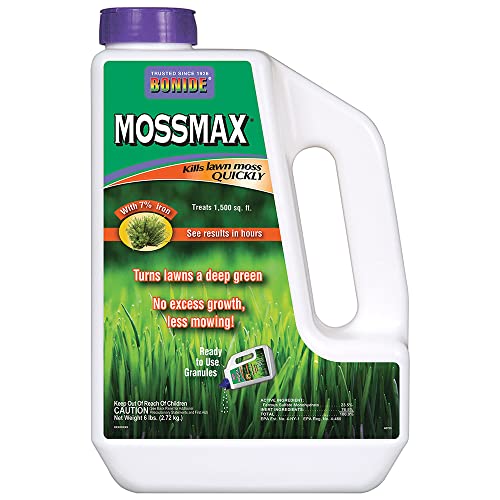
Bonide MossMax Granules
- Best for: Small lawns and moss creeping along flower beds and shrubs
- Form: Ready-to-use granules
- Weight: 6 lbs
- Coverage: Covers up to 1,500 sq ft
- Application rate: 4 lb per 1,000 sq ft for normal moss, 8 lb per 1,000 sq ft for heavy moss
Small lawns and moss creeping along flower beds and shrubs
Coverage is the smallest here, so measure the lawn before counting on one container
Bonide MossMax fits smaller lawns and mixed beds where a big bag would sit half used in the shed. The 6 lb container of ready-to-use granules goes through a standard lawn spreader, and the rates printed on the listing give you two clear gears: a normal rate for light moss and a doubled rate for heavy patches. Bonide also lists use around flowers and ornamental shrubs, which the lawn-only products do not claim, so it suits yards where moss creeps from turf into planted borders. Treated moss darkens and dies back, and the iron in the mix deepens the green of the surrounding grass.
Which One Fits Your Situation
Moss Shows Up Only in Shady Corners
Reach for the Scotts MossEx shaker jug. Patchy moss under trees, along fences, and on the north side of the house does not justify loading a spreader, and the jug lets you dose each patch directly. Its built-in fertilizer greens the thin grass around the patch, helping it close over the bare spot once the moss dies back.
The Whole Lawn Is Thin, Pale, and Mossy
Choose Scotts Turf Builder with Moss Control. When moss is a symptom of a hungry lawn rather than a local damp spot, the combined granule clears the moss and feeds the grass in one spreader pass over up to 5,000 square feet, so the turf thickens into the gaps instead of leaving them open for the moss to reclaim.
Moss Returns Every Wet Winter
Pick Lilly Miller Moss Out Lawn Granules. Its high iron share and calcium carbonate suit regions where moss is a standing winter condition, and the 20 lb bag covers a full lawn at the light rate or most of one at the heavy rate. With no fertilizer in the mix, repeat seasonal use will not push growth you then have to mow.
Moss Creeps From Turf Into Planted Beds
Take Bonide MossMax. It is the only pick here whose listing includes use around flowers and ornamental shrubs, so one container handles the lawn edge and the bed border in the same outing. The two application rates let you go heavier where moss mats thickest, and the small container size fits yards where a full bag would go stale in storage.
Common Mistakes
- Spreading granules over a bone-dry lawn, so they bounce off the moss and never make contact.
- Using the light application rate on thick, matted moss, then judging the product before a heavier pass.
- Letting iron granules sit on sidewalks, driveways, or stone, where they leave rust-colored stains.
- Treating the moss but not the shade, compaction, and drainage that invited it, so it returns next season.
- Raking or reseeding the same day instead of waiting for the moss to blacken, dry, and loosen.
Frequently Asked Questions
How fast do granular moss killers work?
Iron granules act on contact, and treated moss usually darkens within days; Lilly Miller’s listing says its moss browns and starts to die within about a day. Full clearing takes longer, because the dead moss still has to dry out and be raked away before the grass closes over.
Do I need a spreader for these products?
The bagged granules are made for a standard drop or broadcast spreader, and Bonide’s listing names a standard lawn spreader directly. The Scotts MossEx shaker jug is the exception: it is built for hand application on patches, so no spreader is needed as long as you only treat small areas.
Will a granular moss killer hurt my grass?
These products are built on iron salts that scorch moss while established turf tolerates them, and the listings position them as killing moss rather than lawns when applied as directed. Trouble comes from piling granules in one spot or ignoring the label rate, which can darken or stress the grass underneath.
When should I apply moss control granules?
Aim for winter or spring, while moss is actively growing and the lawn is moist. Mow first if tall grass would shield the moss from the granules, keep the product off hard surfaces, and wait for dry weather afterward so the granules stay where they landed instead of washing away.