Our Short List of 3

- Best for: kitchens and bathrooms where tile and grout need steam plus real dirty-water recovery in one pass.
- Best for: mixed kitchen messes on tile, where automatic adjustment between dry debris and wet spills saves constant mode changes.

- Best for: buyers who want steam extraction on tile with the fewest controls to manage, on a single floor.
All 4 Picks at a Glance
| Product | Specs | Action |
|---|---|---|
| 1. BISSELL CrossWave HydroSteam (35151) |
| Check price on Amazon |
| 2. Tineco FLOOR ONE S5 Steam |
| Check price on Amazon |
| 3. Tineco iFLOOR 5 Steam |
| Check price on Amazon |
 4. Shark Steam Pickup SD201 |
| Check price on Amazon |
Key takeaways
- Compare steam extraction cleaners for tile floors that steam and vacuum in one pass, with separate dirty-water tanks, cord reach and self-cleaning cycles.
As an Amazon Associate, we earn from qualifying purchases made through links on this page.
Tile floors collect two kinds of mess at once: loose grit that tracks in from outside, and sticky or greasy films that settle into grout lines. A plain steam mop handles the second problem but mostly pushes the first one around on a wet pad. A steam extraction cleaner attacks both in a single pass, because it pairs live steam with powered suction. The steam loosens dried residue and sanitizes with heat, while the vacuum side pulls loose debris and dirty water off the surface and into a separate tank instead of spreading it across the next row of tiles.
That combination is what this roundup is built around. Every machine below generates real steam and also removes material from the floor in the same pass. Three of the four picks are true extraction designs: they vacuum, wash and steam at the same time, and they recover the dirty water into a dedicated tank. The fourth pick, the Shark Steam Pickup, works differently. It has no suction motor at all; a powered brushroll sweeps wet and dry debris into a collection tray while steam sanitizes. It is included because it solves the same no-pre-sweeping problem, but it is flagged clearly wherever it appears so the distinction is never blurred.
All four machines are corded, which matters on tile. Steam generation is power-hungry, and corded designs hold full steam output and full suction for an entire kitchen or bathroom session without a battery fading halfway through.
What to look for in a steam extraction cleaner for tile
True extraction versus debris pickup. The most important split in this category is how the machine removes dirt. Extraction models use a vacuum motor to pull dirty water into a recovery tank, so contaminated water leaves the floor completely. Pickup designs without suction rely on a spinning brushroll and a tray; they capture crumbs and liquid, but fine dirty water is managed by the roller rather than drawn into a sealed tank. For grout-heavy tile, extraction is the stronger approach because grout sits below the tile surface and holds onto dirty water.
Separate clean and dirty tanks. Two-tank systems keep fresh water and cleaning solution apart from recovered water, so you always lay down clean liquid. Check both capacities: a large clean tank paired with a small dirty tank still forces mid-session stops, because the recovery side fills first on wet passes.
Steam delivery and floor compatibility. Steam output is described differently by each brand, from named steam modes to a stated steam temperature. What matters for tile is sustained steam at the floor head plus honest guidance about surfaces. Glazed ceramic and porcelain tile tolerate steam well. Natural stone, unsealed grout and heat-sensitive flooring need more care, and manufacturers of these machines restrict use to sealed hard floors that resist high temperatures.
Brushroll and grout contact. A motorized brushroll scrubs as it moves, which helps on textured tile and along grout lines where a flat pad can skim over the top. Tangle-resistant brushroll designs reduce hair wrap, and a self-cleaning cycle matters because a roller that has just scrubbed grout lines needs flushing before storage.
Cord reach and weight. Every pick here is corded, with cords from roughly twenty to twenty-six feet. Longer cords reduce outlet changes in open-plan kitchens. Weight ranges from about seven pounds to just over fourteen, which decides how the machine feels on a full ground floor and whether carrying it to an upstairs bathroom is realistic.
Water-only cleaning. Steam machines in this class clean with water alone or with a matched formula in the clean tank. One caution repeats across brands: some steam models prohibit adding solution to the tank at all, because additives can damage the steam path. Check the tank rules for the model you choose before the first fill.
1. BISSELL CrossWave HydroSteam (35151)
- Best for: kitchens and bathrooms where tile and grout need steam plus real dirty-water recovery in one pass.
kitchens and bathrooms where tile and grout need steam plus real dirty-water recovery in one pass.
The CrossWave HydroSteam is the reference design for this category: a corded upright that vacuums, washes and steams at the same time, built around BISSELL’s Two-Tank Technology. The clean tank holds twenty-eight fluid ounces of water and formula, and a separate dirty tank collects everything the suction pulls back off the floor, so the brushroll is never re-wetting tile with recovered water.
Three cleaning modes cover the tile use case directly. Hard Floor mode handles everyday washing, the SteamWash mode adds full steam for dried and greasy kitchen residue, and an Area Rug mode extends the same machine to rugs near sinks and entryways. BISSELL rates the unit at fourteen hundred watts, feeds it through a twenty-five-foot cord, and fits a tangle-free brushroll that resists hair wrap. A one-touch self-cleaning cycle flushes the brushroll and internal pathways after use, and the head swivels for steering around vanities and table legs. The machine weighs twelve and a half pounds.
For tile specifically, the draw is the combination of steam heat with genuine dirty-water recovery. Steam loosens the film that dulls grout, the roller scrubs the surface, and the vacuum side removes the suspended grime instead of leaving it to dry back into the grout line.
The limitations follow from the format. The cord defines your working radius, and at twelve and a half pounds this is not a machine you will enjoy carrying up stairs repeatedly. The dirty tank is smaller than the clean tank, so large open tile areas can mean an extra emptying stop. It is also a hard-floor and area-rug machine, not a carpet extractor, despite the extraction language in the category name.
2. Tineco FLOOR ONE S5 Steam
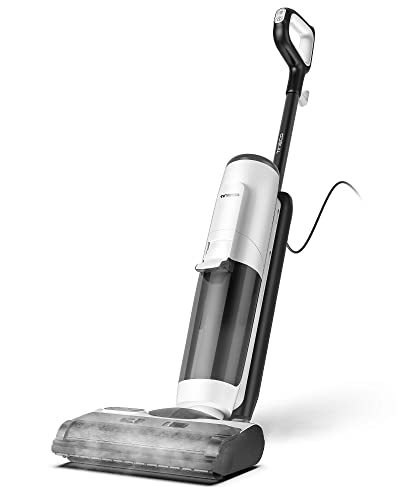
- Best for: mixed kitchen messes on tile, where automatic adjustment between dry debris and wet spills saves constant mode changes.
mixed kitchen messes on tile, where automatic adjustment between dry debris and wet spills saves constant mode changes.
The FLOOR ONE S5 Steam takes the same vacuum, wash and steam formula and adds sensor-driven automation. Tineco’s iLoop Smart Sensor detects wet and dry mess on the floor and adjusts suction power, roller speed and water flow automatically, so the machine applies more aggressive cleaning to a sauce spill and eases off on a clean stretch of hallway tile. A digital display reports the cleaning status while you work.
The hardware is built for longer sessions. Clean and dirty tanks each hold three quarters of a liter, the cord runs twenty-six feet, and the steam system also handles cleanup duty: after a session, high-temperature steam cleans the brush head and speeds its drying, which reduces the sour-roller smell that plagues wet floor machines. The S5 Steam is corded, so steam output and suction do not taper off the way battery models can near the end of a charge.
On tile, the sensor system earns its place when messes are mixed, which describes most real kitchens: crumbs near the stove, a sticky patch by the fridge, and tracked grit at the door all get different treatment without mode switching.
Tineco’s own guidance sets the limitations. The company states the machine should only be used on hard floors that resist high temperatures, so heat-sensitive surfaces are out. It also warns against adding cleaning solution to this model, since additives may damage it; the S5 Steam is a water-and-steam cleaner, full stop. And like the BISSELL, it is a corded upright with real heft, happiest stored on the floor it cleans most.
3. Tineco iFLOOR 5 Steam
- Best for: buyers who want steam extraction on tile with the fewest controls to manage, on a single floor.
buyers who want steam extraction on tile with the fewest controls to manage, on a single floor.
The iFLOOR 5 Steam is the simpler sibling in Tineco’s steam line: still a corded three-in-one that vacuums, mops and steams in one pass, but controlled manually with two power levels instead of a smart sensor. It produces high-temperature steam aimed at dissolving stuck-on grease and stains without chemical solution, and it recovers dirty water into its own tank, keeping it a true extraction design.
Tank capacity matches the S5 Steam at three quarters of a liter on both the clean and dirty sides, and the steam self-cleaning function carries over, flushing the roller with steam after use. A self-propulsion assist helps the fourteen-pound body move forward across large tiled areas, and the power cord measures a little over twenty feet. The included storage tray and cleaning tool cover parking and basic upkeep.
Against the S5 Steam, the trade is clear. You give up the iLoop sensor, the digital display and about six feet of cord. In exchange you get a control scheme with nothing to configure: pick a power level and clean. For a single tiled kitchen and bathroom on one floor, that simpler setup covers the whole job.
The limitations are the weight, which at just over fourteen pounds makes this the heaviest pick in the roundup, the shorter cord, and the same high-temperature caution that applies to every steam model here: sealed, heat-resistant hard floors only, and no assumptions about delicate stone or unsealed surfaces without checking the flooring maker’s guidance first.
4. Shark Steam Pickup SD201
- Best for: quick daily tile cleanups with loose debris, where light weight matters more than true extraction.
quick daily tile cleanups with loose debris, where light weight matters more than true extraction.
The Steam Pickup needs its own explanation, because it is not an extraction machine. There is no vacuum motor and no dirty-water recovery tank. Instead, a motorized brushroll spins continuously, sweeping wet and dry debris into a two-chamber collection tray that separates solid debris from liquid, while steam sanitizes the floor with water alone. Shark positions it as a three-in-one that picks up debris, deep scrubs and steam sanitizes in a single pass, with no pre-sweeping.
The official specifications make it the lightest and simplest pick here: just over seven pounds, a twenty-five-foot cord, a cleaning path a little over nine inches wide, and a self-cleaning brushroll that keeps debris moving into the tray instead of building up on the roller. Shark rates it for sealed hard floors including hardwood, tile, laminate, stone, marble and vinyl.
On smooth tile with everyday crumbs, hair and light spills, this design genuinely removes the sweep-first step, and the low weight makes it easy to pull out for small messes. What it cannot do is extract: dirty water is not drawn into a sealed tank, fine slurry is handled by the roller and tray rather than by suction, and the tray capacity is small, so a whole muddy entryway will need the tray emptied mid-job. Treat it as a steam mop that captures debris, not as a steam vacuum.
Comparison table
| Model | Steam plus removal method | Clean / dirty water | Power | Weight | Self-cleaning |
|---|---|---|---|---|---|
| BISSELL CrossWave HydroSteam (35151) | Steam with vacuum extraction | 28 fl oz clean tank, separate dirty tank | Corded, 25 ft cord | 12.5 lb | One-touch self-clean cycle |
| Tineco FLOOR ONE S5 Steam | Steam with vacuum extraction, sensor-adjusted | 0.75 L / 0.75 L | Corded, 26 ft cord | Full-size upright | Steam self-cleaning of brush head |
| Tineco iFLOOR 5 Steam | Steam with vacuum extraction, two power levels | 0.75 L / 0.75 L | Corded, about 20 ft cord | 14.16 lb | Self-cleaning with steam |
| Shark Steam Pickup SD201 | Steam with brushroll debris pickup, no suction | Water tank plus two-chamber debris tray | Corded, 25 ft cord | 7.01 lb | Self-cleaning brushroll |
Frequently asked questions
Is steam safe for tile and grout?
Glazed ceramic and porcelain tile handle steam well, and steam is widely used on grout because the heat loosens residue that mopping leaves behind. The caution areas are unsealed grout, natural stone and any floor the maker describes as heat-sensitive. Every manufacturer in this roundup limits its machines to sealed hard floors that resist high temperatures, so check your flooring guidance before steaming stone or older grout.
Do these machines replace a carpet extractor?
No. Despite the category name, these are hard-floor machines. The extraction they perform is recovering dirty water from tile and other hard surfaces a few ounces at a time. They do not deep-clean carpet pile, and only the BISSELL lists an area-rug mode among these picks. A carpet cleaner is a separate appliance class with far larger tanks.
Can I add cleaning solution to the tank?
It depends on the model, and the difference matters. The BISSELL is designed to run with water and matched formula in its clean tank. Tineco explicitly warns against adding solution to the S5 Steam because additives may cause damage. Read the tank instructions for your model before adding anything beyond water.
How is the Shark Steam Pickup different from the other three?
The other three picks have vacuum motors that extract dirty water into a recovery tank. The Shark has no suction at all: its brushroll sweeps debris into a collection tray while steam sanitizes. It still removes the pre-sweeping step, but it does not extract, which is why it is flagged separately throughout this guide.
Corded or cordless for steam cleaning?
Every pick here is corded, and that is deliberate for this category. Boiling water into steam draws heavy power, and corded machines hold full steam and suction for an entire session. The trade-off is outlet management, which the longer cords on the BISSELL, Tineco S5 Steam and Shark help offset.
Conclusion
For most tile floors, the BISSELL CrossWave HydroSteam is the most complete answer: real steam, real extraction, separate tanks and a self-cleaning cycle in a proven format. The Tineco FLOOR ONE S5 Steam suits messier kitchens where its sensor can shift effort automatically, while the iFLOOR 5 Steam delivers the same core steam-and-extract cleaning with simpler manual controls. The Shark Steam Pickup earns its place for light daily duty, as long as you choose it knowing it captures debris without suction rather than extracting dirty water. Match the removal method to your floors first, and the rest of the decision is tank size, cord reach and weight.