Our Short List of 3
All 4 Picks at a Glance
| Product | Specs | Action |
|---|---|---|
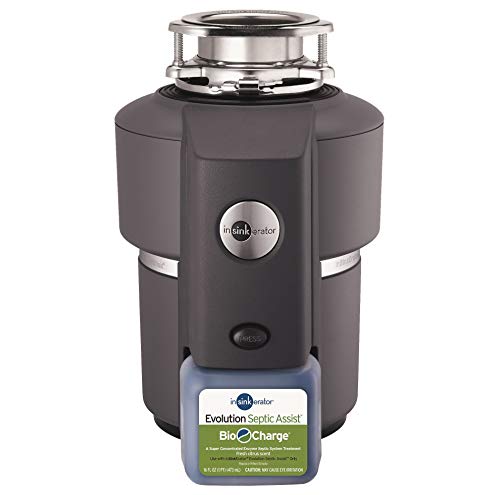
| InSinkErator Evolution Septic Assist, Quiet Series, 3/4 HP Continuous Feed | Check price on Amazon | |
 InSinkErator Evolution Septic Guard, 3/4 HP | Check price on Amazon | |
 Waste King Legend Series L-3200, 3/4 HP Continuous Feed | Check price on Amazon | |
 Waste King Legend Series L-2600, 1/2 HP Continuous Feed | Check price on Amazon |
Key takeaways
- Four septic-safe garbage disposals compared: two purpose-built InSinkErator enzyme models and two Waste King units rated for properly sized septic tanks.
Disclosure: As an Amazon Associate, we earn from qualifying purchases.
Our top pick: InSinkErator Evolution Septic Assist, Quiet Series, 3/4 HP Continuous Feed. Runner-up: InSinkErator Evolution Septic Guard, 3/4 HP.
A garbage disposal changes what a septic system has to handle. Every plate scraped into the sink becomes ground food waste in the tank, and the tank’s bacteria have to break that extra load down along with everything else the household sends its way. That is why the disposals in this guide were not chosen on grinding power alone. Each of the four models below was checked against a real Amazon US listing, and each one has a specific septic connection: two are purpose-built InSinkErator models with enzyme systems designed to aid septic digestion, and two are Waste King models whose listings state plainly that the disposal is safe for properly sized septic tanks.
That distinction matters, and this guide keeps it visible rather than blurring it. A purpose-built septic model does something active to help the tank cope with ground food waste. A model described as safe for properly sized septic tanks makes a narrower claim: the manufacturer is saying the unit can be used with a septic system, provided the tank is big enough for the household and the waste it produces. Both kinds appear here, labelled for what they are, so the choice can be made on the right basis. All four are sink-mounted disposals of the same general type; what separates them is how each one treats the septic side of the job.
Quick Picks
- InSinkErator Evolution Septic Assist, Quiet Series, 3/4 HP Continuous Feed — Best purpose-built pick: a Bio-Charge enzyme cartridge system that injects enzymes on each use, in a sound-insulated Quiet Series housing.
- InSinkErator Evolution Septic Guard, 3/4 HP — Best current-model alternative: the newer Septic Guard name in the same 3/4 HP class, with an integrated enzyme system.
- Waste King Legend Series L-3200, 3/4 HP Continuous Feed — Best of the stated-safe models: 2,700 RPM permanent magnet motor, EZ-Mount fitting, sound insulation and an 8-year limited warranty.
- Waste King Legend Series L-2600, 1/2 HP Continuous Feed — Best straightforward fit: 2,600 RPM permanent magnet motor, stainless steel grind components and a power cord included in the box.
InSinkErator Evolution Septic Assist, Quiet Series, 3/4 HP Continuous Feed
OUR TOP PICK
The Evolution Septic Assist is the clearest answer to the septic question in this guide, because septic use is what it was built for. As stated on the listing, it is a 3/4 HP continuous feed disposal fitted with the Bio-Charge enzyme cartridge system, which injects enzymes each time the disposal runs. Those enzymes go down with the ground food waste and aid the digestion process inside the tank, which is the part of septic ownership a standard disposal does nothing to help with. One Bio-Charge cartridge is included with the unit, as stated on the listing.
The rest of the specification suits a busy kitchen. Continuous feed means the disposal runs while water flows and waste is added gradually, rather than in sealed batches, and 3/4 HP is the stronger of the two power classes in this guide. The housing belongs to the Quiet Series, InSinkErator’s sound-insulated line, so the unit is built to keep grinding noise down inside the cabinet — a practical point in an open-plan kitchen where the sink sits close to living space.
Choose the Septic Assist when the septic system is the deciding factor rather than a box to tick. It is the model here that treats the tank as part of the design: the enzyme dose is automatic, tied to each use, and needs no separate routine from the householder beyond replacing the cartridge as it is used up. For a home that cooks often and sends a steady volume of food scraps to the sink, that automatic dosing is the most direct support any disposal in this guide gives the tank.
Specs
– Model: InSinkErator Evolution Septic Assist, Quiet Series
– Power: 3/4 HP
– Feed type: Continuous feed
– Septic feature: Bio-Charge enzyme cartridge system, injects enzymes on each use to aid septic digestion; 1 Bio-Charge cartridge included
– Sound: Quiet Series sound insulation
Pros
– Purpose-built for septic systems, with enzymes dosed automatically on each use
– 3/4 HP continuous feed grinding for regular family cooking loads
– Quiet Series sound insulation for a quieter cabinet
Cons
– The Bio-Charge cartridge is a consumable that will need replacing as it is used up
– Septic benefit depends on the cartridge system; it is not a fit-and-forget standard disposal
InSinkErator Evolution Septic Guard, 3/4 HP
The Evolution Septic Guard is the current model name in InSinkErator’s septic line, and it sits in the same 3/4 HP class as the Septic Assist. As recorded from the listing checked for this guide, it uses an integrated enzyme system rather than presenting the enzyme side as a separate named cartridge format. The purpose is the same: enzymes travel down with the ground waste to support digestion in the tank, so the disposal and the septic system are working together instead of the disposal simply adding load.
Its place in this guide is as the alternative for buyers who want the newest version of the septic-specific design. The headline figures recorded for it are fewer than for the Septic Assist — the listing information gathered here confirms the 3/4 HP rating and the integrated enzyme system, and no separate feed-type or sound figures were recorded — so the honest comparison is on the septic design itself. Both InSinkErator models in this guide are purpose-built for septic use; the Septic Assist is documented in more detail, while the Septic Guard is the current nameplate carrying the same idea in integrated form.
Choose the Septic Guard if the current model matters more to you than the fuller documentation trail behind the Septic Assist, and confirm the listing details at the point of purchase, since this is the model whose listing information was thinnest in the checks behind this guide. What is not in doubt is its category: it is a septic-specific InSinkErator in the 3/4 HP class, not a standard disposal being stretched into septic duty.
Specs
– Model: InSinkErator Evolution Septic Guard
– Power: 3/4 HP
– Septic feature: Integrated enzyme system, as recorded from the listing checked for this guide
Pros
– Current septic-specific model in the InSinkErator line
– Integrated enzyme system supports tank digestion of ground food waste
– Same 3/4 HP power class as the top pick
Cons
– Fewer listing details were recorded for this model than for the Septic Assist, so check the live listing carefully before buying
– No separate sound-insulation figure was recorded from the listing checked
Waste King Legend Series L-3200, 3/4 HP Continuous Feed
The L-3200 is the stronger of the two Waste King models here, and its septic claim needs to be stated exactly as the listing states it: the disposal is safe for properly sized septic tanks. That is a manufacturer statement about compatibility, not a septic treatment system — there is no enzyme dosing here. What the L-3200 brings instead is a capable general disposal that the manufacturer is willing to stand behind for septic households whose tank is sized correctly for the home.
On specification, as stated on the listing, it pairs a 3/4 HP motor with a 2,700 RPM permanent magnet design. Permanent magnet motors reach full speed quickly, which helps the grind chamber clear food waste rather than labouring against it. The listing also records sound insulation, the EZ-Mount system for fitting, and a power cord included in the box, so the unit plugs in rather than needing a cord bought separately. The warranty recorded on the listing is an 8-year limited warranty, the longer of the two Waste King terms in this guide.
Choose the L-3200 when the tank is properly sized, the household’s septic installer or service company is comfortable with a disposal being fitted, and the priority is a strong, quiet-running unit from a maker that explicitly allows septic use. It asks the owner to be honest about tank size in a way the enzyme models do not, because its septic suitability rests on that sizing being right. For the right house, it is a sound, well-covered fit — the 8-year limited warranty is a meaningful commitment behind a unit that will be grinding daily.
Specs
– Model: Waste King Legend Series L-3200
– Power: 3/4 HP
– Motor: 2,700 RPM permanent magnet motor
– Feed type: Continuous feed
– Mounting: EZ-Mount system
– Sound: Sound insulation, as stated on the listing
– Septic statement: Safe for properly sized septic tanks, as stated on the listing
– Included: Power cord included
– Warranty: 8-year limited warranty
Pros
– Manufacturer states it is safe for properly sized septic tanks
– Fast 2,700 RPM permanent magnet motor in the 3/4 HP class
– Sound insulation and EZ-Mount fitting, with the power cord in the box
– 8-year limited warranty, the longest term in this guide
Cons
– No enzyme system; septic suitability depends entirely on the tank being properly sized
– The septic claim is a compatibility statement, not a digestion aid
Waste King Legend Series L-2600, 1/2 HP Continuous Feed
The L-2600 is the smaller Waste King in this guide, at 1/2 HP, and it carries the same form of septic statement as its bigger sibling: as stated on the listing, the disposal is safe for properly sized septic tanks. Again, that is a compatibility statement from the manufacturer rather than a septic-specific system, and it should be read that way. Within that honest framing, the L-2600 is a well-specified straightforward disposal for a smaller household.
As stated on the listing, its permanent magnet motor runs at 2,600 RPM, close behind the L-3200 despite the lower horsepower class. The grind components are stainless steel and the grind chamber is corrosion-proof, which speaks to longevity in a unit that lives in a wet environment under the sink. A power cord is included, as with the L-3200, and the warranty recorded on the listing is a 5-year in-home warranty — shorter than the L-3200’s term, but an in-home term, meaning covered faults are attended at the house rather than by returning the unit.
Choose the L-2600 for a smaller household on a properly sized tank, where a 1/2 HP unit covers the cooking load and the appeal is durable grind hardware and simple fitting. It is the natural pick for a couple or a small family that cooks at home but does not push large volumes of hard scraps through the sink. What it does not do is help the tank digest anything; the tank’s own bacteria carry the whole load, so sensible use — cold water while grinding, no grease, no overloading — matters more with this model than with either InSinkErator.
Specs
– Model: Waste King Legend Series L-2600
– Power: 1/2 HP
– Motor: 2,600 RPM permanent magnet motor
– Feed type: Continuous feed
– Grind components: Stainless steel, with a corrosion-proof grind chamber
– Septic statement: Safe for properly sized septic tanks, as stated on the listing
– Included: Power cord included
– Warranty: 5-year in-home warranty
Pros
– Manufacturer states it is safe for properly sized septic tanks
– Stainless steel grind components and a corrosion-proof grind chamber
– Power cord included, and a 5-year in-home warranty
Cons
– 1/2 HP is the lower power class in this guide, better suited to smaller households
– No enzyme system; the tank handles all digestion unaided
How to Choose
Start with the kind of septic claim, because it is the decision everything else hangs on. The two InSinkErator models are purpose-built: their enzyme systems actively aid digestion in the tank, dosed automatically as the disposal runs. The two Waste King models make a different, narrower claim — the manufacturer states each is safe for properly sized septic tanks. If the tank is generously sized and the household’s food waste load is modest, a stated-safe model can be a reasonable fit. If there is any doubt about the tank, the purpose-built route is the more defensive choice.
Next, be honest about tank size and household load. “Properly sized” means the tank was sized for the home’s bedrooms and occupancy with normal use in mind; a disposal adds ground solids to that load. A large family that cooks daily sends far more through a disposal than a couple that eats out often, and the tank feels the difference. Neither kind of disposal removes the need for regular tank pumping and inspection; an enzyme system supports digestion between services, it does not replace them.
Then match horsepower to the cooking. The 3/4 HP models — the Septic Assist, the Septic Guard and the L-3200 — suit regular family cooking and tougher scraps. The 1/2 HP L-2600 suits smaller households and lighter loads. All four models in this guide are continuous feed where the feed type is recorded, which is the convenient pattern for clearing a sink of scraps gradually under running water.
Fitting details are worth a look before buying. The L-3200 uses the EZ-Mount system, and both Waste King models include a power cord, which matters if the under-sink cabinet has a socket and no hardwired disposal circuit. Sound insulation is recorded for the Septic Assist, as a Quiet Series model, and for the L-3200; it is not recorded for the other two, so noise-sensitive buyers should weight those two more heavily. Under-sink space is also worth measuring before ordering, because the disposal body, the trap and, on the Septic Assist, the enzyme cartridge all have to share one cabinet.
Finally, compare the warranty terms as recorded: the L-3200 carries an 8-year limited warranty and the L-2600 a 5-year in-home warranty. No warranty figure was recorded from the listings checked for the two InSinkErator models in this guide, so check the live listings if warranty length is a deciding factor.
FAQs
Is it safe to run a garbage disposal on a septic system at all?
It can be, with the right disposal and a properly sized tank. The models in this guide are either purpose-built for septic use, with enzyme systems that aid digestion, or stated by the manufacturer to be safe for properly sized septic tanks. The common thread is tank capacity: a disposal adds ground food solids, and the tank must be big enough for the household plus that load. Regular pumping and inspection remain necessary either way.
What does the enzyme system on the InSinkErator models actually do?
As stated on the Septic Assist listing, its Bio-Charge cartridge injects enzymes each time the disposal runs. Those enzymes travel into the tank with the ground food waste and aid the digestion process — the bacterial breakdown that a septic tank depends on. The Septic Guard carries the same idea in an integrated enzyme system, as recorded from its listing. The point is support for the tank’s own process, not a substitute for servicing the tank.
Do the Waste King models help the septic tank digest food waste?
No. The L-2600 and L-3200 carry no enzyme system. Their listings state that each disposal is safe for properly sized septic tanks, which is a statement that the unit may be used with a septic system of adequate size. The tank’s bacteria do all the digestion work, so these models suit households whose tank sizing has headroom and whose disposal use is moderate.
Conclusion
For a septic household that wants the disposal itself to support the tank, the InSinkErator Evolution Septic Assist is the top pick: a 3/4 HP continuous feed unit whose Bio-Charge system doses enzymes on every use, in a sound-insulated Quiet Series housing. The Evolution Septic Guard is the current-model alternative in the same class, with an integrated enzyme system. The Waste King L-3200 and L-2600 suit properly sized tanks where a manufacturer’s septic-safe statement is enough — the L-3200 with more power, sound insulation and the longer warranty, the L-2600 as the durable smaller-household fit. Whichever way the choice falls, confirm the tank is properly sized for the household first; that single fact decides how well any disposal and septic system will live together.