Our Short List of 3
All 5 Picks at a Glance
| Product | Specs | Action |
|---|---|---|
 1. K-Brands Tomato Cage, 3 Pack, up to 68 Inches | Check price on Amazon | |
 2. Panacea 89729 Tomato and Plant Support Cage, Galvanized, 5 Pack | Check price on Amazon | |
 3. Idzo Garden Obelisk Trellis, 72 Inches, Steel with Stone Coating | Check price on Amazon | |
 4. K-Brands Plant Support Stakes, Half Round, 12 Pack, 10 by 16 Inches | Check price on Amazon | |
 5. K-Brands Cucumber Trellis, A-Frame, 50 by 50 Inches | Check price on Amazon |
Key takeaways
- Compare the best outdoor plant supports, from tall tomato cages and galvanized cone cages to a steel obelisk, half round rings and an A-frame trellis.
As an Amazon Associate, we earn from qualifying purchases made through links on this page.
An outdoor plant support has one job: keep stems upright through wind, rain and the weight of a plant that keeps growing long after planting day. The right support depends on how the plant grows. A tomato vine needs a tall cage it can be trained through as it climbs. A cucumber sends out tendrils and wants a wide surface to grip. A peony does the opposite, pushing heavy blooms outward until the whole clump flops onto the path. Buying one generic stake for all three jobs usually ends with at least two plants on the ground by midsummer.
The five supports below cover the main outdoor jobs: a tall modular tomato cage, a classic galvanized cone cage, a steel obelisk for flowering vines, half round rings for bushy perennials, and an A-frame trellis for climbing vegetables in raised beds. Every pick is built from steel or galvanized wire with a coating the maker specifies for outdoor use, because a support that rusts through in one wet season is not a saving at any point. Sizes, materials and pack counts below come from the manufacturers’ own listings, so you can match the support to the plant’s mature size before you order.
What to look for in an outdoor plant support
Match the support to the growth habit. Cages suit plants that grow up through a frame, like tomatoes and peppers. Flat or A-frame trellises suit tendril climbers such as cucumbers, peas and beans, which need many thin contact points to grip. Rings and half round supports suit bushy plants like peonies and hydrangeas that lean outward rather than climb. Obelisks suit twining vines like clematis and jasmine that wrap around uprights.
Check the height against the mature plant, not the seedling. Indeterminate tomatoes commonly pass five feet, so a three foot cage leaves the top of the plant unsupported exactly when it carries the most fruit. Determinate tomatoes and peppers finish much shorter and do well in a cage around three and a half feet. Perennial rings only need to reach about half the plant’s final height, because their job is to hold the base of the stems in a bundle.
Look at the finish, because the support lives outside. Galvanized steel carries a zinc coating that slows rust. Powder coating and plastic coating over a steel core add a second barrier and keep hot metal from sitting directly against tender stems in strong sun. Bare, uncoated wire is the shortest-lived option in wet soil.
Consider how it stores. Cone cages stack inside each other. Flat panel and A-frame designs fold flat. Modular stake cages come apart into straight poles. If your shed space is limited, the storage shape matters as much as the working shape, because supports spend more of the year stored than installed.
Install early. Every type of support works better when it goes in at planting time or while the plant is small. Pushing a cage over a large plant, or threading stems through rings after they have flopped, damages stems and roots. Setting the support early lets the plant grow into it naturally.
1. K-Brands Tomato Cage, 3 Pack, up to 68 Inches
This is the tall option for gardeners whose tomatoes outgrow standard cages. The K-Brands set builds three cages from steel core stakes with a thick plastic coating, and the stacked sections reach up to 68 inches high. Snap-on clips and support arms let you raise the horizontal rings as the plant grows, so the cage can be built shorter for a young plant and extended later in the season instead of being fixed at one height from day one.
The plastic coating does two jobs outdoors: it keeps the steel core from rusting where it sits in damp soil, and it stops the frame from heating up against stems in direct sun. Assembly needs no tools, since the poles and clips snap together by hand, and the same design comes apart into straight pieces for compact storage over winter. K-Brands lists the cages for tomatoes first, but the frame also suits other tall growers such as beans, roses and jasmine that need vertical guidance.
Who it is for: growers of indeterminate tomatoes and other tall plants who want one cage that adjusts through the season rather than a fixed cone they will outgrow. The honest limitation is the frame style. The open, clip-together build gives less all-around enclosure than a welded square cage, and heavily laden plants in exposed, windy beds may still need an extra stake or tie for anchoring. The connectors are plastic, so they are the part to inspect at the end of each season.
2. Panacea 89729 Tomato and Plant Support Cage, Galvanized, 5 Pack
Panacea’s cone cage is the traditional design most gardeners picture: a conical frame of galvanized welded wire that you push into the soil over a young plant. This version, model 89729, stands 42 inches tall with a 14 inch diameter, and the listing is for a pack of five. The galvanized finish is the weather protection, with the zinc coating on the wire slowing rust through repeated wet seasons, and the welded rings give stems support at several heights as they grow.
Because the cage is a single welded piece, there is nothing to assemble and nothing to lose in the soil. The cones stack inside one another, so five cages store in roughly the footprint of one. The 42 inch height is well matched to determinate tomatoes, peppers and eggplants, which finish compact and bushy, and the wide base ring keeps the cage steady in soft bed soil. Panacea describes the cage as reusable season after season, which fits the galvanized wire construction.
Who it is for: gardeners planting rows of peppers, eggplants or determinate tomatoes who want a simple, ready-to-use cage with no parts to assemble. The limitation is the fixed size and the light wire. Forty two inches will not contain a vigorous indeterminate tomato, and thin galvanized wire can bend under a heavy, fruit-loaded plant or in very soft ground. It is a support for compact plants, not a frame for the tallest vines in the garden.
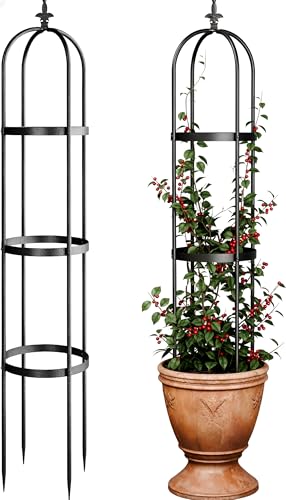
3. Idzo Garden Obelisk Trellis, 72 Inches, Steel with Stone Coating
An obelisk solves a different problem from a cage: it gives twining and scrambling vines a tall, narrow structure to climb in a bed or a large pot, and it keeps its shape as a garden feature even before the plant covers it. The Idzo obelisk stands about 72 inches tall and roughly 14 inches across, built from steel pipe with a hammered stone texture powder coating in black. Idzo rates the structure for vines up to 20 pounds and finishes the legs with spikes that push into the ground to hold the frame steady.
The stone coated finish is there for weather resistance, protecting the steel from rust and fading outdoors, and the ring joints connect without screws, so the obelisk assembles by pushing the sections together. Idzo lists it for clematis, climbing roses, jasmine, mandevilla and similar vines, and the tall, slim footprint works where a wide trellis panel would crowd a border. At just over five pounds, it is light enough to move between beds between seasons.
Who it is for: gardeners growing flowering vines in beds, borders or large containers who want a freestanding structure with a finished look. The limitation is capacity. A limit of 20 pounds suits flowering vines and light climbers, but it is not the frame for a heavy crop of cucumbers or a mature, woody vine, and the maker recommends staking it into the ground for the best stability, which matters in soft soil and open, windy spots.
4. K-Brands Plant Support Stakes, Half Round, 12 Pack, 10 by 16 Inches
Not every plant climbs. Peonies, hydrangeas and other bushy perennials grow outward, and their stems bow under the weight of wet blooms until the whole plant opens up and lies on the ground. Half round supports are built for exactly that habit. Each K-Brands support is a half circle ring on legs, 10 inches wide and 16 inches high, with a steel core and a green plastic coating that blends into foliage. The pack contains twelve supports, and K-Brands includes a roll of plant ties for gathering stems.
Two half rounds placed back to back form a full ring around a clump, or a single half round can brace a plant against a wall or fence. The rings work best when they go in early, while the plant is still compact, so the stems grow up through the ring and are held at the base. The coated steel construction is specified as rust resistant for outdoor use, and at 16 inches the supports stay mostly hidden inside the foliage they hold.
Who it is for: perennial growers tired of peonies and hydrangeas flopping after rain, and anyone supporting shorter bushy plants in borders and pots. The limitation is reach. Sixteen inches of height supports the base of a plant, not its full height, so tall perennials will still lean above the ring, and the half round shape needs a second piece or a wall behind it to give complete support to a freestanding clump.
5. K-Brands Cucumber Trellis, A-Frame, 50 by 50 Inches
Cucumbers, peas and beans climb by tendrils, and they produce best when the vines grow up a sloped surface with airflow underneath the fruit. This A-frame trellis from K-Brands, model CT5350, opens into two panels of about 50 by 50 inches joined at the top, sized to span a raised bed. The frame is powder coated steel, and the kit includes trellis netting, twist ties and zip ties, so the climbing surface and the fasteners arrive in the same box.
The powder coating protects the steel frame from rust outdoors, and the hinged A shape folds flat when the season ends, which makes storage simpler than a rigid panel of the same size. K-Brands lists the trellis for cucumbers, peas, green beans, squash, zucchini and other climbing vegetables, and the sloped panels let heavy fruit hang through the netting where it stays clean and easy to pick. Assembly is tool free, with the frame opening out and the netting clipped across the panels.
Who it is for: raised bed gardeners growing vining vegetables who want the crop lifted off the soil for cleaner fruit and easier picking. The limitations are footprint and handling. The frame needs a bed or a patch of ground wide enough for its 50 inch span, so it is not a container solution, and K-Brands warns that the product has sharp edges, so gloves are sensible during setup and takedown.
Comparison table
| Support | Type | Size | Material and finish | Pack | Best job |
|---|---|---|---|---|---|
| K-Brands Tomato Cage | Modular cage | Up to 68 in tall | Steel core, plastic coated | 3 cages | Tall indeterminate tomatoes |
| Panacea 89729 Cage | Cone cage | 42 in tall, 14 in across | Galvanized welded wire | 5 cages | Peppers and determinate tomatoes |
| Idzo Obelisk Trellis | Obelisk | About 72 in tall, 14 in across | Steel pipe, stone texture powder coat | 1 | Flowering vines in beds and pots |
| K-Brands Half Round Stakes | Half round ring | 10 in wide, 16 in high | Steel core, plastic coated | 12 supports | Peonies and bushy perennials |
| K-Brands A-Frame Trellis | A-frame panel | 50 by 50 in panels | Powder coated steel, with netting | 1 kit | Cucumbers, peas and beans in raised beds |
Frequently asked questions
When should I put plant supports in the ground?
At planting time, or while the plant is still small. A cage or ring placed early lets stems grow through it naturally. Adding a support after a plant has flopped means lifting and threading stems by hand, which breaks brittle growth and disturbs roots.
What is the difference between galvanized and coated steel supports?
Galvanized steel carries a zinc layer bonded to the metal, which slows rust even where the surface is scratched. Coated supports put a plastic or powder layer over a steel core, which adds a barrier against water and keeps the metal cooler against stems, but a deep chip in the coating can expose the core. Both are made for outdoor use; uncoated plain wire is the option that rusts fastest.
How tall a cage does a tomato plant need?
Match the cage to the type. Determinate tomatoes stop at a compact height and are well served by a cage around 42 inches, like the Panacea cone. Indeterminate types keep growing all season and commonly pass five feet, so they need a tall cage such as the 68 inch K-Brands, plus ties for the growth that extends past the top.
Can one support work for both vegetables and flowers?
Sometimes. A tall cage or obelisk will hold a tomato or a clematis, because both climb. But bushy flowers that lean outward, like peonies, need a ring at their base rather than a tall frame, and tendril climbers like peas need a net or panel with many grip points. Matching the support shape to the growth habit matters more than the plant category.
How do I keep a support from tipping over in wind?
Push the legs or base deep into firm soil, set the support before the plant is large enough to act as a sail, and choose a wide base or an A-frame shape for exposed beds. In very soft soil, an extra ground stake tied to the frame adds security for tall cages carrying heavy plants.
Conclusion
The best outdoor plant support is the one shaped like the plant it holds. Tall, adjustable cages such as the K-Brands 68 inch set suit indeterminate tomatoes that never stop growing, while the Panacea galvanized cone covers rows of compact peppers and determinate tomatoes with no assembly at all. The Idzo obelisk gives flowering vines a tall structure that looks deliberate in a border, the K-Brands half round rings quietly hold peonies and hydrangeas upright at the base, and the K-Brands A-frame lifts cucumbers and beans off the soil in a raised bed. Check the mature size of your plant, pick the finish that will live in your weather, and install the support early in the season, and each of these will still be doing its job when harvest arrives.