Key takeaways
- Looking for the best table saws for home woodworking? Compare five jobsite and portable saws by blade size, rip capacity, fence, and stand to find your fit.
A table saw is the centerpiece of most home woodshops, and choosing the right one shapes every project that follows, from bookshelves and cutting boards to cabinets and built-in storage. The best table saws for home woodworking balance cutting capacity with a footprint that fits a garage, a basement, or a shared workspace, and they do it without demanding a dedicated 240-volt circuit or a permanent floor position. This guide compares five saws that suit home use, focusing on blade size, motor strength, rip capacity, fence design, and how easily each saw moves and stores away when the work is done.
Every saw below is a jobsite or portable model with a stand included, which is the format that makes the most sense for a home shop: it can roll out of a corner, set up in a driveway or garage, and fold away when the project ends.
What to Look For in a Table Saw for Home Woodworking
Blade Size and Depth of Cut
Most home woodworking saws use either a 10-inch blade or an 8-1/4-inch blade. A 10-inch blade cuts deeper, typically around 3-1/8 inches at 90 degrees, which means it can cut through thick hardwood and 4×4 stock in a single pass when the saw is built for it. An 8-1/4-inch blade gives up some depth of cut, usually topping out near 2-1/2 inches, but the saw itself becomes smaller, lighter, and easier to store. If you mostly cut plywood, pine boards, and hardwood up to about two inches thick, an 8-1/4-inch saw handles that work in a much smaller package.
Motor Power
Nearly every jobsite table saw in this guide runs on a 15-amp universal motor that plugs into a standard household outlet, and it is enough for ripping hardwood, crosscutting plywood, and cutting joinery stock with a sharp blade. Worm-drive models use gearing to multiply torque at the blade, which helps when the cut gets demanding. What matters more than the headline motor figure is how the saw behaves under load: a motor that holds its speed through a long rip in maple produces a cleaner edge than one that bogs down and burns the wood.
Rip Capacity
Rip capacity is the distance from the blade to the fence at its widest setting, and it decides whether you can rip a sheet of plywood in half. A full sheet is 48 inches wide, so ripping it in half calls for at least 24 inches of capacity, and more is better. Saws in this guide range from about 24-1/2 inches to 32-1/2 inches of rip capacity. The wider end of that range lets you break down sheet goods with fewer passes and less wrestling, which is a real advantage when you work alone in a small shop. Telescoping fence rails extend the capacity when you need it and retract for storage.
The Fence
The rip fence is the part of a table saw you touch on every cut, and a fence that locks parallel to the blade every time is the difference between accurate work and constant frustration. Rack-and-pinion fences move on a geared mechanism and stay parallel as they travel, which makes them easier to set precisely than a fence that clamps at the front only. Bosch uses its own SquareLock fence design, which clamps at the front and locks square to the blade. Whichever system a saw uses, check that the fence locks firmly without flexing and that it can flip over or shift for narrow rip cuts close to the blade.
Stand and Portability
A home shop saw needs to move. Rolling stands with wheels let you roll the saw out to work and back into a corner for storage, while folding stands collapse flat against a wall. Weight matters here: a saw and stand combination can weigh anywhere from roughly 45 pounds to more than 110 pounds, and that difference decides whether one person can load it into a vehicle or carry it up a step. Larger wheels roll more easily over a driveway or a rough garage floor. On-board storage for the fence, miter gauge, push stick, and blade wrenches keeps the accessories with the saw instead of scattered across the shop.
Safety Features
Every saw in this guide ships with a blade guard, a riving knife, and anti-kickback pawls. The blade guard covers the spinning blade above the table, the riving knife sits behind the blade and keeps the kerf open so the workpiece cannot pinch the blade and kick back, and the pawls add a second layer of protection against the board coming back toward you. Use all three whenever the cut allows it. Restart protection, available on some models, prevents the saw from starting on its own if power is interrupted and then restored.
Top Picks
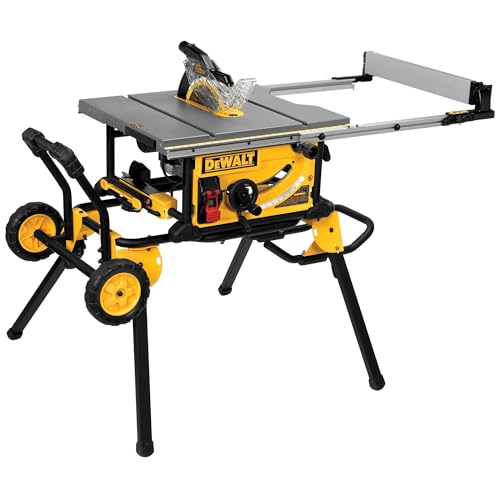
1. DEWALT DWE7491RS 10-Inch Table Saw with Rolling Stand
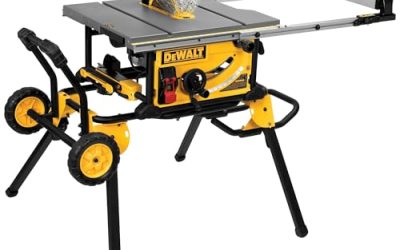
The DEWALT DWE7491RS is the strongest all-round choice in this guide for a home woodworker who wants full-size cutting capacity in a saw that still rolls away for storage. Its 10-inch blade and 15-amp motor run at 4,800 revolutions per minute, and the published depth of cut is 3-1/8 inches at 90 degrees and 2-1/4 inches at 45 degrees, which covers thick hardwood, dimensional lumber, and sheet goods without a second pass. The defining feature is the 32-1/2-inch rip capacity to the right of the blade, the widest in this guide, which lets a single person rip a full sheet of plywood in half with the fence in its outer position.
The rack-and-pinion telescoping fence is the other reason this saw earns the top spot. It moves smoothly on geared rails and locks parallel to the blade, so repeat cuts stay consistent without constant measuring and tapping the fence into square. The fence flips over for narrow rip cuts, which helps when you are cutting thin strips for edge banding or trim. The rolling stand folds for transport and locks solid for use, and the saw with the stand weighs 110 pounds according to the Amazon listing, so it is a two-hand roll rather than a carry, but the large wheels make moving it across a garage floor straightforward.
On-board storage keeps the blade guard assembly, fence, riving knife, miter gauge, wrenches, and push stick with the saw. The included 10-inch 24-tooth carbide blade suits general ripping and crosscutting, and a finer-tooth blade can be fitted for plywood and veneer work. A 2-1/2-inch dust collection port connects to a standard shop vacuum.
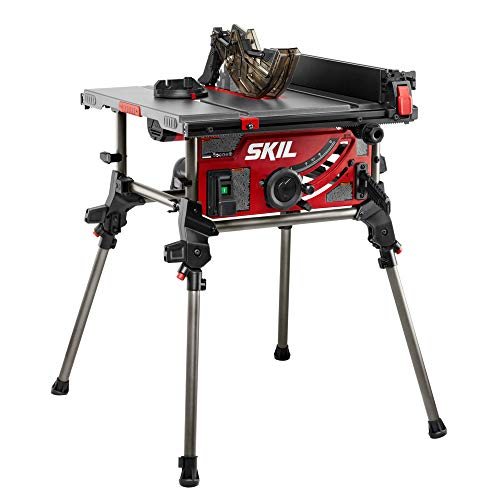
2. SKIL TS6307-00 15 Amp 10-Inch Portable Jobsite Table Saw with Folding Stand
The SKIL TS6307-00 is the value pick in this guide, covering the core jobsite saw formula, a 10-inch blade, a 15-amp motor, a rack-and-pinion fence, and a folding stand, in a package aimed squarely at home woodworkers and DIY builders. Its 10-inch blade runs at 4,600 revolutions per minute, and the published depth of cut is 3-1/2 inches at 90 degrees and 2-1/2 inches at 45 degrees, so it can cut 4×4 stock in a single pass. The rip capacity is 25-1/2 inches to the right of the blade, which handles most furniture parts, drawer boxes, shelving, and trim work.
The rack-and-pinion fence is the standout feature at this level. It adjusts with a geared mechanism that keeps the fence parallel to the blade, which is the kind of fence behavior that usually appears on more expensive saws. The folding stand sets up quickly and collapses for storage against a wall, and the whole saw is lighter and more compact than the rolling-stand models in this guide, which makes it easier to carry to a jobsite or out to a driveway for a dusty cut.
A separate dado insert plate is available for this model, so woodworkers who want to cut dadoes and grooves can add that capability with the matching accessory. The saw includes a blade guard, riving knife, and anti-kickback pawls. For a first table saw in a home shop, or for a woodworker who wants full 10-inch cutting capacity without a large footprint, the TS6307-00 is the most accessible entry point in this guide.
3. DEWALT DWE7485 8-1/4-Inch Compact Portable Jobsite Table Saw

The DEWALT DWE7485 is the compact pick in this guide, designed for woodworkers who need a real table saw that fits in a small shop, a vehicle, or a shared workspace. Its 8-1/4-inch blade runs on a 15-amp motor at 5,800 revolutions per minute, and the published rip capacity is 24-1/2 inches, which is enough to rip a sheet of plywood in half. The bevel range runs from minus 2 degrees to 48 degrees, giving a little extra range past the usual 45 degrees for angled cuts and trim work. The published depth of cut is 2-9/16 inches at 90 degrees and 1-3/4 inches at 45 degrees.
The compact size is the point of this saw. It is small enough to sit on a workbench or a pair of sawhorses, and light enough to carry with one hand to a jobsite or out to the driveway. The rack-and-pinion telescoping fence carries over from the larger DEWALT jobsite saws, so fence adjustments stay smooth and parallel despite the smaller table. On-board storage keeps the fence and accessories with the saw.
The trade-off for the compact size is depth of cut. An 8-1/4-inch blade cannot cut as deep as a 10-inch blade, so thick slabs and 4×4 stock will need a different approach, such as cutting from both sides or using a bandsaw. For plywood, pine, hardwood up to about two inches thick, trim, and small furniture parts, the DWE7485 has the capacity a home woodworker uses most often, in the smallest package in this guide.
4. Bosch 4100XC-10 10-Inch Worksite Table Saw with Gravity-Rise Wheeled Stand
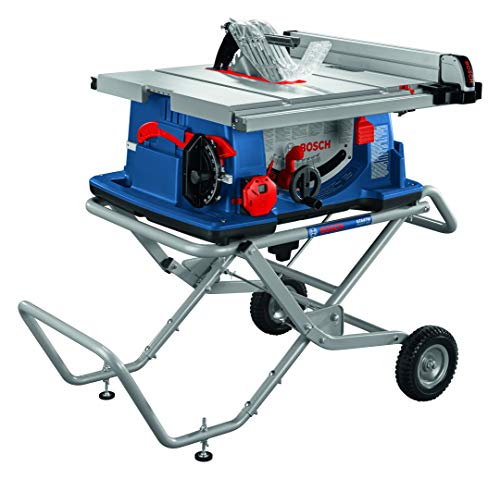
The Bosch 4100XC-10 is the premium jobsite saw in this guide, built around a 10-inch blade, a 15-amp motor that delivers up to 4.0 maximum horsepower, and a blade speed of 3,650 revolutions per minute. Its published rip capacity is 30 inches to the right of the blade, on a 30-inch by 22-1/2-inch tabletop, which handles full sheets and wide cabinet parts with room to spare. The depth of cut is 3-1/8 inches at 90 degrees and 2-1/2 inches at 45 degrees.
The Gravity-Rise wheeled stand is what sets this saw apart in daily use. It unfolds and folds with a single action, and the large treaded wheels make the saw easy to roll across a driveway or a rough floor. The saw itself weighs 58 pounds without the stand and 94 pounds with it, so the stand does the heavy lifting in every move. The SquareLock rip fence is designed to stay parallel to the blade, and an auxiliary fence is included for narrow workpieces.
Bosch adds several features aimed at smooth, controlled operation. Soft-start circuitry ramps the motor up gradually, Constant Response circuitry helps the saw maintain speed under load, and restart protection prevents the saw from starting unexpectedly after a power interruption. The Smart Guard system includes the blade guard, riving knife, and anti-kickback pawls.
5. SKIL SPT99T-01 8-1/4-Inch Portable Worm Drive Table Saw
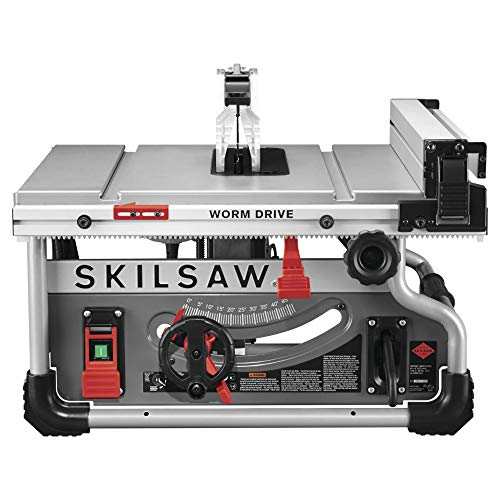
The SKIL SPT99T-01 takes a different approach from the direct-drive saws in this guide. It uses a worm-drive gear system, the same kind of gearing found in worm-drive circular saws, to deliver high torque at the blade from a compact motor. That gearing gives the saw a reputation for steady, powerful cutting in dense material, and it suits a home woodworker who cuts a lot of hardwood and thick stock. The motor is rated at 15 amps with a no-load speed of 5,300 revolutions per minute.
The saw uses an 8-1/4-inch blade and has a 25-inch rip capacity, which covers ripping a sheet of plywood in half and handling wide boards and panels. The published depth of cut is 2-5/8 inches at 90 degrees and 1-7/8 inches at 45 degrees. It rides on an integrated rolling stand with large wheels, so it moves around a garage or a jobsite without being lifted. The table is sized for portability rather than for cabinet-scale work, which keeps the whole package compact enough to store in a corner or load into a vehicle.
Worm-drive saws have a distinct feel: the motor sits behind the blade with the gearing between them, which shifts the weight distribution and gives the saw a solid, planted feel during a cut. A precision rack-and-pinion fence keeps adjustments accurate. The SPT99T-01 suits a woodworker who values torque and a rugged build over maximum depth of cut, and who wants a saw that can move between the home shop and a jobsite without fuss.
Comparison at a Glance
| Saw | Blade Size | Motor | Rip Capacity | Depth of Cut at 90 Degrees | Stand |
|---|---|---|---|---|---|
| DEWALT DWE7491RS | 10 inches | 15 amp | 32-1/2 inches | 3-1/8 inches | Rolling stand |
| SKIL TS6307-00 | 10 inches | 15 amp | 25-1/2 inches | 3-1/2 inches | Folding stand |
| DEWALT DWE7485 | 8-1/4 inches | 15 amp | 24-1/2 inches | 2-9/16 inches | Benchtop, compact |
| Bosch 4100XC-10 | 10 inches | 15 amp, 4.0 max HP | 30 inches | 3-1/8 inches | Gravity-Rise wheeled stand |
| SKIL SPT99T-01 | 8-1/4 inches | 15 amp, worm drive | 25 inches | 2-5/8 inches | Rolling stand |
Frequently Asked Questions
What size table saw is best for home woodworking?
For most home shops, a 10-inch jobsite saw with a 15-amp motor is the most versatile choice, because it cuts deep enough for thick hardwood and rips wide enough for sheet goods. An 8-1/4-inch saw is a good fit when space and portability matter more than depth of cut, for example in a small garage or a saw that travels to jobsites. Either size handles plywood, pine, and hardwood up to about two inches thick, which covers most home projects.
Can a jobsite table saw handle full sheets of plywood?
A jobsite saw with at least 24 inches of rip capacity can rip a full 48-inch sheet in half, and the saws in this guide range from 24-1/2 inches to 32-1/2 inches. Wider rip capacity makes sheet work easier, especially when you work alone. A roller stand or an outfeed support behind the saw helps keep a long sheet level as it passes the blade.
Do I need a dado stack for home woodworking?
A dado stack is useful for cutting grooves for shelves, drawer bottoms, and box joints, but it is not essential for every home woodworker. Many joints can be cut with a router, a single blade with multiple passes, or a different joint design entirely. If dado work is part of your plans, choose a saw that accepts a stacked dado set and buy the matching throat plate, since the standard plate will not fit a wider dado stack.
How much space do I need around a table saw?
Allow enough room to feed a full sheet or a long board through the saw, which means clear space in front of the saw and behind it, plus room to stand at the side to guide the workpiece. A rolling or folding stand helps because you can move the saw into the middle of a garage for a big cut and push it back into a corner afterward. Keep the floor clear of offcuts and cords, and keep the area around the saw free of anything that could catch a board as it moves through the cut.
Conclusion
The best table saws for home woodworking are the ones that fit your space, your projects, and the way you work. The DEWALT DWE7491RS covers the widest range of work with its 10-inch blade and 32-1/2-inch rip capacity, making it the strongest all-round choice for a home shop that handles sheet goods and furniture parts. The SKIL TS6307-00 brings the same 10-inch cutting capacity in a lighter, more accessible package. The DEWALT DWE7485 fits the smallest shops and the most portable setups, while the Bosch 4100XC-10 adds the most refined stand and control features of any jobsite saw in this guide. The SKIL SPT99T-01 brings worm-drive torque for woodworkers who cut a lot of dense hardwood. Pick the saw whose blade size, rip capacity, and stand match the work you actually do, keep the blade sharp, and use the guard and riving knife.
Disclosure: As an Amazon Associate, netflixus.co earns from qualifying purchases made through links on this page.