Key takeaways
- Find the best table saws for furniture making and woodwork, with steady fences, clean cuts, and shop-ready power for cabinets, tables, and joinery.
Introduction
A table saw sits at the center of most furniture shops for a simple reason. Almost every piece of furniture starts with straight, square stock, and the table saw is the tool that turns rough boards and sheet goods into parts that fit together cleanly. When the fence holds its setting, the blade runs true, and the table gives solid support, glue joints close without gaps, drawer parts slide without binding, and cabinet carcasses come out square.
Furniture making asks more from a table saw than rough carpentry does. A fence that drifts by a small amount over a long rip can leave a visible gap in a tabletop glue-up. A table that flexes under a heavy board can change the cut halfway through. The saws in this guide were chosen for the work furniture makers actually do: ripping hardwood to width, cutting panels to size, shaping parts with bevels, and repeating the same cut many times with the same result.
This guide covers three table saws that suit furniture making and woodwork in different kinds of shops. One is a full-size jobsite saw on a rolling stand that moves easily around a garage shop. One is a portable saw with a folding stand that suits a small shop or a shared space. One is a worksite saw with a gravity-rise stand and a fence system built to stay parallel to the blade. Each one is a 10-inch saw with a 15-amp motor, a useful baseline for furniture work, because that combination handles hardwood rips and sheet goods without feeling underpowered for everyday parts.
The right saw is the one that matches the work, the space, and the way you like to work.
How to Choose a Table Saw for Furniture Making
Furniture work rewards accuracy, repeatability, and control. The points below are the ones that matter most when the finished piece will be seen and used every day.
Rip capacity and table size. Rip capacity is the distance from the blade to the fence at its widest setting, and it decides how wide a board or panel you can rip in one pass. For furniture work, a rip capacity of 25 inches or more covers most cabinet parts and table components, while a wider capacity helps with panels and wide tabletops. Table size matters just as much. A larger table supports long boards before and after the blade, which keeps the cut straight and the work under control. Look for a stand that adds support at the back of the saw, where a long board needs it most.
Fence quality. The rip fence is the single most important accuracy feature on a table saw. A good fence locks parallel to the blade every time, without needing to be tapped into place or checked with a square on every cut. Rack-and-pinion fences move smoothly and hold their setting, which is why they appear on all three saws in this guide. A fence with an auxiliary face for narrow work helps when ripping thin strips for edge banding, drawer dividers, or trim. Before you settle on a saw, check how the fence feels: it should slide without sticking, lock without shifting, and stay put when you push a board against it.
Motor power and blade speed. Furniture makers cut hardwoods such as oak, maple, and walnut, and those woods ask for steady power. A 15-amp motor is the standard for saws in this class, and it handles most furniture stock when paired with a sharp blade suited to the cut. Blade speed also matters, because a blade that holds its speed under load leaves a cleaner edge with less burning. Soft-start circuitry, which brings the blade up to speed smoothly instead of jerking at startup, is a welcome feature on a saw that will be switched on and off many times in a working day.
Cutting depth and bevel range. A 10-inch blade cuts through stock thick enough for most furniture parts, including table legs, aprons, and cabinet frames. Check the maximum depth of cut at 90 degrees and at 45 degrees, because bevel cuts for chair parts, edge details, and angled joinery need enough depth at an angle. A bevel range that runs from slightly below zero to 45 degrees or more gives room for fine adjustment when a joint needs a small correction.
Safety features. A blade guard, a riving knife, and anti-kickback pawls are not extras on a furniture saw. They are part of the machine, and they should be easy to fit, adjust, and remove when the cut calls for it. A riving knife that moves with the blade keeps the kerf open behind the cut and helps prevent the board from pinching the blade. Restart protection, which stops the saw from starting again on its own after a power interruption, is another feature worth having in a busy shop. Choose a saw whose safety parts you will actually use, because the best guard is the one that stays on the saw.
Dust collection and storage. A saw with a dust port that connects to a shop vacuum or a dust collector keeps the table clear, and a clear table helps accuracy, because dust under a board can lift it slightly and change the cut. Some makers have a dedicated shop where the saw stays in one place. Others work in a garage or a shared space where the saw must fold away after each session. A rolling or folding stand makes a real difference in those shops.
Top Picks
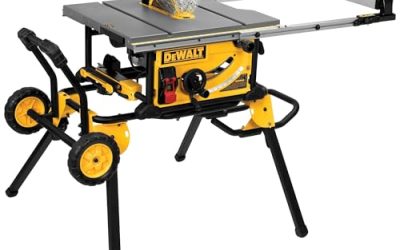
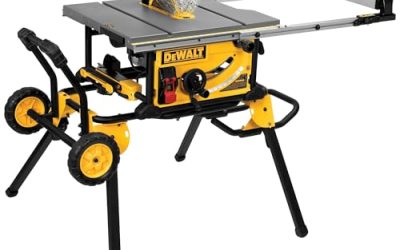
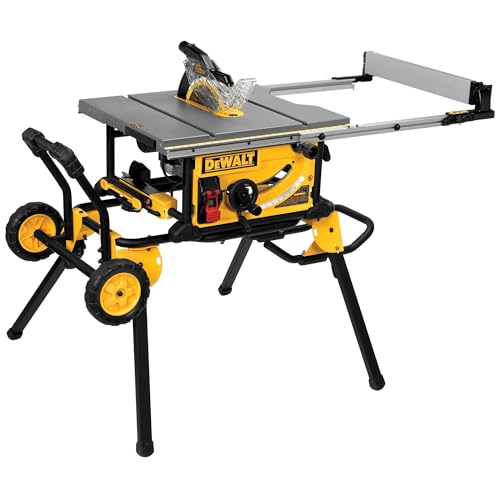
1. DEWALT DWE7491RS 10-Inch Table Saw with Rolling Stand
The DEWALT DWE7491RS is a 10-inch table saw with a 15-amp motor that runs at 4800 RPM, and it comes mounted on a rolling stand that folds for transport and storage. Its rip capacity of 32-1/2 inches is the widest in this guide, which makes it a strong choice for ripping wide boards and cutting sheet goods for cabinets and tabletops. The rack-and-pinion telescoping fence moves smoothly and locks in place, so repeat cuts stay consistent across a run of identical parts, such as the stiles and rails of a set of cabinet doors.
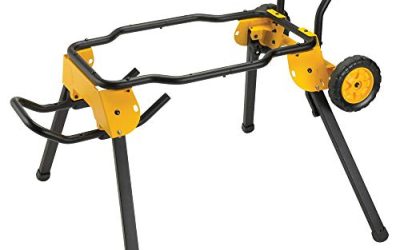
For furniture making, the wide rip capacity is the headline feature, but the stand matters almost as much. The rolling stand lets the saw move from a storage corner to the center of the shop, where long boards have room on both sides, and then fold away again when the session ends. Onboard storage keeps the fence, the blade guard, and the small parts with the saw instead of scattered around the shop. The 15-amp motor and the 4800 RPM blade speed suit hardwood rips, and the 10-inch blade gives enough depth for the thick stock used in table legs and aprons.
This saw suits a furniture maker who works in a garage or a small shop and needs full-size cutting capacity without a permanent cabinet saw footprint. It handles the long rips for a dining table and the panel work for a bookcase, and it stores out of the way between sessions.
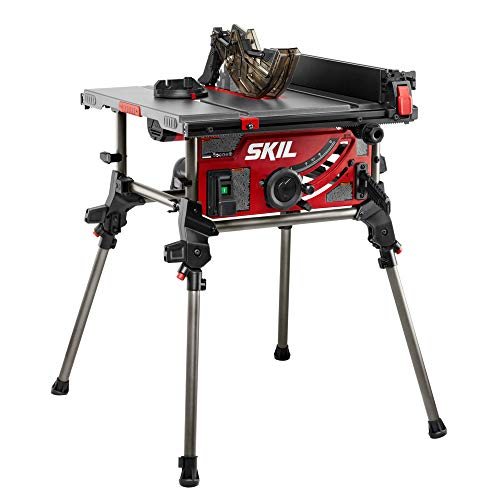
2. SKIL TS6307-00 15 Amp 10-Inch Portable Jobsite Table Saw with Folding Stand
The SKIL TS6307-00 is a 15-amp, 10-inch portable jobsite table saw with a folding stand, and it is the most compact saw in this guide. Its rack-and-pinion fence system gives the kind of smooth, controlled fence movement that furniture work depends on, and the folding stand sets up quickly and folds flat for storage against a wall or in a closet. For a maker starting out, or for a shop where floor space is tight, that combination of a full 10-inch blade and a stand that disappears after use is a practical answer.
The saw suits the core tasks of furniture making: ripping boards to width for shelves and drawer parts, cutting panels for cabinet carcasses, and making bevel cuts for trim and edge details. The 15-amp motor gives the power needed for hardwood, and the portable format means the saw can be carried to a project site or set up outdoors when a long board needs more room than the shop allows. A version of this saw is listed with a dado insert plate, which is useful for makers who cut grooves for drawer bottoms and shelf joints, and the folding stand keeps the whole package easy to move and store.
Choose this saw if your shop is small, if you share the space with other uses, or if you want a capable 10-inch saw at the compact end of the range. It is a good fit for first furniture projects and for garage shops. Pair it with a sharp blade suited to the wood in hand, and it will handle the straight, square cuts that furniture joinery depends on.
3. Bosch 4100XC-10 10-Inch Worksite Table Saw with Gravity-Rise Wheeled Stand
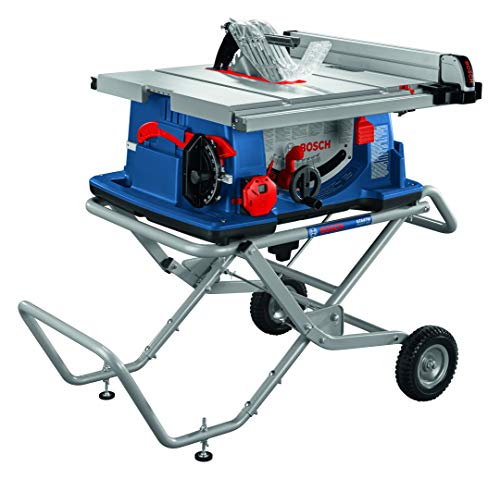
The Bosch 4100XC-10 is a 10-inch worksite table saw with a 15-amp motor that delivers up to 4 horsepower and a blade speed of 3650 RPM. It comes with the GTA47W Gravity-Rise wheeled stand, which folds and unfolds with a single action and lets the saw roll to wherever the work is. The table measures 30 inches by 22-1/2 inches, and the rip capacity is 30 inches to the right of the blade, which covers wide panels and long rips for tabletops and cabinet sides.
The fence on this saw is the SquareLock rip fence, designed to stay parallel to the blade, with an auxiliary fence for narrow workpieces. That matters for furniture work, because narrow strips for edge banding, inlay, and trim need a fence that holds a fine setting without drifting. The saw includes the Smart Guard System, a miter gauge, a push stick, and a 10-inch carbide-tipped blade, so the parts needed for safe, accurate work arrive with the machine. Soft-start circuitry brings the motor up smoothly, Constant Response circuitry helps the saw hold its speed under load, and restart protection stops the saw from starting again after a power interruption.
Cutting depth is 3-1/8 inches at 90 degrees and 2-1/2 inches at 45 degrees, with a bevel range from minus 2 degrees to 47 degrees, which gives room for angled cuts and fine adjustments. The saw itself weighs 58 pounds without the stand and 94 pounds with the stand fitted, which is a useful balance between stability during a cut and mobility around the shop. This saw suits a furniture maker who wants a worksite saw with a fence that stays true, a stand that sets up in one motion, and the power to rip hardwood through long working days. It is a strong choice for cabinet work and for panel cutting.
Comparison Table
| Product | Key Feature | Best For |
|---|---|---|
| DEWALT DWE7491RS | 10-inch blade, 15-amp motor at 4800 RPM, 32-1/2-inch rip capacity, rolling stand | Wide rips and sheet goods in a garage or small shop |
| SKIL TS6307-00 | 15-amp 10-inch portable saw, rack-and-pinion fence, folding stand | Compact shops, first furniture projects, and easy storage |
| Bosch 4100XC-10 | 15-amp motor up to 4 HP, 3650 RPM, 30-inch rip capacity, SquareLock fence, Gravity-Rise stand | Cabinet work and panel cutting with a fence that stays parallel |
Buying Guide
Start with the work, not the machine. List the furniture you plan to build in the next year. If the list is full of cabinets, the fence and the rip capacity matter most. If the list is full of tables, table support and cutting depth matter most. If the list is full of small pieces, such as boxes, stools, and side tables, a compact saw with a good fence may be all you need.
Check the fence before anything else. A fence that locks parallel to the blade, every time, is worth more than any other feature on the saw. When you can, move the fence through its full range, lock it at several settings, and check that it does not shift when you press a board against it. A fence that needs tapping into place on every cut will slow the work and add small errors that show up in glue joints and drawer fits. Rack-and-pinion fences, fitted to all three saws in this guide, are a good sign, because the gear drive keeps the movement smooth and the setting steady.
Match the blade to the cut. The blade that arrives with a saw is a starting point, not a lifetime choice. A rip blade with fewer teeth clears waste quickly on long rips through hardwood. A crosscut blade with more teeth leaves a cleaner edge across the grain for visible parts. A combination blade suits general work when you change between rip and crosscut tasks in the same session. Keep blades sharp and clean, because a dull blade burns hardwood, strains the motor, and pushes the board away from the fence. Change the blade for the task, and the same saw will cut like a different machine.
Keep the saw tuned. Check that the blade is parallel to the miter slots, that the fence is parallel to the blade, and that the bevel stops read true at 90 degrees and 45 degrees. Clean the table top so boards slide freely. A saw that is checked and cleaned regularly will cut square for years. Wear hearing protection and eye protection on every cut, and keep push sticks within reach so your hands stay clear of the blade.
Frequently Asked Questions
What size table saw is best for furniture making?
A 10-inch table saw with a 15-amp motor suits most furniture work. The 10-inch blade cuts through stock thick enough for table legs, aprons, and cabinet frames, and the 15-amp motor handles hardwood rips and sheet goods. Rip capacity matters as much as blade size: a capacity of 25 inches or more covers most cabinet parts, while 30 inches or more helps with wide panels and tabletops. The three saws in this guide are all 10-inch, 15-amp saws, and they differ mainly in rip capacity, fence design, and stand.
Do I need a cabinet saw for furniture, or will a jobsite saw do?
A jobsite or worksite saw handles most furniture projects well, including cabinets, tables, chairs, and bookcases, when the fence is accurate and the blade is sharp. A cabinet saw adds mass, stability, and power for heavy daily use and for very thick hardwood, and it suits a dedicated shop where the saw stays in one place. For a garage shop or a small shop, a jobsite saw with a good fence and a solid stand is a practical choice.
How important is the rip fence for furniture work?
The rip fence is the most important accuracy feature on the saw. Furniture joinery depends on parts that are the same width, cut after cut, and a fence that locks parallel to the blade makes that possible. A fence that drifts, flexes, or needs adjustment on every cut will leave gaps in glue joints and drawers that bind. Look for a fence that moves smoothly, locks without shifting, and stays parallel to the blade across its full range.
Can a portable table saw cut hardwood for furniture?
Yes, a 15-amp portable saw cuts hardwood for furniture when fitted with a sharp blade suited to the cut. Feed the board at a steady pace, let the blade do the work, and do not force the board through the cut. Thick hardwood may need a slower feed and a rip blade with fewer teeth.
Conclusion
The best table saw for furniture making and woodwork is the one that cuts straight, holds its settings, and fits the shop where the work happens. The DEWALT DWE7491RS gives the widest rip capacity in this guide and a rolling stand that suits a garage shop with full-size projects. The SKIL TS6307-00 gives a compact, portable saw with a folding stand for small shops and first furniture projects. The Bosch 4100XC-10 gives a worksite saw with a SquareLock fence, a Gravity-Rise stand, and the power to rip hardwood through long working days.
Choose the saw that matches your projects and your space, fit a sharp blade suited to the wood, check the fence and the blade alignment, and keep the safety parts in place. Straight, square parts make every later step easier, from glue-up to finishing, and a good table saw is the tool that makes those parts possible. With the right saw and steady habits, the furniture that leaves the shop will fit together cleanly and stand up to daily use for years.
Disclosure: As an Amazon Associate, we earn from qualifying purchases.