Key takeaways
- Compare five rugged mobile label printers with thermal-transfer ribbon support, drop-resistant housings and handheld designs built for jobsite labeling.
A label that peels off a breaker panel or fades on an outdoor junction box is worse than no label at all, because the next technician trusts it. The real decision here is twofold: the print has to be thermal transfer, so the image sits in a resin ribbon layer that resists abrasion, solvents and sunlight, and the printer body has to survive the same drops, dust and truck-bed rides as the crew carrying it.
This guide serves electrical and datacom installers labeling panels and ports, facilities teams marking pipes and assets, and cabling crews who need heat-shrink tube markers on site. Every pick below is a handheld thermal-transfer printer sold as a mobile unit, chosen from the name, stated print method, tape width and rugged traits on its Amazon product page, so the comparison rests on what each listing actually claims rather than on brochure language.
Quick Picks
As an Amazon Associate we earn from qualifying purchases
| Product | Best for | Key spec from title |
|---|---|---|
| Epson LabelWorks LW-PX900PCD Industrial Label Maker Kit | High-volume crews printing wide labels and heat-shrink tubes | 36 mm max tape width, 360 dpi |
| DYMO Rhino 5200 Kit | Panel and port labeling with a standalone keyboard | Hard case and two vinyl tape rolls included |
| Brady M211 Portable Bluetooth Label Printer | Phone-first techs who need the toughest small body | 6-foot drop and 250-lb crush resistance |
| DYMO Rhino 4200 | Standalone labeling with hot-key shortcuts and no phone | QWERTY keyboard, tapes from 6 to 19 mm |
| Brother P-touch EDGE PT-E560BTVP | Heat-shrink and laminated tapes with Bluetooth design | Tape widths from 3.5 to 24 mm |
How to Choose
Confirm the print method before anything else
Start with the print method, because it decides how long the label stays readable. Thermal-transfer printing melts ink from a ribbon into the tape surface, and the listings here state that method or name a thermal wax and resin consumable. Direct-thermal labels, by contrast, darken with heat and fade under sunlight, friction and solvents, which is why warehouse shipping printers are the wrong tool for panel and asset work. If a listing does not state thermal transfer, treat the printer as out of scope for jobsite labeling.
Match tape width and cartridge family to the work
Tape width limits what a printer can say. The handhelds here top out at 0.75 inch or 19 mm, while the Epson reaches 36 mm for panel schedules and larger equipment plates, and the Brother spans 3.5 to 24 mm across laminated, heat-shrink and stencil stock. Just as important, every system is locked to its maker’s cartridges: DYMO Rhino tapes, Brady M21, Epson PX and Brother TZe families do not interchange. Check the tape types you will actually consume, in the widths you need, before committing to a body.
Decide between a built-in keyboard and a phone app
Standalone models with their own keyboard and screen, like both Rhino units and the Epson, work with gloves on, in dead zones and on sites where phones stay in the truck. App-driven models such as the Brady M211 and the Brother shift design to a phone, which gives richer layouts and easier text entry but adds a second device, a charged battery and an app account to every job. Neither path is better in the abstract; match it to whether your crew labels at a panel all day or designs in batches.
Weigh the rugged evidence, not the rugged wording
Every listing in this class calls itself tough, so compare the stated evidence instead. The Brady M211 publishes concrete figures: resistance to 6-foot drops, 250-pound crushes and military-grade shock testing. The Epson kit leans on a hard case and industrial housing, while the Brother lists only a hand strap and utility ring, with no drop height at all. Then weigh size against protection: the 7-pound Epson kit survives by being cased, while the 1.44-pound M211 survives on a belt. Choose the evidence level your site actually dishes out.
The 5 Best Options
Epson LabelWorks LW-PX900PCD Industrial Label Maker Kit

Crews who label all day and need the widest output in this group will land here. The LW-PX900PCD prints at 360 dpi and up to 35 mm per second, takes PX tapes up to 36 mm wide, and handles heat-shrink tube stock alongside standard industrial cartridges, which suits panel schedules, pipe markers and cable identification from one machine. The kit arrives as a complete field package with battery, AC adapter, a starter tape cartridge, software and a hard case. The trade-off is bulk: at seven pounds for the kit, it lives in a case rather than on a belt.
Specs
- Print method: Thermal transfer
- Resolution: 360 dpi
- Maximum print speed: 35 mm/s
- Cutter: Automatic, with half-cut and full-cut function
- Maximum media size: 1.4173 inches (36 mm class PX tapes)
- Included: AC adapter, lithium-ion battery, 212VTBWPX tape cartridge, USB cable, Label Editor software, guide, magnetic attachments, black industrial hard case
- Item weight: 7 pounds (kit)
- Model number: C52CE97010
Best for: High-volume field crews printing the widest labels in this lineup, up to 36 mm, plus heat-shrink tubes, who want the highest resolution and fastest print speed of the five.
Watch out for: Heaviest kit here at 7 pounds per the listing, and the Label Editor software is Windows-only per maker materials; PX tape cartridges only, with no cross-brand tape compatibility.
DYMO Rhino 5200 Kit

The Rhino 5200 Kit is the established standalone choice for electrical and datacom work. It is built around ANSI and TIA/EIA 606-A labeling standards, prints Code 39 and Code 128 barcodes, and stores up to 100 labels in memory, with a library of more than 100 industry symbols. The kit bundles a durable carrying case and two rolls of 3/4-inch industrial vinyl tape, so it is ready for panel and port work out of the box. There is no phone or PC design path; everything happens on the unit’s own keyboard and screen.
Specs
- Print method: Thermal transfer
- Kit contents: Durable carrying case and 2 rolls of DYMO industrial vinyl labels (3/4 in)
- Barcodes: Code 39 and Code 128
- Symbol library: 100+ industry symbols, fractions and punctuation marks
- Memory: 100 labels
- Power: Rechargeable lithium polymer battery or AC adapter
- Resolution: not stated
- Model number: 1756589
Best for: Electrical and datacom crews who want a proven standalone keyboard handheld with ANSI/TIA-606-A panel-labeling features, a hard case and starter vinyl tapes in the box.
Watch out for: The oldest design in the lineup, first listed in 2009, with no wireless or PC design path; confirm the selected offer is the kit variant with case and battery, not the printer-only listing.
Brady M211 Portable Bluetooth Label Printer

The M211 takes the opposite design path from the keyboard models: there is no onboard designer at all, and every label is built in the Brady Express Labels app on a phone, then sent over Bluetooth. In exchange it is the smallest body here at 1.44 pounds and carries the strongest stated abuse ratings, with resistance to 6-foot drops, 250-pound crushes and military-grade shock. Output is narrower, topping out at 0.75-inch media from the M21 cartridge family, and a full charge is rated for up to 300 labels.
Specs
- Print method: Thermal transfer
- Resolution: 203 dpi
- Maximum media size: 0.75 inch; M21 cartridge series
- Connectivity: Bluetooth; Android and iOS smartphones
- Drop resistance: 6 feet
- Crush resistance: 250 pounds
- Shock resistance: MIL-STD-810G
- Battery: Lithium-ion (included); up to 300 labels per full charge
- Included: M211 printer, M21-750-499 label cartridge, quick start guide, AC adapter
- Item weight: 1.44 pounds
Best for: Phone-first field technicians who want the strongest drop and crush ratings in the lineup in the smallest, wearable body.
Watch out for: No onboard keyboard or screen-based designer, so a phone or tablet with the Express Labels app is required for every label; the media ceiling is 0.75 inch and M21 cartridges only.
DYMO Rhino 4200

The Rhino 4200 keeps the standalone formula lighter and simpler. Its familiar QWERTY keyboard and job-specific hot keys shortcut wire and cable wraps, flags and fixed-length labels, and a Favorites key stores the labels, symbols and terms a crew reaches for most. At 1.19 pounds it is the lightest keyboard model here, and it runs on six AA batteries or an optional rechargeable pack. The cutter is manual and there is no PC connection on the base unit, so it suits crews who value speed at the panel over design features.
Specs
- Print method: Thermal transfer
- Keyboard: QWERTY, with hot keys for wire and cable wraps, flags and fixed-length labels
- Library: Over 150 symbols and terms; Favorites key for stored labels, symbols and terms
- Tape widths: 6 to 19 mm
- Cutter: Manual
- Power: 6 AA batteries (included) or rechargeable lithium-ion
- Resolution: not stated
- Item weight: 1.19 pounds
- Model number: 1801611
Best for: Electricians who want a light standalone QWERTY handheld with job-specific hot keys and no phone or PC in the workflow.
Watch out for: Manual cutter and no PC connectivity on the base unit, and the availability signals for this model are the oldest of the keyboard picks, so confirm the live offer before ordering.
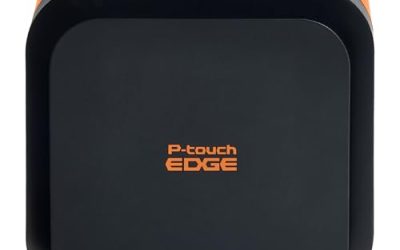
Brother P-touch EDGE PT-E560BTVP

The PT-E560BTVP is the cabling specialist of the five. Its laminating thermal-transfer engine works across the widest media families here, including laminated tapes, heat-shrink tubes and stencil stock from 3.5 to 24 mm, and a dual auto-cutter handles full and half cuts. Labels are designed over Bluetooth 5.0 or USB-C from a phone or PC. The honest caveat is toughness: the maker’s own datasheet lists drop protection only as a hand strap and utility ring, with no published drop height, so treat it as a protected handheld rather than a rated one.
Specs
- Print method: Laminating thermal transfer
- Media: HGe and TZe laminated tapes, HSe heat-shrink tubes, STe stencil; 3.5 to 24 mm widths
- Resolution: 180 dpi
- Print speed: Up to about 30 mm/s on AC power
- Connectivity: Bluetooth 5.0 and USB-C
- Cutter: Dual auto-cutter, full and half cut
- Kit configuration: Printer, lithium-ion battery, hand strap, case and tape cassettes
- Drop protection: Hand strap and utility ring; no drop-height rating published
Best for: Cabling crews who want heat-shrink tube printing and laminated tapes in one handheld, with label design over Bluetooth from a phone or PC.
Watch out for: The rugged claim rests on a hand strap, not a tested drop rating, and the kit contents should be confirmed on the live listing; Brother TZe, HSe and HGe cassettes only.
Which One Fits Your Situation
Labeling panels and ports to a wiring standard
Panel schedules, port maps and breaker directories follow the ANSI and TIA/EIA 606-A conventions the DYMO Rhino 5200 Kit is built around, and its barcode printing and 100-label memory suit repetitive room-by-room work. If the same job also needs wider equipment plates, step up to the Epson LW-PX900PCD, whose 36 mm tapes carry longer legends.
Working off a ladder or lift all day
Weight and one-handed carry matter more than screen size when the work happens on a ladder. The Brady M211 is the pick: 1.44 pounds, drop resistance to 6 feet and crush resistance rated at 250 pounds, with labels designed on the phone already in your pocket. Its 0.75-inch tape ceiling is the compromise to accept.
Marking individual cables with heat-shrink tubes
Heat-shrink markers need a printer whose media family actually includes tube stock. The Brother PT-E560BTVP prints HSe heat-shrink tubes alongside laminated tapes up to 24 mm, and the Epson LW-PX900PCD also handles tube stock within its wider 36 mm range. Pick the Brother for cable-dense racks, the Epson when tubes are one job among many larger labels.
Equipping several technicians with simple standalone units
When every technician needs a unit and nobody wants to manage phones or software accounts, the DYMO Rhino 4200 is the straightforward issue item. Its QWERTY keyboard and hot keys cover wraps, flags and fixed-length labels, the Favorites key standardizes each tech’s common legends, and AA battery power means a flat unit is a battery swap away from working again.
Common Mistakes
- Buying a direct-thermal warehouse printer for jobsite labels that must survive sunlight, abrasion and solvents.
- Assuming tape cartridges interchange between brands, when each system here takes only its own maker’s cartridges.
- Choosing a phone-app printer for a crew whose site rules keep phones in the truck or the trailer.
- Reading the word rugged as a rating, without checking for a stated drop height or crush figure.
- Ordering a printer-only variant when the job needs the kit’s case, battery and starter tapes.
Frequently Asked Questions
Why does thermal transfer matter for jobsite labels?
Thermal-transfer printing bonds ribbon ink into the tape surface, so the legend resists abrasion, moisture, common solvents and sunlight far longer than direct-thermal paper, which darkens with heat and fades in the same conditions. For panels, pipes and outdoor assets that must stay legible for years, the listings here state thermal transfer or a thermal wax and resin consumable.
Can these printers make heat-shrink cable markers?
Two of the five can. The Epson LW-PX900PCD handles heat-shrink tube stock within its PX tape range, and the Brother PT-E560BTVP prints dedicated HSe tubes from 3.5 to 24 mm. The DYMO Rhino models and the Brady M211 list no tube media in their specifications, so treat tubes as unsupported there and confirm media on the live listing before ordering.
Do I need a phone or computer to use these printers?
It depends on the model. The DYMO Rhino 5200 and 4200 and the Epson LW-PX900PCD are standalone units with their own keyboards, and the Epson adds Windows design software. The Brady M211 has no onboard designer and requires its phone app for every label, while the Brother designs over Bluetooth or USB-C from a phone or PC.
What should I check before trusting a rugged claim?
Look for numbers, not adjectives. A stated drop height, a crush figure or a named test standard such as MIL-STD-810G can be compared across models, as the Brady M211’s listing shows. Where a datasheet lists only a hand strap or bumper, as with the Brother here, treat the protection as basic handling insurance rather than a tested rating.