Key takeaways
- Compare the best Bluetooth transmitters for TV by codec, inputs and dual-headphone support, from an Auracast flagship to a hi-fi LDAC desktop unit.
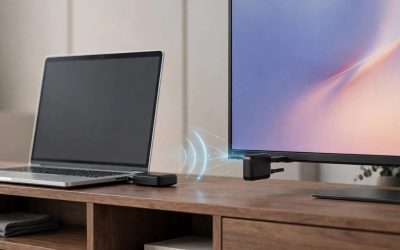
The best Bluetooth transmitter for TV for most households is the Avantree Audikast Plus, because it takes sound from the widest set of TV outputs in this group, optical, 3.5 mm, RCA and USB audio, feeds two pairs of headphones at once, and puts volume buttons on the box itself, which solves the common problem of a TV whose optical output ignores the remote’s volume keys. A Bluetooth transmitter does one job: it takes sound out of a television through a wired audio output and rebroadcasts it wirelessly to Bluetooth headphones, earbuds or a Bluetooth speaker, for the many TVs that have no Bluetooth audio output at all, or one that pairs with a single device or adds enough delay that dialogue drifts visibly away from the picture. As an Amazon Associate, we earn from qualifying purchases. The five transmitters below were compared on published specifications only: the TV inputs each one accepts, the Bluetooth version and audio codecs it supports, whether it can feed two headphones at once, its published range, and each maker’s warranty and listing data. Every one of them connects to the TV with a cable; none of them can take sound from a TV that sends audio only over HDMI, with one partial exception covered in its section below.
What separates these five is the generation of Bluetooth inside and the job each is shaped for. The Audikast Plus is the flexible default, a Bluetooth 5.0 box with the broadest input set here. The Orbit Pro is the control pick, the only one with an LCD screen, a remote control and an HDMI ARC input. The Audikast 4 is the future-facing pick, built on Bluetooth 5.4 with Auracast broadcast for compatible hearing aids and headphones. The 1Mii B03Pro+ is the value pick, a transmitter and receiver in one with an LDAC badge and a screen of its own. The FiiO BTA30 Pro is the hi-fi pick, a desktop unit with a dedicated DAC chip. Buy the inputs first and the codec second.
Table of Contents
- Quick Answer
- How to Choose a Bluetooth Transmitter for TV
- Quick Comparison
-
- Avantree Audikast Plus
-
- Avantree Orbit Pro
-
- Avantree Audikast 4
-
- 1Mii B03Pro+
-
- FiiO BTA30 Pro
- Before You Buy: Fit, Safety and Listing Checks
- Frequently Asked Questions
- Conclusion
Quick Answer
For the standard job, one TV, one or two listeners, wireless headphones after dark, buy the Audikast Plus: the broadest input set in this group, dual-headphone pairing, aptX Low Latency support and volume controls on the unit. Buy the Orbit Pro when the setup needs to be run by someone who does not pair Bluetooth devices for fun, because its screen names what is connected and which codec is running, and its remote adjusts volume from the couch. Buy the Audikast 4 when the listeners include Auracast-ready hearing aids or newer headphones. Buy the 1Mii B03Pro+ when the same box also needs to work in reverse, receiving phone audio into an older stereo, or when LDAC support at a budget tier is the point. Buy the FiiO BTA30 Pro when the transmitter is really a hi-fi component feeding one good pair of headphones. Whichever you choose, start at the back of the TV: a transmitter can only use an audio output your TV actually has, and every pick here except the Orbit Pro is blind to a TV that sends sound only over HDMI.
How to Choose a Bluetooth Transmitter for TV
Start at the TV’s output panel, because it narrows the list before anything else matters. The outputs a transmitter can use are the optical digital output (TOSLINK), the 3.5 mm headphone or AUX output, and the red-and-white RCA outputs, and TVs differ: many recent sets offer optical only, older sets offer RCA or a headphone jack, and a growing number send audio out only over HDMI ARC or eARC. Four of the five picks here cover optical and 3.5 mm; the Audikast Plus adds RCA and USB audio, and the Orbit Pro is the one pick that also accepts an HDMI ARC feed. If your TV has none of the wired outputs a pick needs, that pick cannot work in your setup no matter how good its radio is.
Match the codec to your headphones, because lip sync is a two-ended agreement. Standard SBC Bluetooth carries a delay that dialogue makes obvious. The low-delay answers are aptX Low Latency and aptX Adaptive, and both work only when the headphones at the other end support the same codec; a transmitter cannot force a low-delay mode onto headphones that do not speak it. Three of the picks here support aptX Low Latency, the Audikast 4 runs aptX Adaptive, and the 1Mii and FiiO units add LDAC, a higher-bandwidth codec aimed at music quality rather than delay. The codec line in a transmitter’s specs is a ceiling, not a promise: your headphones decide how much of it you get. One TV setting matters as much as any codec. When a transmitter takes the optical feed, the TV’s digital audio format should be set to PCM, because these boxes do not decode surround formats and will pass silence if the TV sends them a Dolby or DTS bitstream; the Orbit Pro, which converts surround to stereo in its optical mode, is the stated exception.
Decide how many listeners, because dual link is a feature, not a default. Dual link, feeding two pairs of headphones at the same time, is the feature couples and shared rooms actually use, and the Audikast Plus, Orbit Pro and B03Pro+ publish it. The Audikast 4 splits the answer by mode: its Auracast broadcast can feed many compatible receivers at once, while its classic Bluetooth mode pairs with a single headphone. The FiiO is a single-listener unit by design. A related question is what happens to the TV’s own speakers while the transmitter runs: a unit fed from the optical output leaves them alone in most setups, while a unit fed from the headphone jack usually silences them by the jack’s own switching. Know which behavior your wiring produces before the first movie night depends on it.
Read range figures as open-air ceilings. The published ranges here run from about 98 ft for the FiiO to 100 ft for the Audikast Plus and up to 164 ft for the Orbit Pro and the 1Mii, and every one of those figures is measured without walls. Class 1 radios hold a living-room connection through a wall or two; they do not hold it across a house. What range actually buys is stability at couch distance plus the freedom to walk to the kitchen during a break without the audio tearing.
Decide whether you need the box to run backwards. A pure transmitter sends TV sound out and does nothing else, which is the Audikast Plus, Orbit Pro and Audikast 4 pattern. A transceiver adds a receiver mode, taking audio from a phone and feeding a wired stereo, which is the 1Mii and FiiO pattern; the FiiO adds a third role as a USB DAC. Finally, note the power plan: all five are corded USB-powered units that live plugged in beside the TV. None carries a battery to charge, forget or wear out, and none is the pocket adapter you would take on a plane.
Quick Comparison
| Product | Tier | Bluetooth | TV Inputs | Codecs | Listeners |
|---|---|---|---|---|---|
| Avantree Audikast Plus | Mid-range | 5.0 | Optical, AUX, RCA, USB audio | aptX Low Latency, aptX, FastStream, SBC | Two headphones |
| Avantree Orbit Pro | Premium | 5.0 | HDMI ARC, optical, AUX, RCA | aptX Low Latency, FastStream, aptX, SBC | Two headphones |
| Avantree Audikast 4 | Mid-range | 5.4 with Auracast | Optical, AUX | aptX Adaptive, aptX HD, aptX, SBC, LC3 | Many by Auracast; one by classic Bluetooth |
| 1Mii B03Pro+ | Budget | 5.3 | Optical, RCA, AUX | LDAC, aptX HD, aptX Low Latency, aptX Adaptive, AAC, SBC | Two headphones |
| FiiO BTA30 Pro | Premium | 5.0 | Optical, coaxial, USB audio | LDAC, aptX HD, aptX Low Latency, aptX, SBC | One headphone |
1. Avantree Audikast Plus
Specs
- Model: BTTC-418-P, per the maker’s manual
- Type: Bluetooth audio transmitter for TV (transmit only; no receiver mode, per the listing title)
- Bluetooth: 5.0, Class 1
- Codecs: aptX Low Latency, aptX, FastStream, SBC, per the maker
- Inputs: optical (TOSLINK), 3.5 mm AUX, RCA, USB audio, per the listing
- Dual link: two headphones at once, per the maker
- Range: up to 100 ft, per the maker
- Controls: volume buttons on the unit, per the listing
- Power: USB powered
- Warranty: 24-month manufacturer warranty, per the maker
What the specs say
The Audikast Plus is the default pick because its input set is the widest here: optical for a modern TV, 3.5 mm and RCA for an older one, and USB audio for a set or a computer that offers sound that way, so it fits almost any television without an adapter hunt. On top of the inputs sit the two features TV listeners actually use. Dual link feeds two pairs of headphones at once, and the volume buttons on the box answer the category’s most common complaint, a TV whose optical output is fixed at one level and ignores the remote. The codec set is the proven one rather than the newest: aptX Low Latency for lip sync with headphones that support it, FastStream with compatible headsets, and SBC for everything else. The listing has been tracked on Amazon since 2021, a long run for the category, and the maker’s price record for it was still being updated in November 2026.
Where it fits
Choose it for the ordinary living room: a TV of any recent vintage, one or two listeners on headphones, and no appetite for setup rituals. The RCA and USB inputs also make it the pick for the second television in the house, the older set whose outputs predate optical-only design.
Trade-offs
The Audikast Plus is transmit-only; the listing title itself notes there is no receiver mode, so it will never feed phone audio into a wired stereo, which is the 1Mii and FiiO’s trick below. Its Bluetooth is version 5.0, a generation behind the Audikast 4, with no Auracast and no screen: pairing state is read from indicator lights. And like every pick here except the Orbit Pro, it cannot hear a TV that outputs sound only over HDMI.
2. Avantree Orbit Pro
Specs
- Model: BTTC-580-P, per the maker’s manual
- Type: Bluetooth audio transmitter for TV, per the maker
- Bluetooth: 5.0, Class 1
- Display: LCD screen showing connected device, codec and volume, per the maker
- Codecs: aptX Low Latency, FastStream, aptX, SBC, per the maker’s manual
- Inputs: HDMI ARC, optical, 3.5 mm AUX, RCA, per the maker’s manual
- Audio handling: converts Dolby and DTS surround to stereo in optical mode, per the maker’s manual
- Dual link: two headphones at once, per the maker
- Range: up to 164 ft (50 m), per the maker’s manual
- Controls: on-unit buttons plus an included remote control, per the maker
- Dimensions: 8.5 x 8 x 10 cm, per the maker’s manual
- Weight: 225 g, per the maker’s manual
- Power: USB powered (DC 5V)
- Warranty: not stated in the listing data reviewed
What the specs say
The Orbit Pro is the control pick, built around the observation that most transmitter frustration is not audio quality but state: what is paired, which codec is running, how loud it is. Its LCD screen answers all three at a glance, naming the connected device and the active codec, and the included remote control moves volume and pairing from the couch, which makes this the transmitter a household can hand to its least technical member. The input set is the other headline: beside optical, AUX and RCA, the Pro accepts an HDMI ARC feed, the only pick here that can take sound from a TV whose only audio output is the ARC port. The maker’s manual also states that in optical mode the unit converts Dolby and DTS surround to stereo for the Bluetooth link, which removes the PCM-setting chore the other picks impose. Underneath, the radio is the established one: Bluetooth 5.0, aptX Low Latency and FastStream, dual link, and the longest published range in this group at up to 164 ft.
Where it fits
Choose it for the main family television, especially where listeners vary in technical patience, or where the transmitter will sit in a cabinet and be run by remote. The screen and remote also suit a setup shared with an older listener, for whom a named connection on a display is worth more than a newer Bluetooth version.
Trade-offs
Two cautions belong with this pick. First, the identifier in the reference table was confirmed through a regional Amazon store’s product information for this exact model rather than a domestic listing crawl, so confirm the live offer and the model name on the listing itself before ordering; current review coverage still carries the Orbit Pro as a present-day pick. Second, the radio is Bluetooth 5.0 with the aptX Low Latency generation of codecs, so buyers chasing Auracast or aptX Adaptive are served by the Audikast 4 below, and the listing data reviewed states no warranty term.
3. Avantree Audikast 4
Specs
- Model: BTTC-480, per the maker’s manual
- Type: Bluetooth audio transmitter for TV with Auracast broadcast, per the maker
- Bluetooth: 5.4, with Auracast (LC3) broadcast, per the maker’s manual
- Codecs: aptX Adaptive, aptX HD, aptX, SBC in classic Bluetooth mode; LC3 in Auracast mode, per the maker
- Inputs: optical (TOSLINK), 3.5 mm AUX, per the maker
- Listeners: multiple compatible devices by Auracast broadcast; one headphone in classic Bluetooth mode, per published specialist coverage
- Controls: display with volume knob, per the maker
- Firmware: updatable over USB-C, per the maker
- Dimensions: 2.7 x 2.9 x 2.6 in, per the maker’s manual
- Weight: 5.5 oz (156 g), per the maker’s manual
- Power: USB-C powered (5V)
- Warranty: 24-month manufacturer warranty, per the maker
What the specs say
The Audikast 4 is the generational pick. Its Bluetooth 5.4 radio adds the feature none of the other four has: Auracast, the broadcast mode of LE Audio, in which the transmitter sends one stream that any number of compatible receivers nearby can join, including Auracast-ready hearing aids, which no classic Bluetooth transmitter in this group can feed at all. In classic Bluetooth mode it runs the modern codec set, aptX Adaptive and aptX HD alongside aptX and SBC, and pairs with a single headphone. The hardware is current in the small ways that matter: a display with a volume knob rather than indicator lights alone, USB-C power, and firmware that can be updated over that connection, the mechanism by which a still-settling broadcast standard stays compatible. Specialist coverage of Auracast transmitters, updated within days of this roundup, carries it as a current pick for exactly this mixed household: one listener on hearing aids, another on ordinary headphones.
Where it fits
Choose it when the audience includes Auracast-compatible hearing aids or earbuds, or when a household wants several listeners on one broadcast without pairing each in turn. It is also the pick for a single listener who wants aptX Adaptive’s automatic delay management with matching headphones.
Trade-offs
The honest limits are about the standard’s youth. Auracast only helps receivers that support it, and most headphones on most couches do not yet; for them this box is a single-headphone classic Bluetooth transmitter, with no dual link of the older kind. The input set is the narrowest of the Avantree three here, optical and AUX only, with no RCA, no USB audio and no HDMI ARC.
4. 1Mii B03Pro+
Specs
- Model: B03Pro+, per the Amazon product information
- Type: Bluetooth transmitter and receiver (TX, RX and bypass modes), per the maker
- Bluetooth: 5.3
- Codecs: LDAC, aptX HD, aptX Low Latency, aptX Adaptive, AAC, SBC, per the Amazon product information
- Inputs and outputs: optical, RCA, 3.5 mm AUX, per the maker
- Display: LCD screen, per the maker
- Dual link: two headphones at once in transmitter mode, per the maker
- Range: up to 164 ft (50 m) in open air, per the maker’s specification sheet
- Antennas: dual external antennas, per the maker’s specification sheet
- Power: USB powered
- Warranty: 12 months, per the Amazon product information
What the specs say
The B03Pro+ is the value pick, and its spec sheet reads a tier above its position: Bluetooth 5.3, an LDAC badge the Avantree picks at this level do not carry, the full aptX family including Low Latency and Adaptive, an LCD screen, dual external antennas and a published open-air range of up to 164 ft. It is also a two-way box: receiver mode takes audio from a phone and feeds a wired stereo, and a bypass mode passes the wired signal through to a soundbar or receiver while the transmitter side runs, so the unit can live permanently in the chain between a TV and its bar. The paperwork is the budget tier’s usual shape: the Amazon product information states a 12-month warranty, half the term the Avantree maker publishes, and the listing data reviewed shows the unit shipped from Amazon and sold by a marketplace seller, so the seller’s identity is part of the checkout check on this one.
Where it fits
Choose it when one box must cover both directions, TV out to headphones at night and phone into the stereo by day, or when LDAC support is worth more than a longer warranty. The bypass mode suits a soundbar setup that cannot spare its optical feed, and the screen makes its pairing state legible.
Trade-offs
The B03Pro+ name sits inside a crowded family: B03, B03Pro and B03Pro+ are separate listings with different internals, and the maker’s own store documentation links this model name to more than one listing identifier over its life, so the model name and the ASIN in the reference table are the pair to match at ordering. LDAC deserves its honest reading: it is a music-quality codec, not a low-delay one, and television dialogue still rides on aptX Low Latency or Adaptive with headphones that support them. There is no Auracast and no HDMI input.
5. FiiO BTA30 Pro
Specs
- Model: BTA30 Pro, per the maker (the listing’s model field prints a longer numeric code; the maker’s model name governs)
- Type: Bluetooth transmitter, receiver and USB DAC, per the maker
- Bluetooth: 5.0, Qualcomm CSR8675 chip, per the maker
- Transmit codecs: LDAC, aptX HD, aptX Low Latency, aptX, SBC, per the maker
- DAC: ESS ES9038Q2M, per the maker
- Inputs: optical, coaxial, USB audio, per the maker
- Outputs in receiver and DAC modes: RCA line-out, optical, coaxial, per the maker
- Range: approximately 30 m (about 98 ft) with no obstacles, per the maker
- Controls: unit controls plus app control from a phone, per the maker
- Dimensions: 120 x 55 x 25.8 mm, per the maker
- Weight: 145 g, per the maker
- Power: USB-C powered
- Warranty: not stated in the listing data reviewed
What the specs say
The BTA30 Pro is the hi-fi pick, a desktop audio component that happens to transmit, from a maker whose home ground is DACs and amplifiers rather than TV accessories. The published internals say so: a Qualcomm CSR8675 Bluetooth chip, an ESS ES9038Q2M DAC for its wired conversion, transmit support for LDAC alongside aptX HD and aptX Low Latency, and a port set no TV-first box here matches, optical and coaxial digital inputs plus USB audio, with RCA line-out and digital outputs for its receiver and DAC modes. In a system, that makes it the bridge in both directions at component quality: TV or streamer in, one pair of good headphones out; phone in by Bluetooth, stereo out by line-out or digital. A current Amazon mirror record for this listing, crawled within days of this roundup, shows the unit in stock and fulfilled by Amazon.
Where it fits
Choose it when the transmitter lives in a real audio system rather than behind a television: a listening chair fed from a streamer or a TV on the same rack, a desktop where the USB DAC role matters as much as the TV role, or a single listener with LDAC headphones. Its coaxial input also serves CD players and streamers that the optical-and-AUX boxes here cannot hear.
Trade-offs
The FiiO is a single-listener transmitter: there is no dual link, so a second pair of headphones has nowhere to join, and there is no screen, no remote and no HDMI or RCA input on the transmit side. Its published range, about 98 ft in the open, is the shortest here on paper, though ample at room distance. Its Bluetooth is version 5.0, and its app control is a phone app rather than a couch remote. The listing data reviewed states no warranty term.
Before You Buy: Fit, Safety and Listing Checks
Fit and Sizing Checks
Fit is a chain of three checks. First, the TV’s outputs against the pick’s inputs: optical and 3.5 mm cover most televisions between them; RCA belongs to older sets and to the Audikast Plus and Orbit Pro here; USB audio belongs to the Audikast Plus and the FiiO; coaxial belongs to the FiiO alone; and an HDMI-ARC-only television is served only by the Orbit Pro, or by an extractor in front of any other pick. Second, the TV’s digital format setting: with an optical feed, set the TV’s digital audio output to PCM, because four of these five cannot decode a surround bitstream and will answer one with silence; the Orbit Pro’s published surround-to-stereo conversion is the exception. Third, the headphones against the codec: aptX Low Latency and aptX Adaptive deliver their delay figures only with headphones that support the same codec, Auracast delivers its broadcast only to Auracast receivers, and LDAC delivers its bandwidth only to LDAC headphones. A mismatch defaults everything to SBC and its delay.
Safety and Recall Checks
None of the five transmitters in this roundup is under a CPSC recall, and no recall covers TV Bluetooth transmitters as a class. The nearest federal record in the wider home-audio category names a different kind of product: in June 2023 the CPSC announced the recall of about 884,000 Bose Acoustimass, Lifestyle and Companion bass modules made before April 2006, because electrical components in the bass module could fail and create a fire hazard. No subwoofer or bass module is in this roundup, and the record is named because it states this category’s safety logic from the failure side: the recalled audio products are the mains-powered ones with amplifiers inside. A Bluetooth transmitter is a low-voltage USB-powered accessory with no amplifier and, in all five cases here, no battery; it carries a signal, not power. The standing checks still apply: run the exact model through saferproducts.gov before installation, and keep the unit ventilated rather than sealed inside an unvented cabinet with the television’s power supply.
Listing Checks
Four listing details deserve a second look. First, family discipline: Avantree sells three generations of similar boxes and 1Mii sells a B03 family with near-identical names, and each model carries its own identifier, so the product name and the ASIN in the table below are a matched pair, and a search result landing on a sibling model is not this pick. Second, the Orbit Pro’s identifier was confirmed through a regional Amazon store’s product information rather than a domestic listing crawl, so its live offer and seller deserve a direct confirmation on the listing itself. Third, codec language: a listing that advertises low latency is describing a capability that engages only with matching headphones, and a listing that leads with LDAC is describing music bandwidth, not lip sync; read both claims against the headphone you own. Fourth, modes: a buyer who needs the receive direction, phone into stereo, should confirm the pick is the 1Mii or the FiiO before ordering, not after.
Frequently Asked Questions
My TV has no Bluetooth. Will a transmitter let me use wireless headphones with it?
Yes, that is the exact job these five exist for. The transmitter takes sound from a wired output your TV already has, optical, 3.5 mm, RCA or, on the Orbit Pro, HDMI ARC, and sends it to ordinary Bluetooth headphones, which pair to the transmitter rather than to the TV. Verify that your TV has one of the wired outputs the pick accepts, and that its digital format can be set to PCM for an optical feed. A TV whose only audio path is HDMI and which is not paired with the Orbit Pro needs an HDMI audio extractor between the TV and the transmitter.
Why is the sound behind the picture, and how do I fix it?
Delay is the physics of standard Bluetooth audio, and the fix is a matched codec. SBC, the universal fallback, carries enough delay for dialogue to drift visibly. aptX Low Latency and aptX Adaptive exist to close that gap, but each engages only when the headphones support the same codec as the transmitter; a low-latency transmitter feeding SBC-only earbuds still delivers SBC delay. Check the headphone’s codec list before blaming the box, set the TV’s optical output to PCM, and prefer a transmitter whose codec family matches the headphones you already own, with LDAC reserved for music, where its bandwidth rather than its delay is the point.
Can two people listen on two pairs of headphones at once?
On three of these five, yes, by dual link: the Audikast Plus, the Orbit Pro and the 1Mii B03Pro+ each feed two pairs of headphones simultaneously in transmitter mode. The Audikast 4 answers differently: its Auracast broadcast can be joined by many compatible receivers at once, including compatible hearing aids, but its classic Bluetooth mode pairs with one headphone. The FiiO BTA30 Pro is a single-listener unit. One caution applies to every dual arrangement: the shared stream runs at the codec both headphones can agree on, so pairing an aptX Low Latency headset with an SBC-only headset gives both listeners the common denominator.
What is the difference between a transmitter and a receiver, and which do I need?
A transmitter sends sound out of a wired source, your TV, to wireless headphones. A receiver does the reverse, taking sound from a phone or tablet and feeding a wired speaker or stereo. Television listening needs the transmitter direction. Two picks here, the 1Mii B03Pro+ and the FiiO BTA30 Pro, are transceivers that work in both directions, which suits a room where the same box should also bring phone audio into an older stereo. The three Avantree picks are transmit-focused for TV use.
Conclusion
A Bluetooth transmitter for TV is judged by three matches: its inputs against the outputs on the back of your television, its codecs against the headphones on your head, and its listener count against the room it serves. The Audikast Plus is the default, the broadest input set here with dual link and on-box volume. The Orbit Pro is the control pick, a screen, a remote and the group’s only HDMI ARC input. The Audikast 4 is the future pick, Bluetooth 5.4 with Auracast broadcast. The 1Mii B03Pro+ is the value pick, a two-way LDAC box with a screen at a budget tier. The FiiO BTA30 Pro is the hi-fi pick, a component-grade bridge for one listener in a real audio system. Confirm the TV’s outputs, match the codec to the headphones, and any of the five will put the television in your ears without waking the house.