Our Short List of 3
All 3 Picks at a Glance
| Product | Specs | Action |
|---|---|---|
 Amazon Basics Biometric Safe, 0.5 Cubic Feet | Check price on Amazon | |
 AmazonBasics 25EI Biometric Safe, 1 Cubic Foot | Check price on Amazon | |
 Viking Security Safe VS-20BLX Mini Biometric Safe | Check price on Amazon |
Key takeaways
- Compare biometric home security safes with concealed hinges, fingerprint access and steel bodies to protect documents and valuables at home.
A home safe only does its job when it stays shut against the wrong hands and opens fast for the right ones. That balance is why biometric safes have become a fixture in bedrooms, closets, and home offices: a registered fingerprint opens the door in a moment, while a PIN or backup key covers the days when the sensor, the batteries, or a bandaged finger does not cooperate. Concealed hinges add a quiet layer of defense to that setup. With the hinge hardware hidden inside the door and frame, there is no exposed knuckle for a prying tool to attack, and the door sits flush in a way that makes the whole box harder to force.
This guide compares three biometric home security safes that suit everyday household storage: documents, passports, jewelry, cash, small electronics, and other valuables you want locked away but reachable. Two of the picks list pry-resistant concealed hinges directly in their specifications. The third takes a different route to the same goal, with a seamless laser-cut door and a motorized deadbolt. For each safe we lay out the capacity, construction, lock options, and practical limits drawn from its listing, so you can match the box to the shelf or floor space you actually have.
As an Amazon Associate, we earn from qualifying purchases.
Quick Answer
For most households, the Amazon Basics biometric safe in the half cubic foot size is the most practical starting point, with concealed hinges, a steel body, and room for documents and jewelry. Step up to the one cubic foot AmazonBasics 25EI when you need space for binders and larger items. Choose the Viking VS-20BLX for a compact, wall-mountable safe with a fast optical sensor and a motorized deadbolt.
How to Choose
Start with what you plan to store, because capacity decides almost everything else. A half cubic foot safe holds passports, jewelry boxes, a stack of documents, and some cash comfortably, but a standard binder or a camera body may not fit. A one cubic foot safe takes binders, folders, and bulkier items, yet it weighs more and needs a deeper shelf or a floor spot. Measure the interior height as well as the footprint: a tall item that cannot stand upright wastes the space around it. Check the shelf layout too, since a removable shelf lets you switch between one tall compartment and two short ones.
Look closely at the lock system. A semiconductor fingerprint sensor reads the ridges of a finger and tends to be quick and precise, while an optical sensor photographs the print and is a proven, widely used design. Either way, count how many fingerprints the safe stores. A household with two adults and a trusted relative needs more slots than a single user does, and a separate PIN code adds a way in when a finger is wet, cut, or dirty. A backup key is not optional in our view: batteries die, sensors fail, and a mechanical override is the only way back in without a locksmith. Keep the key somewhere outside the safe itself, in a place only you can reach.
Hinges deserve the same attention as the lock. Concealed hinges sit inside the door and frame, so no hinge pin or knuckle is exposed to a pry bar. Pry-resistant construction usually pairs with them: a reinforced door, live locking bolts that extend into the frame, and a tight door fit with little gap to exploit. Steel thickness matters as well. A thicker door gauge resists bending and drilling better than a thin one, and a heavier body is harder to carry away. If the safe is light enough to lift, anchor it: pre-drilled mounting holes and included hardware let you bolt the box to a floor or wall.
Think about where the safe will live. A bedroom closet shelf needs a compact footprint and a door that swings open without hitting the shelf above. A home office floor spot can take a taller, heavier unit. An interior light sounds minor until you open a dark safe at night, and a carpeted floor protects jewelry and watch faces from scratches. Finally, check the power setup: most biometric safes run on AA batteries, and a low-battery warning light gives you time to swap them before the electronics go quiet.
Amazon Basics Biometric Safe, 0.5 Cubic Feet
The half cubic foot Amazon Basics biometric safe is the compact pick in this guide, and it is the one we would point most households toward first. Its steel body is sized for a closet shelf or a bedside cabinet, and its listing states pry-resistant concealed hinges outright, which is exactly the feature this guide is built around. The door uses heavy-duty carbon steel, with an eight-gauge steel door and a fourteen-gauge steel body, plus two live-door bolts that extend into the frame when the safe locks. That combination of hidden hinges, thick door steel, and live bolts gives a small box a serious resistance to prying.
Access is built around a programmable biometric fingerprint lock. The semiconductor sensor reads at 500 DPI, matches in under a second according to the listing, stores up to 50 individual fingerprints, and is rated for a long touch lifetime. Fifty slots is generous for a household safe: two adults can register several fingers each, and there is still room for a trusted family member. A backup key covers battery failure or a sensor problem, and pre-drilled mounting holes with included hardware let you bolt the safe to a floor or wall so it cannot simply be carried off.
Inside, the fourteen-litre capacity holds documents, jewelry, and cash, with an interior shelf for organizing them. The shelf keeps small items from piling into a single heap and makes the space easier to use day to day. The exterior measures 35 cm wide by 24.9 cm deep by 24.9 cm high, which fits on most closet shelves and inside many cabinets. Before ordering, measure your shelf depth and the swing of the door: the door needs clear space in front of it, and a tight closet may force you to pull the safe forward to open it fully.
The main limitation is capacity. Half a cubic foot fills quickly once you add a jewelry box, a passport wallet, and a folder of documents. It is not the right box for binders, large camera gear, or a laptop. Treat it as a valuables safe for the items you reach for most, not as a general storage cabinet.
AmazonBasics 25EI Biometric Safe, 1 Cubic Foot
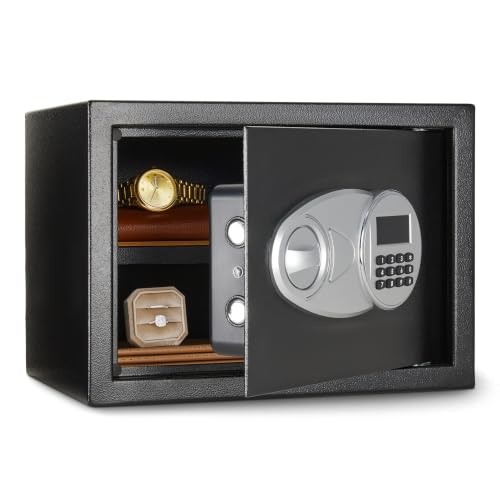
The AmazonBasics 25EI is the larger sibling in the Amazon Basics biometric line, and it answers the capacity question the half cubic foot model leaves open. With one cubic foot of interior space, it takes standard binders, document folders, and bulkier valuables that the smaller box cannot. Its exterior measures 13.8 inches wide by 13 inches deep by 19.7 inches high, and it weighs 27.6 pounds, so it suits a floor position, a low cabinet, or a sturdy shelf that can carry the weight. Like the smaller model, its listing states a solid steel build with a pry-resistant door and concealed hinges, so the hinge protection carries over to the bigger size.
Access combines a biometric fingerprint scanner with a digital keypad, giving every user two electronic ways in plus the mechanical backup. The keypad matters more than it first appears: it lets you open the safe when a finger is injured, wet, or dirty, and it lets you grant access to someone whose print is not enrolled. The interior includes an adjustable shelf and a carpeted floor, which protects watch faces, jewelry, and camera lenses from scratches while keeping folders upright. An interior layout you can rearrange is worth more than a fixed one, because the mix of items in a home safe changes over the years.
The extra height is the real reason to choose this model over the half cubic foot version. Tall items such as binders and document wallets stand upright instead of lying flat, and the adjustable shelf divides the space into two usable levels. That said, the taller body needs more vertical clearance, and the door swings on a taller arc, so measure the space above and in front of the safe before you buy. The weight also means you should plan the final position before loading it: a filled safe is awkward to move, and anchoring it to the floor or wall is a stronger idea here than with a lighter box.
Viking Security Safe VS-20BLX Mini Biometric Safe
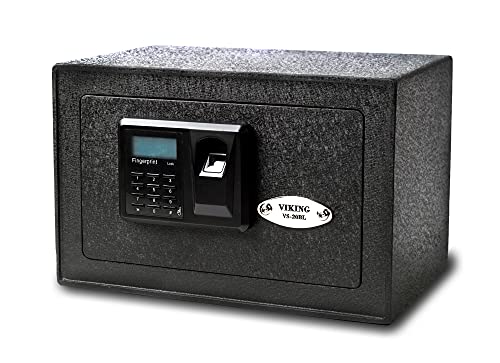
The Viking Security Safe VS-20BLX is the compact, wall-mountable option in this guide, built for quick access in a bedroom or office. Its alloy steel body measures 8 inches high by 12 inches wide by 8 inches deep, with 705 cubic inches of interior capacity and a weight of 18 pounds. That size fits on a closet shelf, inside a cabinet, or mounted to a wall, and the weight is light enough for one person to position before anchoring it. The door is a seamless laser-cut design, which leaves a tight, even gap around the door and no exposed hinge knuckle to work a tool into, and two pry-resistant insertion slots back up the motorized deadbolt.
The lock system is the most detailed of the three picks. A 500 DPI optical fingerprint sensor stores up to 32 fingerprints, and the safe also accepts one PIN code and a four-prong backup cross key. The motorized 20 mm deadbolt drives two locking bars into the frame when the safe locks. Thirty-two fingerprint slots cover a household with room to spare, and the PIN gives you a way in when a print will not read. The backup cross key is a sturdier design than a flat override key, and it matters because this safe has no other mechanical way in once the electronics are exhausted.
Inside, the safe has a carpeted interior, a built-in LED light, and one removable shelf. The light switches on when the door opens, which makes a real difference in a dark closet, and the carpet protects jewelry and small electronics from scratches. The shelf divides the 705 cubic inches into two levels for documents and smaller items, or lifts out for one taller compartment. The chamber depth is 7.5 inches, so check the depth of the items you plan to store: a deep camera lens or a thick binder may not fit even if the width looks fine.
The VS-20BLX is not a fireproof or waterproof safe, and its listing does not claim certified fire or burglary ratings. Buy it for quick, everyday protection against casual theft and unauthorized access, not as a disaster-proof vault. Also note that the safe runs on six AA batteries, so keep spares nearby and pay attention to the low-battery signals. For buyers who want the concealed-hinge wording stated directly on the listing, the two Amazon Basics picks above carry that wording; the Viking earns its place here through its laser-cut door, motorized bolts, and fast sensor.
Who Should Skip It
A biometric home safe is not the right purchase for everyone. If you need certified fire protection for paper documents, look for a safe with a stated fire rating and tested endurance, because none of the three picks in this guide is sold as a fireproof vault. Paper chars at temperatures a house fire reaches quickly, and a steel box without fire insulation will not save it. The same applies to water: a safe that survives a burglary attempt may still let in water from sprinklers or a burst pipe, so store irreplaceable papers in a separate fireproof container if that risk worries you.
Skip a small biometric safe if your real need is bulk storage. A gun collection, a large camera kit, or a full set of estate documents belongs in a larger safe or a locking cabinet, not in a half cubic foot box you will outgrow in a month. Likewise, if nobody in the household can reliably use a fingerprint sensor because of worn prints from manual work or a skin condition, a keypad or dial safe may serve you better than a biometric one, though the PIN and key backups on these models soften that concern.
FAQ
Do concealed hinges make a safe harder to break into?
Concealed hinges hide the hinge pins and knuckles inside the door and frame, so a prying tool has no exposed hinge to attack. They work best as part of a wider design that includes a pry-resistant door, live locking bolts, and a tight door fit. Hinges alone do not make a safe burglar-proof, and no home safe in this size class carries a guarantee against a determined attack with time and tools.
How many fingerprints should a household safe store?
Most households need fewer slots than they expect. Two adults registering three fingers each use six slots, and a trusted relative adds a few more. A capacity of 32 fingerprints covers a family comfortably, while 50 slots leaves room for children as they grow older. Register more than one finger per person, because a cut or a bandage can make a primary finger unreadable on the day you need access.
What happens if the batteries die while the safe is locked?
The safe keeps its enrolled fingerprints in non-volatile memory, so dead batteries do not erase your prints. You open the safe with the backup key, then replace the batteries and resume normal use. Some models also support an external battery pack for emergency power. Keep the backup key outside the safe, and replace batteries promptly when the low-battery warning appears.
Should I bolt my safe to the floor or wall?
Yes, whenever the safe is light enough for one person to carry. A safe that can be lifted can be opened later at leisure, which defeats its purpose. Use the pre-drilled mounting holes and the hardware included with the safe, and anchor into a stud or a solid floor. Renters should get permission before drilling, and should consider a heavier safe or a discreet fixed location as an alternative.
Final Verdict
Whichever model you choose, measure your space first, enroll several fingers per user, store the backup key outside the safe, and anchor the box if it can be carried. A safe earns its keep through daily habits, not through its specification sheet, and the best safe is the one that stays locked, stays put, and still opens in a moment when you need it.
Product and ASIN Reference
| Product | ASIN |
|---|---|
| Amazon Basics Biometric Safe, 0.5 Cubic Feet | B0799BK2RK |
| AmazonBasics 25EI Biometric Safe, 1 Cubic Foot | B00UG9HB1Q |
| Viking Security Safe VS-20BLX Mini Biometric Safe | B015PI6P3M |