Key takeaways
- From the SawStop cabinet saw to DEWALT jobsite classics, compare the table saws that defined their classes by rip capacity, fence design and safety gear.
Ask a room of woodworkers to name the best table saws ever made and the same short list comes up every time. A few names are legends that no longer ship, like the old Delta Unisaw and Powermatic 66 that anchored school shops and cabinet shops for decades. The more useful question for a buyer today is which of the all-time designs are still in production, still supported, and still worth putting in your own shop.
That is the list below. These five saws each defined their class when they arrived and still set the terms everyone else competes on: the flesh-sensing cabinet saw, the rack-and-pinion jobsite saw, the gravity-rise stand saw, the compact 8-1/4 inch saw, and the budget jobsite saw that borrowed the pro fence idea. Every one of them is a current model you can buy new today, which matters, because a legend you cannot get parts for is a museum piece, not a tool.
As an Amazon Associate, we earn from qualifying purchases.
Quick Picks
| Product | Best for | Key point |
|---|---|---|
| SawStop PCS31230-TGP236 Professional Cabinet Saw | A permanent shop where safety and power come first | The flesh-sensing brake on a full 3 HP cabinet saw |
| DEWALT DWE7491RS Jobsite Table Saw | Contractors and small shops that need one saw to do everything | The rack-and-pinion fence and 32-1/2 inch rip capacity |
| Bosch 4100XC-10 Worksite Table Saw | Jobsite crews who set up and tear down every day | The Gravity-Rise stand plus a rear outfeed in the box |
| DEWALT DWE7485 Compact Jobsite Table Saw | Tight shops, vans and anyone who moves the saw often | Full fence quality in an 8-1/4 inch footprint |
| SKIL TS6307-00 Jobsite Table Saw | First-time buyers who want the pro formula for less | Rack-and-pinion fence and folding stand at an entry tier |
How to Choose
Decide which class of saw your work actually needs. Table saws split into three broad classes. Cabinet saws are heavy, stationary machines with induction motors, cast iron tops and the mass to run all day without vibration. Jobsite saws trade some of that mass for wheels and folding stands, using universal motors that are louder but strong enough for sheet goods and framing lumber. Compact saws shrink the jobsite formula further, with smaller blades and tables, for people whose shop is a corner of a garage or the back of a van. Buying the wrong class is the most expensive mistake on this page: a compact saw will frustrate a furniture maker, and a cabinet saw will frustrate anyone who has to move it.
Rip capacity tells you what sheet goods you can handle. Rip capacity is the widest cut you can make between the blade and the fence. Around 24 to 25 inches lets you rip a sheet of plywood in half, which covers most cabinet and furniture parts. Capacities past 30 inches let you handle wider panels without flipping the sheet or reaching for a track saw. The cabinet saw in this guide pairs its fence system with a 36 inch setup, while the biggest jobsite saw here reaches 32-1/2 inches, which is remarkable for a saw on wheels.
The fence matters more than the motor. Almost every saw in this class runs a motor strong enough for its blade size. What separates the great saws from the frustrating ones is the fence. Rack-and-pinion fences, pioneered on jobsite saws by DEWALT, move both ends of the fence together so it stays parallel to the blade as you adjust it. Cabinet saws use heavy T-square style fences that lock down dead square and glide on rails. A fence that drifts or sits out of parallel makes every cut a negotiation and quietly ruins accuracy no matter how good the blade is.
Take the safety system seriously. The table saw causes more serious workshop injuries than any other stationary tool, which is why one invention changed the whole industry. SawStop’s flesh-sensing technology detects contact with skin, fires a brake into the blade and drops it below the table in milliseconds. Every other saw here uses the standard guard package of a blade guard, riving knife and anti-kickback pawls, which works well when it stays on the saw. Whichever saw you choose, the riving knife is the single most important piece to keep fitted, because it prevents the workpiece from pinching the blade and kicking back.
Check the unglamorous details before you buy. Confirm the arbor size and dado capacity if you plan to cut grooves, look at the dust port size and whether it matches your extractor, and think about power: a 3 HP cabinet saw needs a 230 volt circuit, while every jobsite saw here runs on a normal household outlet. Finally, weigh the saw honestly against your space. A rolling stand that folds upright can matter more in a two-car garage than an extra inch of rip capacity.
Best Options
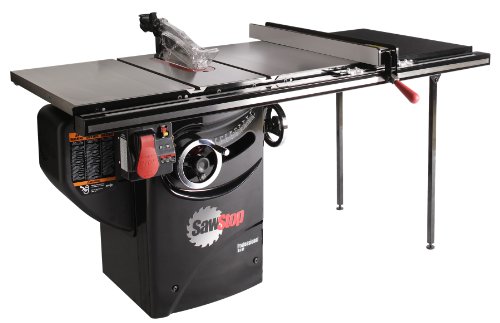
SawStop PCS31230-TGP236 Professional Cabinet Saw
If one saw changed what a table saw is, it is this one. SawStop built its Professional Cabinet Saw around a safety system that senses electrical contact with skin, slams an aluminium brake into the blade and retracts it below the table faster than an injury can happen. Around that system sits a proper cabinet saw: a 3 HP motor, a heavy cast iron table, and the Professional T-Glide fence, which is SawStop’s take on the classic T-square fence, with a 36 inch rip capacity in this configuration.
In a permanent shop, the appeal is the combination rather than any single feature. The mass of the cabinet keeps cuts smooth, the fence locks parallel and repeatable, and the dust collection shroud under the blade keeps the cabinet interior far cleaner than older designs. It is the saw that schools, shared shops and safety-conscious professionals standardised on, and it has held that position for years because nothing else offers the brake on a machine of this quality.
Specs
- 10-inch blade; 3 HP motor; 230 volt single-phase power; Professional T-Glide fence system with 36-inch rip capacity; cast iron table; flesh-sensing blade brake with below-table retraction; enclosed cabinet base
Best for: A permanent shop where safety and power come first, and furniture or cabinet work that runs wide panels
Watch out for: It needs a 230 volt circuit and a fixed home in the shop; the brake cartridge and blade are single-use after an activation, so a spare cartridge belongs in the drawer
DEWALT DWE7491RS Jobsite Table Saw
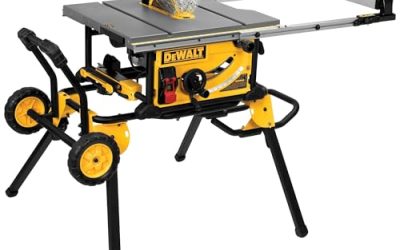
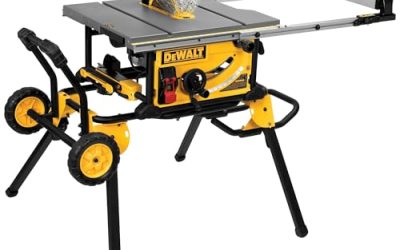
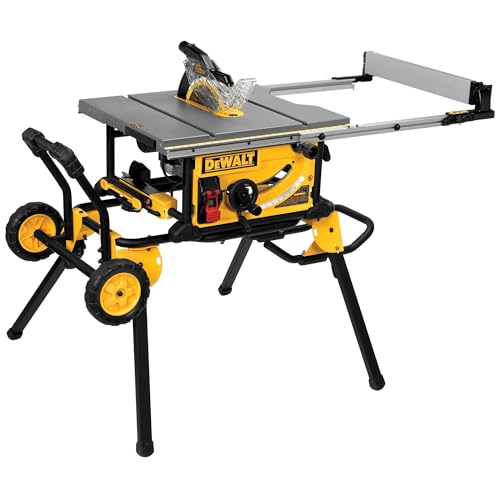
The DWE7491RS is the jobsite saw by which all others are judged, and the reason is the fence. DEWALT’s rack-and-pinion telescoping fence adjusts with a single knob, moves both ends in unison, and stays parallel to the blade, which solved the crooked-fence problem that plagued portable saws for years. Around it, the saw offers a 32-1/2 inch rip capacity, the largest in the jobsite class, on a rolling stand with large wheels that handle stairs and rough ground.
The 15 amp motor turns the 10-inch blade at 4,800 RPM, enough to rip framing lumber and sheet goods all day, and the flip-over ripping fence supports narrow cuts without removing the main fence. Onboard storage keeps the guard, riving knife, miter gauge and push stick with the saw. Plenty of newer rivals have copied pieces of this formula, but the complete package is why this model has stayed at the top of the jobsite class for so long.
Specs
- 10-inch blade with 5/8-inch arbor; 15 amp motor; 4,800 RPM no-load speed; 32-1/2 inch rip capacity to the right of the blade; rack-and-pinion telescoping fence; rolling stand included; onboard accessory storage
Best for: Contractors and small shops that need one saw to do everything, from breaking down plywood to finish trim work
Watch out for: Like every universal-motor jobsite saw it is loud, and the stand, while sturdy, takes a moment to fold and unfold compared with simpler leg sets
Bosch 4100XC-10 Worksite Table Saw
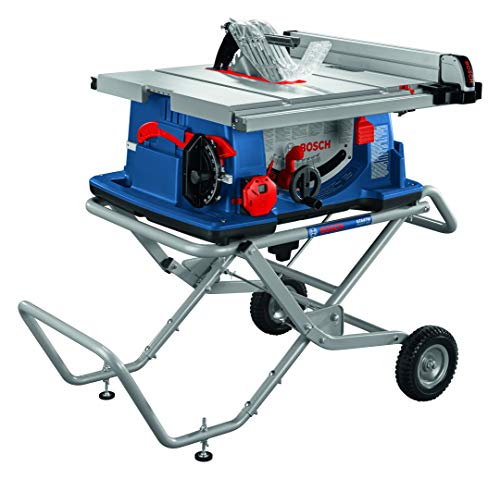
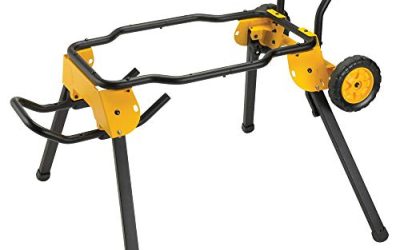
Bosch’s 4100 series earned its place in table saw history with one idea executed brilliantly: the Gravity-Rise stand. One motion lifts the saw from folded to working height or drops it back down, and the large treaded wheels roll it over site debris that would stop lesser stands. The current 4100XC-10 keeps that stand and adds the details crews asked for, including a rear outfeed support and an auxiliary fence for narrow workpieces, both included rather than sold as accessories.
The saw itself runs a 15 amp motor at 3,650 RPM with electronics that ease the blade up to speed gently and hold that speed under load. The SquareLock rip fence clamps at both rails and glides smoothly, the cast aluminium top measures 30 by 22-1/2 inches, and rip capacity reaches 30 inches. Bosch’s Smart Guard System splits the guard, riving knife and pawls into modules that swap without tools, which makes it far more likely the guard goes back on after a non-through cut.
Specs
- 10-inch blade; 15 amp motor; 3,650 RPM no-load speed; 30-inch rip capacity; 30 x 22-1/2 inch cast aluminium tabletop; SquareLock rip fence; Gravity-Rise wheeled stand; rear outfeed and auxiliary fence included
Best for: Jobsite crews who set up and tear down every day, and anyone who values the fastest stand in the business
Watch out for: Bosch has a newer worksite model in its range, so confirm the 4100XC-10 configuration when ordering; the stand makes the folded package tall, which matters in low vehicles
DEWALT DWE7485 Compact Jobsite Table Saw

The DWE7485 proved that shrinking a table saw does not have to mean shrinking its usefulness. It keeps the same rack-and-pinion telescoping fence as its bigger sibling, which is the feature compact saws usually lose, and pairs it with a 24-1/2 inch rip capacity: enough to rip a sheet of plywood in half, the benchmark that decides whether a small saw can work as a shop’s only saw.
The trade is the 8-1/4 inch blade, which gives up some depth of cut compared with a 10-inch saw but lets the whole machine fold into a package measuring about 22.75 by 22.75 by 13 inches. The 15 amp motor spins the smaller blade at 5,800 RPM, and the bevel range runs from -2 to 48 degrees for trim work. Metal roll-cage framing protects the saw in transit. For remodelers, van-based trades and small shops, this is the compact saw that set the standard the rest now chase.
Specs
- 8-1/4 inch blade; 15 amp motor; 5,800 RPM no-load speed; 24-1/2 inch rip capacity; rack-and-pinion telescoping fence; bevel range -2 to 48 degrees; saw-only package about 22.75 x 22.75 x 13 inches; stand sold separately
Best for: Tight shops, vans and anyone who moves the saw often but still needs a fence that stays parallel
Watch out for: The smaller blade limits depth of cut on thick stock, and the stand is a separate purchase, so budget for it if you work away from a bench
SKIL TS6307-00 Jobsite Table Saw
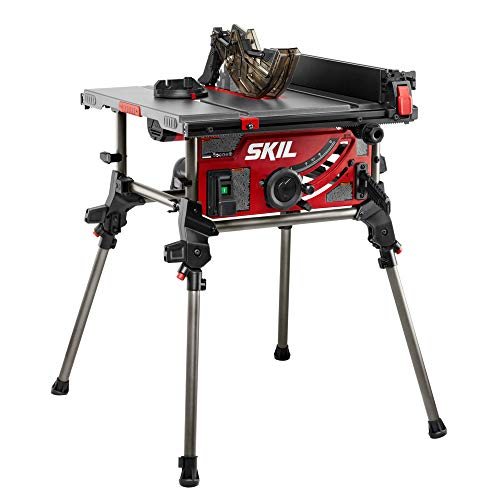
The TS6307-00 is the saw that brought the pro jobsite formula down to an entry-level tier, and it did it by keeping the right feature: a rack-and-pinion fence. Where budget saws used to ship with fences that clamped wherever they landed, the SKIL fence adjusts smoothly and stays parallel, which is the single biggest factor in whether a first table saw produces good work or frustration.
The rest of the specification is honest full-size jobsite kit. A 15 amp motor turns the 10-inch blade at 4,600 RPM, rip capacity is 25-1/2 inches to the right and 14 inches to the left, and depth of cut reaches 3-1/2 inches at 90 degrees, enough for a 4×4 in one pass. The legs fold into the saw body to form an integrated stand, the table measures 24 by 25 inches, and an 8-inch dado stack up to 5/8 inch wide fits with a separate insert. It gives up the big rip capacity and rolling stands of the saws above it, but as a first serious table saw it has few equals.
Specs
- 10-inch blade with 5/8-inch arbor; 15 amp motor; 4,600 RPM no-load speed; 25-1/2 inch rip capacity right, 14 inch left; 3-1/2 inch depth of cut at 90 degrees; bevel range -2 to 47 degrees; rack-and-pinion fence; integrated folding stand; 24 x 25 inch table
Best for: First-time buyers and DIY shops that want the pro fence formula in a full-size saw without the pro-tier cost
Watch out for: Dado work needs a separate insert plate, and the folding legs are less forgiving on uneven ground than the wheeled stands above
Which One Fits
Buy the SawStop PCS if the saw will live in one place and safety tops the list. Nothing else combines a flesh-sensing brake with a true 3 HP cabinet saw, and for shared shops, schools and anyone who teaches others on the machine, that combination settles the question.
Buy the DEWALT DWE7491RS if you need one saw for everything. The 32-1/2 inch rip capacity, benchmark fence and rolling stand make it the default recommendation for contractors and serious home shops alike.
Buy the Bosch 4100XC-10 if setup speed is your daily pain. The Gravity-Rise stand, included rear outfeed and auxiliary fence suit crews who unfold and fold the saw constantly.
Buy the DEWALT DWE7485 if space and transport rule your decision. It is the only compact here that keeps the pro fence and still rips a sheet in half.
Buy the SKIL TS6307-00 if the budget rules but the work is real. You give up capacity and wheel kits, not cutting quality, and the fence keeps your work accurate while you learn.
Common Mistakes
Buying a legend that is out of production. The great saws of the past, like the Unisaw in its original form, can be wonderful machines, but parts, fences and support fade with time. Every saw in this guide is a current model with a supply chain behind it.
Judging a saw by motor power alone. A strong motor behind a sloppy fence produces bad cuts quickly. Fence design, table flatness and blade quality decide the result far more than small differences in amps or horsepower.
Removing the riving knife and never refitting it. Most kickback happens on ordinary rip cuts, not exotic ones. Modern modular guard systems exist precisely so the knife and guard can come off for a dado and go straight back on.
Ignoring the electrical requirement. The cabinet saw here needs 230 volt power. Ordering it for a garage with only household outlets turns delivery day into a rewiring project, so check the circuit before the saw arrives.
Skipping the stand decision. A jobsite saw spends half its life being moved. A rolling or gravity-rise stand is not an accessory; for site work it is half the product, and buying the saw-only version to save money often costs more later.
FAQ
What makes a table saw one of the best ever, rather than just good?
Influence and staying power. Each saw here either introduced something the industry copied, like the flesh-sensing brake or the rack-and-pinion jobsite fence, or defined the benchmark its class is still measured against years after launch.
Is the SawStop brake worth choosing over a regular cabinet saw?
For most buyers, yes. The brake replaces the worst workshop injury with a damaged blade and a replaceable cartridge, and the saw underneath it is a fully competitive cabinet saw, so you are not trading away cut quality to get the safety system.
Can a jobsite saw really replace a cabinet saw in a home shop?
For sheet goods, joinery and most furniture parts, a good jobsite saw like the DWE7491RS covers the work. What you give up is mass and smoothness on long hardwood rips, some dado capacity, and the quieter induction motor. Many shops run a jobsite saw for years before wanting more.
Why do two saws here use smaller or different blade sizes?
The DWE7485 uses an 8-1/4 inch blade to shrink the whole machine for transport, trading depth of cut for portability. The other four use the standard 10-inch blade, which keeps blades, dado stacks and accessories interchangeable across the widest range.
Final Verdict
The best table saws ever are not museum pieces; they are the designs so good that the industry reorganised around them, and the five here are still on sale today. The SawStop PCS stands alone for safety on a cabinet platform, the DEWALT DWE7491RS remains the jobsite benchmark, the Bosch 4100XC-10 owns the stand, the DWE7485 owns the compact class, and the SKIL TS6307-00 proves the pro formula works at an entry tier. Pick by the class of work you do, keep the riving knife fitted, and any of them will earn its place in your shop’s own history.