Key takeaways
- Compare the best TV antennas for rural areas, from a 70-mile multi-directional loop to an amplified directional, an 80-mile Yagi and a high-gain bowtie.
The best TV antenna for most rural homes is the Antennas Direct ClearStream 4MAX, because it is the one pick in this guide that combines a 70-mile advertised range with a multi-directional design: four patented loop elements that receive UHF signals from several directions at once, a 20-inch mast and mounting hardware in the box, and VHF coverage through its reflector design, so it pulls distant towers without demanding a precise aim. Around it, this guide covers the other four ways a rural home gets its channels: an amplified directional antenna for long cable runs and marginal signals, a budget Yagi rated to 80 miles for towers that sit in one direction, the highest-gain bowtie in this guide for UHF-heavy markets, and a full-band Yagi that covers low VHF as well as high VHF and UHF for markets where the low channels still matter.
The five picks split first by design. The ClearStream 4MAX and the Antennas Direct DB8e are the two multi-directional designs, and they are the picks for rural homes where the towers sit in more than one direction or behind trees and hills. The Winegard Elite 7550, the GE Outdoor Yagi and the Winegard YA7000C are the three directional designs, and they are the picks for homes where the towers cluster on one bearing and the job is raw reach in that direction. The Elite 7550 is the only amplified pick here, which makes it the pick for long cable runs and multi-television setups, while the GE Yagi is the budget pick and the YA7000C is the only pick that covers low VHF channels 2 through 6.
Start with the How to Choose section if you are not sure which design fits the house, because the tower map decides most of the purchase: the distance to the towers, whether they sit in one direction or several, which bands the local stations broadcast on, and how long the cable run to the television will be. The quick comparison table puts the five side by side, and each product section lists the full published specs.
As an Amazon Associate, we earn from qualifying purchases.
Table of Contents
- How to Choose TV Antennas for Rural Areas
- Quick Comparison
- 1. Antennas Direct ClearStream 4MAX
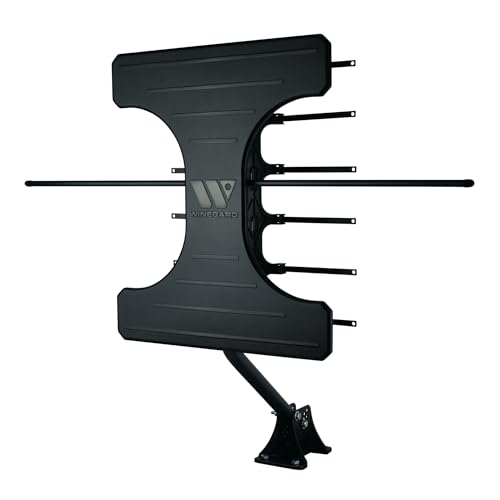
- 2. Winegard Elite 7550 Amplified Directional
- 3. GE Outdoor Yagi TV Antenna, 33685
- 4. Antennas Direct DB8e 8-Element Bowtie
- 5. Winegard YA7000C Full-Band Yagi
- Before You Buy: Checks for Rural Antennas
- Frequently Asked Questions
- Conclusion
- Product and ASIN Reference
How to Choose TV Antennas for Rural Areas
Check the towers before buying the antenna. An antenna is bought by distance, direction and band, and all three are free to look up before anything is ordered. AntennaWeb and the FCC reception maps take a home address and return the towers, their distance in miles, their compass direction, and whether each station broadcasts on UHF, high VHF or low VHF. If the towers sit within 50 miles and spread around the compass, a multi-directional loop or bowtie is enough. If the towers sit 60 miles or more away in one direction, a directional Yagi earns its place. If the map shows stations on low VHF, channels 2 through 6, only the YA7000C in this guide covers that band natively, and a home with an important low-VHF station should favor it or plan on a separate low-VHF element.
Treat advertised range as a best case, not a promise. A range figure is measured with a clear line of sight, and a rural home rarely has one: hills, trees, barns and distance all eat signal, and the curve of the Earth itself blocks most broadcast signals at about 70 miles, which is why the honest picks in this guide cluster at 70 to 80 miles. Claims of 150 miles or 200 miles are not credible for ordinary hardware, and this guide leaves those antennas out entirely. The honest way to read the numbers here is as a ranking: the 80-mile GE Yagi sits at the top, the four 70-mile picks sit together below it, and the real reception in any given home depends on the terrain and the distance together. A rooftop mount beats an attic mount for the same reason, because the roof is one more layer of signal loss removed.
Decide on amplification by signal strength, not by habit. An amplifier helps when the signal arriving at the antenna is weak, and it hurts when the signal is already strong, because too much gain overloads the tuner and the picture breaks up worse than it did without the amplifier. The Winegard Elite 7550 in this guide carries a built-in amplifier with a 20 dB preamplifier, which is the right kind for weak signals at the end of a long cable run or a run feeding several televisions. The four passive picks are the right kind for strong signals near the towers or for short cable runs, and a passive antenna with a separate mast-mounted preamplifier added later is the flexible option for a home that is not sure which it needs. If the towers are close and the picture still breaks up, the amplifier is the first suspect, not the antenna, and the fix is a passive antenna or an amplifier that can be switched off, not a bigger amplifier.
Match the design to the towers, not the other way around. A directional Yagi must point at the towers, so it needs a clear aim in one direction and a mount that holds that aim, which the GE Yagi provides with its included J mount and the YA7000C provides with its universal mount system. A multi-directional loop or bowtie receives from several directions, so it forgives towers that sit on opposite sides of the house, which is the ClearStream 4MAX and the DB8e advantage. A bowtie is strongest on UHF, so a market with important high-VHF stations favors the loop or Yagi designs, and the DB8e needs a separate VHF kit for high-VHF reception, which is sold separately and is not part of the pick. The ClearStream 4MAX is the only multi-directional pick here that covers VHF in the box.
Plan the cable run and the mount before the antenna goes up. Rural homes often have long runs from a rooftop mast to the television, and long runs lose signal, so a run over 50 feet to a single television, or any run that feeds several televisions through a splitter, may need a distribution amplifier at the antenna end. Every splitter costs signal, so one antenna feeding four televisions is a different job from one antenna feeding one television, and the amplifier question should be settled with the splitter in mind. None of the five picks here ships with a coaxial cable except the complete kit version of the ClearStream 4MAX, which is a separate listing from the pinned standard version, so the cable run must be bought to length with RG6 coaxial cable, and the mast must be bought separately for the picks that do not include one.
Respect power lines and the roof. A rural rooftop antenna goes up near the service drop and the roofline, and the safety section below names the federal record that makes the hazard more than a suggestion. The practical rule is simple: install in daylight, keep the mast and the ladder clear of overhead power lines, ground the mast and the coaxial cable the way the maker’s instructions describe, and never install during a lightning storm or high winds.
Quick Comparison
| Product | Design | Advertised range | Best for |
|---|---|---|---|
| Antennas Direct ClearStream 4MAX | Multi-directional loop, 4 elements | 70 miles | The default pick, towers in several directions |
| Winegard Elite 7550 | Amplified directional | 70 miles | Long cable runs, weak signals, multi-television setups |
| GE Outdoor Yagi, 33685 | Directional Yagi with J mount | 80 miles | The budget pick, towers in one direction |
| Antennas Direct DB8e | 8-element bowtie, multi-directional | 70 miles | The highest-gain pick, UHF-heavy markets |
| Winegard YA7000C | Full-band Yagi | 70 miles | Low-VHF stations, the full-band pick |


1. Antennas Direct ClearStream 4MAX

The ClearStream 4MAX is the antenna to buy first for most rural homes, because it is the only pick here that combines a 70-mile advertised range with a multi-directional design and VHF coverage in the box. Four patented loop elements receive UHF signals from several directions at once, and the reflector design adds VHF reception, so towers on opposite sides of the house both come in without re-aiming, and the 70-mile range is the honest top of the multi-directional class: far enough for rural towers, without the size and the aiming demands of a long Yagi. The 20-inch mast and the mounting hardware are included, so it mounts to a mast in the attic or on the roof, and the whole assembly is built for indoor or outdoor use, which means attic heat and dust are not a problem for it.
The multi-directional design is the detail that justifies the pick. A directional antenna must be aimed, and a rural home rarely offers a clean aim in one direction, because the towers may sit in two counties at once, and the trees and hills between the house and the towers do not respect compass bearings. The 4MAX receives from several directions, so it works with the towers wherever they sit, and the 43-degree horizontal reception pattern is wide enough that a small error in placement does not cost channels. The antenna is also ready for the current broadcast standard, with 4K and 8K UHD reception and NEXTGEN TV support, which is the ATSC 3.0 standard rolling out in many markets, so the purchase is not tied to the older broadcast format. Its peak gain is 12.25 dBi on UHF, which is the strongest loop gain in this guide.
The limits are the usual ones for a loop antenna. It is larger than a flat panel, so a home with no attic and no mast may suit the compact GE Yagi better, and it ships without a coaxial cable, so the cable run to the television must be bought separately and sized to the distance. The complete kit version of this antenna, which adds cable, an amplifier and a splitter, sells under a separate listing, so the listing to confirm at checkout is the standard version pinned in the reference table below, not the kit. For a rural home with towers in more than one direction and a 70-mile reach, the 4MAX is the default pick, and its mounting hardware is the reason it installs in an afternoon instead of a weekend.
Specs
- Design: multi-directional loop antenna, 4 patented elements
- Range: 70 miles advertised
- Bands: UHF, with VHF through reflector design
- Gain: 12.25 dBi peak on UHF
- Beam angle: 43-degree horizontal reception pattern
- Mast: 20-inch mast and mounting hardware included
- Use: indoor, attic or outdoor
- Broadcast: 4K and 8K UHD, NEXTGEN TV
- Cable: not included
- Tier: Premium
2. Winegard Elite 7550 Amplified Directional
The Winegard Elite 7550 is the amplified pick, and it earns its place because it solves the weak-signal problem at the antenna instead of at the television. A compact directional body hides an embedded Boost ultra-low-noise amplifier with a 20 dB preamplifier, which sits directly at the elements, where the full signal is amplified before the cable run can lose any of it. That placement is the engineering point: amplifying at the antenna preserves the signal, while amplifying at the television end only amplifies the noise the cable picked up along the way. The 70-mile advertised range covers high VHF and UHF, and the antenna has been tested in wind tunnels above 100 miles per hour and exposed to salt and fog, which is the durability a rooftop antenna needs in open country.
The amplifier is the detail that sets this pick apart from the four passive antennas in this guide. A rural home with a long cable run from a rooftop mast to the television, or a run that feeds two or three televisions through a splitter, loses signal on every foot of cable and every split, and the embedded amplifier offsets those losses before they happen. The mounting supplies are included, with a pipe, a foot and the hardware, and the inline 5-volt power inverter with an LED indicator and a 3-foot USB power cable with a 110-volt adapter make the power setup visible and simple. The antenna is directional, so it must be aimed at the towers, and the compact flat body sits quietly on a roof or tucks into an attic.
Buy the Elite 7550 if the towers sit in one direction, the signals are weak enough to need amplification, and the cable run is long or split among several televisions. Buy the ClearStream 4MAX if the towers sit in several directions, or the GE Yagi if the budget is the deciding factor and the run is short. The amplifier is the Elite 7550 advantage and its risk in the same package: a home within about 15 miles of the transmitters should skip it, because the amplifier may overload the tuner there, and the passive picks are the right choice for strong signals.
Specs
- Design: amplified directional antenna
- Range: 70 miles advertised
- Bands: high VHF and UHF
- Amplifier: embedded Boost ultra-low-noise amplifier, 20 dB preamplifier
- Mount: pipe, foot and hardware included
- Power: inline 5-volt power inverter with LED indicator, 3-foot USB cable, 110-volt adapter
- Use: outdoor or attic
- Broadcast: 4K and 1080p high definition
- First available: October 2017
- Tier: Mid-range
3. GE Outdoor Yagi TV Antenna, 33685

The GE Outdoor Yagi is the budget pick, and it earns its place by being the cheapest way to put a real directional antenna on a rural roof with the longest advertised range in this guide. It is a Yagi-style antenna rated to 80 miles, covering VHF and UHF with support for 4K and 1080p high-definition broadcasts, and it comes with a J mount included, so it mounts to a roof or a mast and aims at the towers without extra hardware. The maker describes it as long range and lists up to 200 potential channels, which is a count of what the tuner may find across the bands rather than a promise, and the honest reading is that it suits towers at a moderate to long distance in one direction rather than the farthest fringe in the guide.
The Yagi design is the practical advantage. A Yagi is a directional array: a row of elements on a boom that focuses reception in one direction and rejects signals from the sides, which is why it reaches farthest when the towers all sit on one bearing. The GE Yagi is weather resistant, so the same antenna works on the roof or in the attic if the roof turns out to block too much signal, and it carries a limited-lifetime replacement pledge with free United States-based technical support, which is rare at this price point. It is also ATSC 3.0 compatible, so it is ready for the NEXTGEN TV standard as it rolls out.
The trade is that the antenna is passive and directional, so it has no amplifier and must be aimed. A weak signal at the end of a long cable run may need a separate preamplifier, and a market with towers in opposite directions will suit the multi-directional ClearStream 4MAX better. The listing records reviewed are about 237 days old, so the live page deserves a glance before ordering to confirm the seller and the availability. Buy the GE Yagi if the budget is the deciding factor, the towers sit in one direction at a moderate to long distance, and the home has room for a small J-mount antenna on the roof or in the attic.
Specs
- Design: directional Yagi-style antenna with J mount
- Range: 80 miles advertised
- Bands: VHF and UHF
- Channels: up to 200 potential
- Mount: J mount included, for attic or outdoor
- Use: attic or outdoor, weather resistant
- Broadcast: 4K and 1080p high definition, NEXTGEN TV
- First available: June 2016
- Tier: Budget
4. Antennas Direct DB8e 8-Element Bowtie
The Antennas Direct DB8e is the highest-gain pick in this guide, and it earns its place because it is the design that pulls UHF signals through trees and roofing when nothing else will. Eight bowtie elements in two panels deliver a maximum gain of 17.4 dBi, which the maker describes as the most powerful bowtie gain available, and the specially designed brackets let the two panels turn to target towers in different directions, so the antenna works as a multi-directional array without a rotor. The 70-mile advertised range is the honest top of the bowtie class, and the antenna is built for indoor, attic or outdoor use with all-weather mounting hardware and an adjustable mast clamp in the box.
The gain is the detail that justifies the pick. Gain is what separates a signal from the noise around it, and the DB8e has more of it than any other antenna in this guide, which is why it suits rural installations challenged by heavy foliage or roofing materials. The two panels can be aimed together at one tower cluster or split to cover two directions, which is the flexibility a rural home with towers in two counties needs, and the antenna carries a lifetime manufacturer warranty, which is the longest warranty in this guide. It supports NEXTGEN TV, 4K, 8K UHD and Full HD 1080p broadcasts without an internet connection, so the purchase is current with the broadcast standard.
The limits are the usual ones for a bowtie. It is UHF only, so it receives real channels 14 through 51 and needs a separate VHF kit for high-VHF reception, which is sold separately and is not part of the pick. A market with important high-VHF stations should favor the ClearStream 4MAX or one of the Yagi picks instead. At about 37 inches high and 50 inches wide it is also the widest antenna in this guide, so it needs a solid mast and room to turn. Buy the DB8e if the market is UHF-heavy, the signals are weak, and the home has room for a large bowtie array on the roof or in the attic.
Specs
- Design: 8-element bowtie, multi-directional, two adjustable panels
- Range: 70 miles advertised
- Bands: UHF only, real channels 14 through 51
- Gain: 17.4 dBi maximum
- Size: about 37 x 50 x 6 in
- Weight: about 12 lb
- Mount: all-weather mounting hardware, adjustable mast clamp included
- Use: indoor, attic or outdoor
- Broadcast: NEXTGEN TV, 4K, 8K UHD, Full HD 1080p
- VHF kit: compatible, sold separately
- Warranty: lifetime manufacturer warranty
- Tier: Premium
5. Winegard YA7000C Full-Band Yagi
The Winegard YA7000C is the full-band pick, and it earns its place because it is the only antenna in this guide that covers low VHF as well as high VHF and UHF. A compact Yagi with a fold-and-lock design covers VHF-low channels 2 through 6, VHF-high channels 7 through 13, and UHF channels 14 through 50, with an optimized design that gives uniform gain and an increased front-to-back ratio, so it rejects signals from behind the antenna and hears the towers in front of it more clearly. The 70-mile advertised range is the honest top of the full-band class, and the universal mount system is included, so it mounts to a roof, an attic or a mast without extra hardware.
The low-VHF coverage is the detail that sets this pick apart. Most modern antennas skip low VHF entirely, because few stations still broadcast there, but a rural market with a low-VHF station on the map has no use for an antenna that cannot hear it, and the YA7000C is the pick that does. The fold-and-lock elements assemble in minutes, with low-band element extensions included for channels 2 through 51, and the antenna is about 37 inches long and about 5.5 pounds, which makes it compact for a full-band Yagi and light enough for a simple mount. The 75-ohm impedance is the standard for television coaxial cable, so no matching transformer is needed.
Buy the YA7000C if the tower map shows a low-VHF station, the towers sit in one direction, and the home needs one antenna that covers every band. Buy the GE Yagi if the budget is the deciding factor and the market has no low-VHF stations, or the ClearStream 4MAX if the towers sit in several directions. The YA7000C is passive, so a weak signal at the end of a long cable run may need a separate preamplifier, and the coaxial cable is sold separately, so the run to the television must be bought to length.
Specs
- Design: full-band Yagi, fold-and-lock elements
- Range: 70 miles advertised
- Bands: VHF-low channels 2 through 6, VHF-high channels 7 through 13, UHF channels 14 through 50
- Impedance: 75 ohm
- Size: about 37 x 34.5 x 19 in
- Weight: about 5.5 lb
- Mount: universal mount system included
- Use: roof, attic or mast
- Broadcast: Full HD
- Tier: Mid-range
Before You Buy: Checks for Rural Antennas
Confirm the exact variant on the live page, because antennas sell in families that look alike. The ClearStream line sells the 4MAX in a standard version and a complete kit version with cable, amplifier and splitter, and the pinned listing is the standard version, so the listing title is the check that matters there. The Winegard Elite line sells the 7550 amplified directional and a separate omnidirectional 360 model under the same Elite name, and the pinned listing is the amplified directional 7550, so the words Amplified Directional in the title are the check that matters there. The GE line sells attic-mount, outdoor Yagi and flat-panel antennas under the same brand, so the model number 33685 is the check that matters for the Yagi pick. The DB8e sells alongside the older 8-element bowtie under a similar name, and the pinned listing is the DB8e with the 17.4 dBi gain figure, so the gain figure is the check that matters there. Ordering from a search result without reading those lines can deliver the right antenna in the wrong configuration, which is a return rather than a re-aim.
Check the live offer, because listing records lag. The Winegard YA7000C manual record was crawled less than a minute before this guide was written, which is the freshest stock evidence in this guide, and the other four listings were confirmed in Amazon listing records crawled within the last eight months. The GE Yagi and the DB8e deserve the closest glance, because their listing records are the oldest in this guide, and a quick look at the live page confirms the seller and the availability before the order goes in. The Channel Master 8-bay bowtie was considered for this guide and set aside because no clean Amazon listing record could be pinned to it through the sanctioned routes, so it is not repeated here.
Map the towers and mind the roof. AntennaWeb and the FCC reception maps give the distance, the direction and the band for every local station, and those three numbers settle the design before anything is ordered. A metal roof or a foil-faced radiant barrier can block an attic antenna outright, in which case the same antenna moves outdoors, which is why the attic-or-outdoor picks in this guide carry their mounts with them. A long coaxial run loses signal, so a run over 50 feet or a splitter feeding several televisions may need a distribution amplifier at the antenna end, and every splitter costs signal, so the amplifier question should be settled with the splitter in mind.
On safety recalls, no pick in this guide is covered by one, and the record that matters is the power-line record. A search of the federal recall record found no CPSC recall covering TV antennas as a class, and none covering any of the five picks or their makers. The records on file are different products, named here so the categories stay separate: the CPSC warned in 1973 about the Little Wonder TV Antenna, a device that connected antenna leads directly to home electrical outlets with no safety device, creating a severe shock hazard, and the Commission moved to remove it from the marketplace; the Shakespeare Company recalled two models of omnidirectional CB base station antennas in 1983, Styles 176-S and 176-SU, because contact with a power line during installation or removal could cause severe or fatal shock; and the CPSC proposed in 1978 that outdoor CB and TV antennas carry warning labels and instructions, after 122 deaths and 156 injuries in a single year associated with antennas contacting overhead power lines during installation and removal. None of those is a pick in this guide, and the practical lesson is the same one the proposal carried: never install an antenna near overhead power lines, install in daylight, and keep the mast and the ladder clear of the service drop. The attic fan motor recall of August 2025, covering about three million Air Vent motors sold from 2003 to 2013, is also named here only to keep it separate: it covers attic fans, a different product that merely shares the word attic. The Vizio television recall of 2014, covering about 245,000 E-series televisions with faulty included stands, is named for the same reason: it covers televisions, not antennas. The Sauder television stand recall of December 2007, covering model 402806, and the Ameriwood Ridgewood and Charleswood entertainment center recall of the same month, covering about 138,000 units of model 93956, are also named only to keep them separate: they cover television furniture, a different product.
Frequently Asked Questions
How far can a rural TV antenna really reach?
The picks in this guide advertise 70 miles on four antennas and 80 miles on the GE Yagi, and those figures are best cases measured with a clear line of sight. A rural home is not a clear line of sight: hills, trees, barns and distance all cost signal, and the curve of the Earth blocks most broadcast signals at about 70 miles, which is why claims of 150 miles or 200 miles are not credible for ordinary hardware. The honest way to read the numbers is as a ranking, and the real test is a channel scan after installation, with the antenna repositioned a few feet at a time and re-aimed until the scan holds the stations the household watches.
Do I need an amplifier in a rural home?
Only if the signals arriving at the antenna are weak, or the cable run is long, or the run feeds several televisions. An amplifier helps a weak signal and hurts a strong one, because too much gain overloads the tuner and the picture breaks up worse than it did without the amplifier. The Winegard Elite 7550 in this guide carries a built-in amplifier for weak signals and long runs, and the passive picks suit towers that are close and strong or runs that are short. If the picture breaks up with an amplifier in line, the amplifier is the first suspect, and the fix is a passive antenna or an amplifier that can be switched off, not a bigger amplifier.
Can one rural antenna feed several televisions?
Yes, with a splitter, but every split costs signal, so one antenna feeding four televisions is a different job from one antenna feeding one. A passive splitter divides the signal among the outputs, and a long cable run after the split loses more, so a distribution amplifier at the antenna end is often the piece that makes a multi-television setup work. The amplifier belongs at the antenna, where the signal is strongest, not at the television, where it would only amplify the noise the cable picked up along the way. The Elite 7550 with its built-in amplifier is the pick in this guide that handles this job without extra hardware.
Should a rural antenna go on the roof or in the attic?
On the roof, whenever the home allows it. The roof is one more layer of signal loss removed, and a rural home is already fighting distance and terrain, so the attic costs channels that the roof keeps. An attic mount works when the towers are near, the roof is asphalt shingles over plywood, and the antenna is one of the attic-or-outdoor picks in this guide, but a metal roof or a foil-faced radiant barrier can block an attic antenna outright, in which case the same antenna moves outdoors. The mount and the grounding stay the same either way: a solid mast, a clear aim, and a grounded cable run.
Conclusion
The Antennas Direct ClearStream 4MAX with its 20-inch mast is the antenna to buy first for most rural homes: a multi-directional loop that hears towers in several directions, a 70-mile advertised range, and mounting hardware in the box, so it installs to a mast in an afternoon. The Winegard Elite 7550 is the amplified directional alternative for weak signals, long cable runs and multi-television setups. The GE Outdoor Yagi is the budget pick for towers in one direction, with the longest advertised range in this guide. The Antennas Direct DB8e is the highest-gain pick for UHF-heavy markets where the signals are weak and the trees are thick. The Winegard YA7000C is the full-band Yagi for markets with a low-VHF station that the other picks cannot hear. Choose by the tower map first, then by the roof, and any of the five will do the job its specifications promise.