Our Short List of 3
All 4 Picks at a Glance
| Product | Specs | Action |
|---|---|---|
 Super Lube 56204 O-Ring Silicone Lubricant | Check price on Amazon | |
 Danco 88693 Waterproof Silicone Faucet Grease | Check price on Amazon | |
 KEZE Waterproof Food Grade Silicone Lubricant | Check price on Amazon | |
 BTAS Pool Silicone Grease | Check price on Amazon |
Key takeaways
- Find the best lubes for hot tubs to protect O-rings, jets, valves, and pump seals from leaks, sticking, and wear. Compare top silicone and PTFE greases.
A hot tub is a simple pleasure until a small seal starts to leak. Pump lids stick, jet fittings squeak, union O-rings flatten and crack, and a slow drip turns into a weekend repair. The fix is often unglamorous but cheap and quick: the right lubricant, applied to the right seals at the right time. The best lubes for hot tubs are maintenance greases made for O-rings, gaskets, valves, and pump seals, and they keep the moving and sealing parts of your spa working the way the manufacturer intended.
To be clear about what this guide covers: these are equipment lubricants for hot tub parts, not personal lubricants. They are applied to rubber O-rings, pump lids, jet bodies, union fittings, diverter valves, and filter housings. They are not meant to be added to the water, and they should never be used as a substitute for a worn or damaged seal. Used correctly, a thin film of the right grease keeps seals pliable, prevents them from bonding to their seats, and makes disassembly far easier the next time you open the equipment for cleaning or a filter change.
This guide compares four lubricants that suit hot tub maintenance, explains how to choose between silicone and PTFE formulas, and answers the questions owners ask most often before their first tube runs out. Availability changes over time, so check the listing before ordering, and always confirm compatibility with your tub’s seals and your owner’s manual.
At a Glance
| Product | Best for | Key spec |
|---|---|---|
| Super Lube 56204 O-Ring Silicone Lubricant | All-round O-ring care | 4 oz silicone fluid, rated to 392°F |
| Danco 88693 Waterproof Silicone Faucet Grease | Small jobs and valve stems | 0.5 oz tube, rated to 400°F |
| KEZE Food Grade Silicone Lubricant | Food-grade sealing work | 1 oz bottle, rated from -40°F to 400°F |
| BTAS Pool Silicone Grease | Larger maintenance sessions | 5 oz bottle, rated from -40°F to 428°F |
How to Choose a Lubricant for Your Hot Tub
Choosing a hot tub lubricant is mostly about chemistry, compatibility, and the size of the job. The wrong product can swell a seal, wash out of a fitting, or contaminate the water. The right one disappears into the background and simply keeps things sealed and moving.
Base formula: silicone or PTFE. Silicone greases are the default choice for hot tub seals. They stay flexible across a wide temperature range, resist water washout, and are compatible with most rubber and plastic parts found in spas. PTFE, often sold as Teflon-based lubricant, is chemically inert and will not break down rubber over time, which makes it a strong choice for owners who service their own pumps and valves every season. Either base works well for O-rings; the deciding factor is usually what your equipment manual recommends and which seals you are servicing.
Rubber compatibility. Hot tub seals are commonly made from EPDM, silicone rubber, or Buna-N. Silicone and PTFE greases are generally safe on these materials, while petroleum-based greases are not. Petroleum products can soften, swell, and degrade rubber, which leads to leaks rather than preventing them. Before applying any lubricant, check that the product label lists compatibility with your seal material, and when in doubt, apply a small amount to a spare O-ring first and check it after a day.
Water and chemical resistance. A hot tub is a warm, chlorinated or brominated environment, and the lubricant on a pump lid or union fitting sits close to that water. A grease that washes out quickly leaves the seal unprotected. Look for products described as waterproof and chemical resistant, and reapply whenever you disassemble a fitting. A lubricant that stays put between service intervals is worth more than one that needs constant reapplication.
Temperature range. Hot tub water typically runs well below the upper limits of these greases, but the equipment bay can get warm, and winter storage can get cold. A wide temperature range, such as -40°F to 400°F, means the grease will not melt out in summer heat or stiffen into a useless paste in a cold garage. Check the rating on the tube and match it to the conditions your equipment actually faces.
Tube size and application. A half-ounce tube is plenty for occasional valve-stem work and a single pump lid, while a four or five-ounce bottle makes more sense if you service the whole tub each season, including jets, unions, and the filter housing. Squeeze tubes and bottles with a narrow tip give better control than wide tubs, and a little goes a long way. Over-application attracts grit and can squeeze into places it does not belong, so apply a thin, even film and wipe away the excess.
Safety and food-grade ratings. Some silicone greases carry food-grade or NSF ratings, which means they are formulated to be safe around drinking water and are non-toxic. That matters when the fitting you are servicing sits near water people soak in. A food-grade rating is a useful tiebreaker between two otherwise similar products, especially for owners who want the lowest-risk option for seals near the water path.
Product Reviews
Super Lube 56204 O-Ring Silicone Lubricant
Super Lube 56204 is a purpose-built O-ring silicone lubricant that fits hot tub maintenance well. It is a non-curing silicone fluid designed to lubricate, seal, and condition O-rings and other regulator, vacuum, and valve system components, which covers the exact parts that give hot tub owners trouble: pump lids, union fittings, diverter valves, and filter housings. The formula is moisture resistant, heat stable, and food grade H1 rated, and it is compatible with most plastics and rubbers, so it suits the mixed materials found in a typical spa equipment bay.
The specifications are straightforward and practical. It comes in a 4-ounce bottle, weighs 4 ounces, and is rated to an upper temperature of 392 degrees Fahrenheit. The liquid form spreads easily into a thin, even film on an O-ring, which makes it simple to coat a pump lid seal without overdoing it. The bottle format also keeps the product clean between uses, since you are not dipping fingers into an open tub. Its model number is 56204, and it has been listed on Amazon since April 2018.
This is the strongest all-round pick for owners who want one lubricant for the whole tub. The four-ounce size covers several full service sessions, and the silicone base handles both warm water and cold storage. Its main limitation is that it is a fluid rather than a thick paste, so on vertical seal surfaces a thicker grease may stay in place a little longer. For most residential hot tubs, though, the ease of application and the broad compatibility make it the default choice.
Pros:
– Purpose-built for O-rings, valves, and seals
– Food grade H1 rated and compatible with most plastics and rubbers
– Heat stable to 392 degrees Fahrenheit
– 4-ounce bottle covers multiple service sessions
Cons:
– Fluid consistency may run on vertical surfaces compared with a thick paste
– Bottle format offers less precision than a narrow squeeze tube
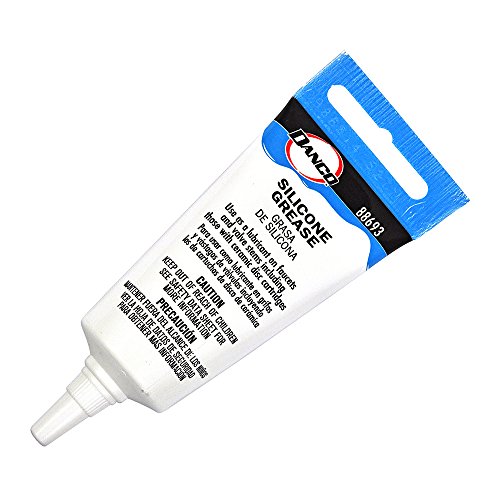
Danco 88693 Waterproof Silicone Faucet Grease
Danco 88693 is a compact waterproof silicone grease that earns its place in a hot tub toolkit by doing small jobs well. It is a 0.5-ounce tube of silicone grease made for lubricating moving parts in plumbing and household applications, including O-rings, valve stems, and cartridges. In a hot tub, that translates to jet valve stems, diverter seals, and any small fitting that has become stiff or squeaky. Its small size is a feature rather than a drawback for owners who only need a dab at a time.
The listed specifications underline its suitability for wet environments. It is a grease, not a liquid, so it stays where it is applied. It is rated to an upper temperature of 400 degrees Fahrenheit, with a flash point of 200 degrees Celsius, and it is listed as not discontinued by the manufacturer. The tube measures 4.63 by 2.75 by 3 inches in its packaging and weighs half an ounce. It has been listed on Amazon since January 2007, making it one of the longest-running silicone greases in this category, and its UPC is 037155886937.
This is the best choice for owners who want a small, inexpensive tube for targeted repairs rather than a large bottle for whole-tub servicing. It is easy to keep in a toolbox, it applies precisely, and the thick grease clings to vertical seal surfaces. The obvious limitation is quantity: half an ounce will not last long if you are servicing every jet, union, and pump seal in one session. For a single sticky valve or a pump lid that will not budge, however, it is exactly the right size.
Pros:
– Thick grease stays put on vertical surfaces
– Waterproof silicone formula for wet plumbing parts
– Rated to 400 degrees Fahrenheit
– Compact 0.5-ounce tube is easy to store and apply precisely
Cons:
– Small quantity runs out quickly on whole-tub servicing
– Best suited to small fittings rather than large pump and filter seals
KEZE Waterproof Food Grade Silicone Lubricant
KEZE’s food grade silicone lubricant is a one-ounce bottle built around clean, safe sealing work. It is described as a waterproof, odorless, and colorless silicone grease for valves, faucets, O-rings, filters, and pool equipment, and the listing names pool lube and O-ring use directly. For hot tub owners, that combination matters: the product is aimed at the same class of seals found in spa equipment, and the food-grade formulation means it is made not to contaminate water it comes near.
The specifications are practical for routine maintenance. It is a one-ounce bottle of silicone grease, weighing one ounce, with a listed temperature range of -40 degrees Fahrenheit to 400 degrees Fahrenheit, so it stays workable in a cold garage and stable in a warm equipment bay. It is odorless and colorless, which keeps application clean and avoids staining light-colored fittings or leaving a visible residue on a pump lid. The brand is KEZE, and the product is packaged as a single one-ounce bottle.
This is a strong pick for owners who prioritize a food-grade, non-toxic formula for seals near the water path. The one-ounce size is enough for several individual jobs, such as a pump lid, a pair of union O-rings, and a diverter valve, without committing to a large bottle that may sit unused for a year. Its limitation is the same as its strength: the small bottle is not the economical choice for owners who service a large tub and a pool every season. For a single hot tub, though, it is a sensible middle ground between the tiny Danco tube and the larger bottles in this guide.
Pros:
– Food-grade silicone, odorless and colorless
– Listed for pool equipment, valves, filters, and O-rings
– Wide temperature range from -40°F to 400°F
– One-ounce bottle suits several maintenance jobs
Cons:
– Small bottle is not the best value for very large or frequent servicing
– Less widely known as a brand than the long-established options
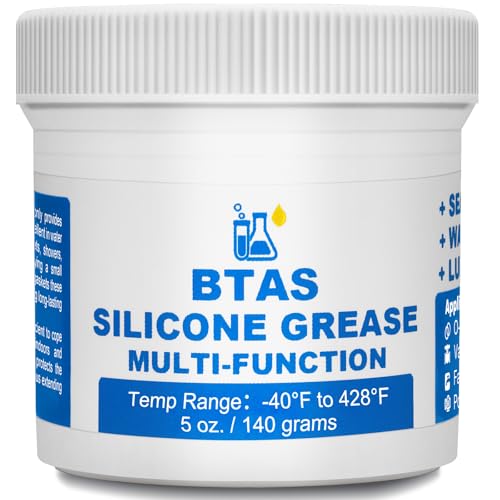
BTAS Pool Silicone Grease
BTAS Pool Silicone Grease is the large-format option in this guide, and it is the one to reach for when a whole maintenance session is on the schedule. The listing describes it as a food-grade silicone grease for pool O-rings, filter gaskets, faucets, valve stems, cartridges, gears, bearings, and seals, which maps closely onto the parts of a hot tub that need regular attention. It is odorless and colorless, thick and clear, and described as non-melting and non-drip, so it stays on the seal rather than migrating into the water path.
The specifications suit heavier use. It comes in a five-fluid-ounce bottle, with a temperature range of -40 degrees to 428 degrees Fahrenheit and an upper temperature rating of 428 degrees Fahrenheit, which is the widest range in this guide. Its viscosity is listed at 7 centipoise, and the part number is GZ-5 with model number SG100. The waterproof formula is rust and corrosion resistant, and it is listed for O-rings, gaskets, faucets, valve stems, cartridges, gears, bearings, and seals, which covers nearly every sealing surface on a residential spa.
This is the best choice for owners who service their tub thoroughly each season and want one bottle that lasts. Five ounces covers pump lids, union fittings, jet bodies, and filter housings with product to spare, and the high temperature ceiling gives extra headroom in a warm equipment bay. The trade-off is size: a five-ounce bottle is more than a casual owner needs. It is also a newer listing than the long-established brands here, so it has a shorter track record, but its specifications and pool-specific labeling make it a solid large-format pick.
Pros:
– Large 5-ounce bottle covers full-season servicing
– Widest temperature range in this guide, -40°F to 428°F
– Food-grade, odorless, colorless, and non-melting
– Listed specifically for pool O-rings, gaskets, and filter seals
Cons:
– Larger bottle is more than occasional users need
– Newer listing with a shorter track record than established brands
Which One Fits Your Hot Tub
The right choice depends on how much servicing you do and which seals give you trouble. For most hot tub owners, Super Lube 56204 is the best starting point: it is purpose-built for O-rings, it comes in a useful four-ounce size, and its food-grade rating and broad compatibility cover the whole equipment bay. If your main problem is a single sticky valve or a pump lid that will not turn, the small Danco 88693 tube is the cheapest and most precise way to fix it without buying a large bottle.
Owners who want a food-grade formula in a middle size should look at the KEZE one-ounce bottle, which balances clean application with enough product for several jobs. Owners who service the entire tub each season, including every jet, union, and filter seal, will get the best use from the five-ounce BTAS bottle, whose wide temperature range and large volume suit heavy maintenance. Whichever you choose, keep petroleum greases away from your seals, apply a thin film, and re-lubricate every time you open a fitting.
Frequently Asked Questions
What kind of lubricant should I use on hot tub O-rings?
Use a silicone or PTFE grease made for O-rings, gaskets, and seals. Both bases are waterproof, resist chemical exposure, and are compatible with the rubber compounds used in hot tub seals. Avoid petroleum-based greases and household oils, which can swell and degrade rubber and lead to leaks.
Can I use regular silicone grease from the hardware store on my hot tub?
In many cases, yes, provided it is a silicone grease rated for plumbing or O-ring use and it is compatible with your seal material. The products in this guide are chosen because their listings name O-rings, valves, and pool or spa equipment directly. Check the label for rubber compatibility and temperature range before applying.
Where exactly do I apply lubricant on a hot tub?
Apply a thin film to the O-rings on pump lids, union fittings, jet bodies, diverter valves, and filter housings, and to the seals on drain plugs and heater unions. Clean the seal and its groove first, coat the O-ring evenly, seat it without twisting, and wipe away excess. Never pour lubricant into the water or into the filter itself.
How often should I lubricate hot tub seals?
Re-lubricate whenever you disassemble a fitting, and inspect seals at least once a season. If an O-ring looks dry, stiff, cracked, or flattened, lubricate it if it is still sound, or replace it if it is damaged. Regular inspection prevents the small leaks that turn into larger repairs.
Will lubricant in the water harm bathers?
Lubricant applied correctly to a seal should not enter the water in any meaningful amount. Apply a thin film, wipe away excess, and keep the product off surfaces that sit in the water path. Food-grade silicone greases add an extra margin of safety, but they are still maintenance products for equipment, not additives for the water.
Can lubricant fix a leaking hot tub?
It can fix a leak caused by a dry, stiff, or poorly seated O-ring, since lubrication helps the seal compress evenly and stops it from pinching during assembly. It will not fix a cracked seal, a wrong-size O-ring, a damaged fitting, or a cracked shell. If lubrication does not stop the leak, replace the seal and inspect the fitting.
Conclusion
A hot tub does not need much to stay sealed and quiet: clean O-rings, a thin film of the right grease, and a quick inspection each season. Silicone and PTFE lubricants made for O-rings protect the seals that keep water where it belongs, and they make every future service job easier. Super Lube 56204 covers most owners as an all-round choice, Danco 88693 handles small targeted jobs, KEZE offers a clean food-grade option, and BTAS covers full-season servicing in a large bottle. Pick the size and formula that match your tub, apply it sparingly, and your seals will last longer with fewer leaks.
Disclosure: As an Amazon Associate, we earn from qualifying purchases.