Our Short List of 3
All 3 Picks at a Glance
| Product | Specs | Action |
|---|---|---|
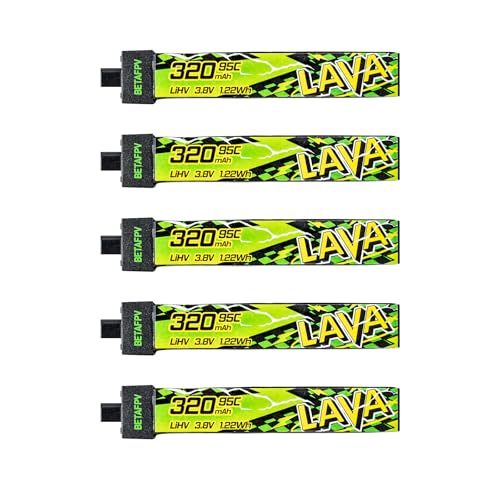
| 1. BETAFPV Lava II 1S 320mAh 95C LiHV (5pcs) — the lively 65mm pick | Check price on Amazon | |
 2. BETAFPV BT2.0 450mAh 1S 30C (4pcs) — the balanced everyday pick | Check price on Amazon | |
 3. BETAFPV BT2.0 550mAh 1S 40C (4pcs) — the longer-flight pick | Check price on Amazon |
Key takeaways
- A focused guide to micro FPV batteries for tiny whoops and small 2S drones: BT2.0 1S packs in 320, 450 and 550mAh, how connectors and C-ratings work, and how to choose.
As an Amazon Associate we earn from qualifying purchases.
Affiliate Disclosure: This article contains affiliate links. If you buy through a link on this page, we may earn a commission at no extra cost to you. Product specifications below are taken from the manufacturers’ and retailers’ published listings, and availability should be confirmed on the product page before you order.
How to read this guide: the scope we chose
The FPV battery market is enormous, running from tiny single-cell whoop packs to large six-cell freestyle batteries. This guide deliberately narrows that field. Here, the focus is the small end of the hobby: micro FPV drones and tiny whoops that fly on 1S power, plus the small 2S whoops that are commonly powered by a pair of 1S packs or a small dedicated 2S pack. If you fly a five-inch freestyle quad on 4S or 6S, this is not your guide. If you fly a 65mm or 75mm whoop around the house, a small cinewhoop, or a lightweight 2S micro, you are in the right place.
That narrowing matters because micro packs play by different rules. On a whoop that weighs less than the battery packs of a big quad, a few grams either way changes how the drone feels. Connector choice matters more, because the tiny plugs used at this scale can waste a real share of a small pack’s output. And flight times are measured in a few minutes, so capacity, weight, and discharge rating have to be balanced together rather than maximised one at a time.
All three picks below are genuine micro packs from BETAFPV’s published range, sold on Amazon US. Each is listed with its ASIN and an evidence level. All three are rated candidate: their Amazon US listings and specifications were confirmed from indexed product listings, but a live product-page read could not be completed at the time of writing, so confirm stock and the exact variant on the page before ordering.
Quick comparison
| Pick | Pack | Capacity | Voltage | Discharge | Connector | Best for |
|---|---|---|---|---|---|---|
| 1 | BETAFPV Lava II 1S 320mAh (5pcs) | 320mAh | 3.8V LiHV | 95C | BT2.0 | 65mm whoops, lively indoor flying |
| 2 | BETAFPV BT2.0 450mAh 1S (4pcs) | 450mAh | 3.8V LiHV | 30C | BT2.0 | 75mm whoops, balanced everyday flying |
| 3 | BETAFPV BT2.0 550mAh 1S (4pcs) | 550mAh | 3.8V | 40C continuous, 80C burst | BT2.0 | Longer flights on larger whoops |
1. BETAFPV Lava II 1S 320mAh 95C LiHV (5pcs) — the lively 65mm pick
The Lava II 320 is the pack aimed squarely at 65mm brushless whoops such as the Meteor65 class and the Cetus-style ready-to-fly kits named in its listing. It is a single-cell LiHV pack: nominal voltage 3.8 volts, charging to the higher LiHV ceiling rather than the standard LiPo ceiling, which is where the extra punch comes from. Capacity is 320mAh, the discharge rating is a headline 95C, the connector is BT2.0, and the published weight is about 8.2 grams with dimensions around 64 x 10.5 x 6.5 millimetres. The listing is for a five-pack, which suits whoop flying well, because whoop pilots rotate through several packs in a session rather than waiting on one.
Why it leads this list: on a 65mm whoop, weight is everything, and this is the lightest format here while still offering a high discharge rating for snappy throttle response. The Lava line uses a folded-cell construction that the manufacturer credits with a flatter discharge curve, meaning less voltage sag late in the flight. Treat the headline C-rating as a manufacturer’s figure rather than a laboratory measurement — that caution applies to every pack in this class — but the combination of low weight, LiHV chemistry, and the BT2.0 connector is exactly the recipe current 65mm builds are designed around.
Choose this pack if your whoop is a 65mm running 1S and you value agility over raw flight time. If your flights feel short even for a whoop, step up to the 450 size below rather than forcing this smaller pack to do a bigger job.
2. BETAFPV BT2.0 450mAh 1S 30C (4pcs) — the balanced everyday pick
The 450mAh BT2.0 pack is the middle path in BETAFPV’s range and the one that suits the widest spread of micro drones. Its published specification is a 450mAh single cell at 3.8 volts, a 30C discharge rating, BT2.0 connector, dimensions of about 62 x 15.5 x 6.7 millimetres, and a weight of about 12.7 grams per pack, sold as a set of four. The listing names compatibility with 75mm-class whoops such as the Meteor75 and with the Cetus Pro and Cetus X kits.
That extra capacity over the 320 buys noticeably longer flights on a 75mm whoop, and the wider, flatter format fits the battery bays of the larger whoop frames. The trade-off is the discharge rating: 30C is modest next to the Lava II’s headline figure, and aggressive pilots flying hard acro indoors may feel more voltage sag on punch-outs. For the way most people actually fly a 75mm whoop — cruising, practising lines, learning acro — that trade is usually worth it, and the calmer discharge character is gentler on the packs over a season of use.
This is also the size that bridges into 2S flying. Small 2S whoops in this class are commonly flown either on a dedicated small 2S pack with an XT30 connector or on paired 1S packs, depending on the frame, and 450 is the capacity where both approaches overlap. Check which arrangement your frame expects before ordering, because the connector, not the capacity, is what decides whether a pack fits your build.
3. BETAFPV BT2.0 550mAh 1S 40C (4pcs) — the longer-flight pick
The 550mAh pack is the endurance option in this trio. Published specifications give a 550mAh single cell at 3.8 volts, a discharge rating of 40C continuous and 80C burst, the BT2.0 connector, and a four-pack format aimed at 75mm to 85mm 1S whoops, with the Meteor75 Pro class named in the listing.
On the right frame, the step up from 450 to 550 is the difference between a flight that ends just as you settle into a rhythm and one that lets you finish the line you were practising. The cost is weight: every extra gram on a whoop dulls its response, and a frame designed tightly around a 450 bay may not accept the longer 550 format at all. Measure your battery bay, or check the frame maker’s stated battery size, before assuming the bigger pack fits.
Choose the 550 if your whoop is at the larger end of the micro class, your flying is more cruise than acro, and flight time is the thing you keep wishing for. Choose the 450 or 320 if your flying is tight, technical, and indoors, where a lighter pack you swap more often beats a heavier pack you fight.
Connectors: why BT2.0 dominates this class
All three picks use the BT2.0 connector, and that is deliberate rather than a coincidence. The older PH2.0 connector, common on earlier whoops, uses crimped pins that loosen and add resistance over time; on a pack this small, that resistance shows up as voltage sag and lost punch. BT2.0 uses a solid banana-style contact rated by its maker for substantially higher continuous current than PH2.0, and it has become the default on current BETAFPV whoops and most of the micro frames that followed them.
The practical rule is simple: match the pack to the connector on your drone. A BT2.0 pack will not plug into a PH2.0 pigtail without an adapter, and adapters at this scale add the very resistance and weight you were trying to avoid. When you upgrade an older whoop, changing the pigtail to BT2.0 and standardising on BT2.0 packs is one of the most effective small changes you can make. For dedicated 2S micro packs, the equivalent standard is XT30, a larger connector suited to two-cell current levels; do not confuse the two systems when ordering.
LiHV versus standard LiPo at micro scale
Two of the three picks are LiHV packs, and the third sits in the same 3.8-volt nominal family. LiHV cells charge to a higher per-cell ceiling than standard LiPo, which gives a stronger start to each flight and a little more usable energy from the same size cell. The obligations that come with that: you need a charger that has a LiHV mode and is set to it for these packs, and you should be consistent — charging a LiHV pack on a standard setting leaves performance on the table, while charging a standard pack on a LiHV setting is a genuine safety mistake. Keep the two chemistries labelled and separate in your charging routine if you own both.
Charging and care for micro packs
Micro packs live hard lives: high discharge rates in flight, many cycles, and long spells sitting in a flight bag. A few habits extend their useful life a great deal:
- Use a proper 1S charger or charging board that supports BT2.0 packs and, for LiHV packs, a LiHV charge mode. Parallel charging boards are popular for whoops; if you use one, only parallel packs that start at similar voltages.
- Bring packs back to storage charge if they will sit for more than a few days. Storing micro packs fully charged is the fastest way to puff them.
- Retire a pack that has puffed, been punctured in a crash, or comes down hot and weak compared with its siblings. At this size a replacement pack is a small purchase; a damaged lithium pack is not a small problem.
- Land when the pack still has something in reserve rather than flying every pack to the cut-off. Consistently deep-discharging micro packs shortens their life noticeably.
- Keep packs in a fire-resistant bag for storage and transport, and never charge them unattended.
How to choose among the three
Start from your frame, not from the biggest number. A 65mm whoop points to the 320 Lava II: light, high-discharge, built for that class. A 75mm whoop flown as an all-rounder points to the 450: the best balance of flight time, weight, and availability in multi-packs. A larger 75mm to 85mm whoop flown gently, or any micro where flight time is the priority and the bay accepts the longer format, points to the 550.
Then check three things before you order any of them: the connector on your drone is BT2.0, your charger supports the pack’s chemistry and connector, and the pack’s physical length fits your frame’s battery bay. Those three checks prevent almost every disappointing micro-battery purchase.
A note on evidence: all three ASINs above are marked candidate because they were confirmed from indexed Amazon US listings, including their specifications and pack formats, while a live read of the product pages could not be completed during writing. Prices are not quoted in this guide, and stock at this end of the market moves quickly, so treat the product page as the final word on availability and on which exact variant is being offered.
Frequently asked questions
Can I fly a 2S whoop on these 1S packs?
Some small 2S whoops are designed to run on two 1S packs, and the listings for the 450 size name a 2S kit among their compatible models. Others expect a single dedicated 2S pack with an XT30 connector. The frame decides; follow its stated battery specification rather than adapting a pack to fit.
What does the C-rating actually tell me?
It is the manufacturer’s stated discharge capability relative to capacity. Higher figures generally mean less voltage sag under hard throttle, but ratings are not measured to one shared standard across brands, so compare them within a brand’s range more confidently than across brands.
How many packs should a whoop pilot own?
Enough to fly while others charge. For most micro pilots that means rotating through at least four to five packs, which is why the multi-pack formats above make sense: a session of short flights with quick swaps beats one long wait at the charger.
Why does my whoop feel weaker late in a flight?
That is voltage sag and a falling discharge curve, and it is normal for single-cell packs. Higher-discharge packs and the BT2.0 connector both reduce it, which is why they dominate current micro builds, but no 1S pack holds its first-thirty-seconds punch to the end.
Can I mix these packs with older PH2.0 packs in the same session?
Only if the drone’s connector matches each pack, which in practice means changing pigtails or using adapters. Standardising on one connector across your micro fleet is simpler, lighter, and gives more consistent performance.
The bottom line
For micro FPV, the best battery is the one that matches your frame’s size, connector, and appetite for current — not the one with the largest capacity on the box. The Lava II 320 (ASIN B0GC8W2XSV, candidate) is the agile pick for 65mm whoops, the BT2.0 450 (ASIN B0CQR1MCRZ, candidate) is the balanced default for 75mm flying and the overlap point with small 2S setups, and the BT2.0 550 (ASIN B0BZPJX27C, candidate) trades a little sharpness for the longest flights in this class. Confirm the variant and stock on the product page, charge them in the right mode, store them at storage charge, and a set of any of these will outlast a drawer of mismatched packs bought on impulse.