Our Short List of 3


All 4 Picks at a Glance
| Product | Specs | Action |
|---|---|---|
| 1. Keter Easy Grow Raised Garden Bed — Best for Growing Vegetables Without Bending | Check price on Amazon | |
| 2. Mayne Fairfield 36 Inch Window Box Planter (5822-W) — Best for Window Flower Displays | Check price on Amazon | |
| 3. Veradek V-Resin Indoor/Outdoor Taper Planter, Set of 2 (30 Inch, Black) — Best for Entrances and Patios | Check price on Amazon | |
 4. Bloem Ariana Self-Watering Planter, 8 Inch (AP0831) — Best Small Everyday Pot | Check price on Amazon |
Key takeaways
- Compare the best garden planters for patios and porches, from raised self-watering beds and window boxes to tall taper pots and small resin pots.
A good planter does three jobs at once. It holds enough soil for roots to grow properly, it manages water so plants are neither drowned nor dried out, and it survives sun, rain and frost without cracking, fading or rotting after one season. A bad planter fails quietly at one of those jobs, and the plant pays for it. That is why choosing a planter is less about matching your patio furniture and more about matching the container to the plant, the place and the way you actually water.
This guide compares four garden planters that cover the most common situations. There is a raised, self-watering garden bed for growing vegetables and herbs without bending to ground level. There is a self-watering window box for flowers under a window. There is a tall taper planter sold as a pair for framing a doorway or patio corner, and a small self-watering resin pot for herbs, flowers and indoor-outdoor use. Every pick is a real planter for soil and plants; we have not included seeds, soil, tools or accessories dressed up as planters.
We have not tested these planters ourselves. The sizes, capacities and features below come from the product listings, and planter listings often offer several sizes and colors under one page, so confirm the exact variant, dimensions and price on the product page before ordering.
Disclosure: As an Amazon Associate, we earn from qualifying purchases. When you buy through links in this article, we may earn a commission at no extra cost to you.
How We Chose These Garden Planters
The first filter was purpose. Garden planters is a broad search, and a single list that mixed tiny indoor pots with huge troughs would help nobody. We picked one strong option for each of the jobs gardeners ask about most: raised growing, window displays, statement pots for entrances, and an affordable everyday pot that can move between a windowsill, balcony and patio.
The second filter was water management. More plants in containers die from watering mistakes than from almost anything else. Self-watering reservoirs, water gauges, drainage plugs and overflow drainage appear again and again in the listings below because they forgive a missed day, or a heavy week of rain, better than a plain pot with no plan for excess water.
The third filter was material honesty. All four picks use resin or polypropylene-style plastics rather than timber, terracotta or glazed ceramic: the listings describe them as weather resistant and UV protected, they are light to move before filling, and they need no sealing or painting. Finally, we checked practical details: soil capacity, what is included in the box, and whether assembly is required.
Quick Comparison
| Planter | Type | Water feature | Best for |
|---|---|---|---|
| Keter Easy Grow | Raised garden bed, 31.7 gallon | Reservoir, gauge and drainage plug | Vegetables and herbs at standing height |
| Mayne Fairfield 5822-W | Window box, 36 inch, 3 gallon | Self-watering with overflow drainage | Flower displays under windows |
| Veradek V-Resin Taper | Tall taper pots, 30 inch, set of 2 | Removable insert shelf (per brand description) | Doorways, patios and corners |
| Bloem Ariana AP0831 | Round pot, 8 inch | Self-watering grid and hidden reservoir | Herbs and small flowers, indoor or outdoor |
1. Keter Easy Grow Raised Garden Bed — Best for Growing Vegetables Without Bending
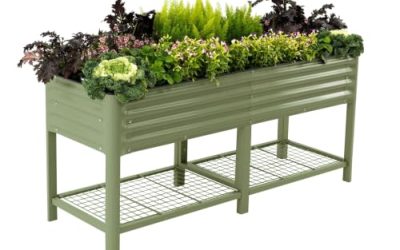
The Keter Easy Grow is a raised planter bed with a listed capacity of 31.7 gallons, in a rectangular format listed at about 44.9 x 19.3 x 29.8 inches. That height is the point of the design. The bed stands on legs at roughly waist-friendly working height for many adults, so planting, thinning, harvesting and weeding happen without kneeling in soil or bending over a ground-level border. For gardeners with stiff knees or a bad back, or for anyone growing salad leaves and herbs they want to pick daily, that ergonomic difference is the main reason to buy a raised planter at all.
Watering is the second reason. Listings for the Easy Grow describe a built-in water tank and drainage system, a water gauge that shows the reservoir level, and a drainage plug or tap arrangement that lets you release excess water deliberately rather than letting it spill where it likes. In practice, a reservoir system suits thirsty vegetables well: tomatoes, cucumbers and leafy greens in a container dry out fast in summer, and a tank beneath the soil smooths out the gap between waterings. The gauge removes the guesswork of not knowing whether the reservoir is full or empty.
The body is resin with a rattan-style texture in the common brown and graphite variants, described in listings as UV protected and weather resistant. Be realistic about two things: assembly is required, and 31.7 gallons of wet compost is heavy. Assemble the bed in its final position, then fill it, and on a balcony confirm the structure can take the combined weight of bed, wet soil, water and plants.
Who should buy it: vegetable and herb growers who want a contained, raised growing space with self-watering help, especially on patios and balconies. Who should look elsewhere: gardeners who want to plant directly at ground level, grow deep-rooted crops that need more soil depth than a raised container offers, or decorate a front step, where the smaller picks below fit better.
2. Mayne Fairfield 36 Inch Window Box Planter (5822-W) — Best for Window Flower Displays
The Mayne Fairfield is a 36 inch window box, model 5822-W, designed to mount under a window and turn it into a flower display. The listing gives a capacity of about 3 gallons, product dimensions around 11 inches deep and 11 inches high at the 36 inch length, and an item weight of 13.5 pounds before soil. Included components listed are the window box itself, mounting brackets and a fill port plug, which matters because a window box without suitable brackets is only half a product.
Its water system is the feature to understand. The listing describes built-in self-watering and built-in overflow drainage in a double-wall design. The reservoir holds water for the plants between waterings, and the overflow gives heavy rain somewhere to go instead of washing compost over the front of the box and down your wall. Anyone who has kept window boxes through a wet month will recognize why that matters: window boxes are shallow, they sit in full weather, and they swing between soggy and dry faster than a deep bed does.
The listing describes the material as plastic with a matte finish, UV resistant and weather resistant, and gives a warranty description of 15 years for residential application and 5 years for commercial application. Treat warranty terms as something to confirm on the current product page, but even as a signal it tells you the maker positions this as a long-life fixture rather than a seasonal novelty. The clean, paneled style also suits house fronts where a rustic timber box would need repainting every couple of years.
Measure before you buy: check your window width, the depth available, and what you are fixing the brackets into, since masonry, timber and siding each need appropriate fixings. Trailing flowers, geraniums, petunias and herbs suit a 3 gallon window box far better than hungry, deep-rooted plants.
Who should buy it: homeowners who want a tidy, self-watering flower display under a window and are comfortable fitting mounting brackets. Who should look elsewhere: renters who cannot fix into a wall, gardeners who want to grow vegetables, and anyone whose window is much wider or narrower than the 36 inch format listed here, although other sizes appear on Mayne listings and are worth checking on the product page.
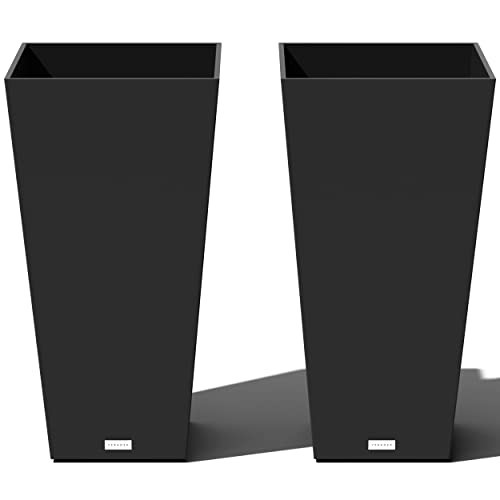
3. Veradek V-Resin Indoor/Outdoor Taper Planter, Set of 2 (30 Inch, Black) — Best for Entrances and Patios
Some planters are for growing, and some are for framing a space. The Veradek V-Resin taper planter is firmly in the second group, with a growing job to do as well. It is listed as a set of two 30 inch tall taper planters in black, for indoor or outdoor use. Tall, square, tapered pots like these are the ones you see either side of a front door with a small tree, a grass or a fern in each, or marking the corners of a patio seating area.
Height changes how a planter behaves. A 30 inch pot lifts foliage into view and gives roots a deeper column of soil than a squat pot. Brand descriptions of the V-Resin design emphasize a modern tapered shape, all-weather resin construction and a removable insert shelf, which sets the root ball at a sensible depth instead of filling the entire tall pot with compost — saving money and weight. The unfilled pots are light and easy to position, but a tall planted pot can catch wind on an exposed patio, so a sheltered position or some ballast low in the pot is sensible. A matched pair looks best planted symmetrically, and indoors you should confirm the listing’s drainage arrangement before relying on it over flooring.
Who should buy it: anyone dressing an entrance, doorway or patio who wants tall, modern, matched planters that are light to move before planting. Who should look elsewhere: vegetable growers, who will get far more use from the Keter bed, and gardeners who want a self-watering gauge or reservoir, which is not the focus of this design.
4. Bloem Ariana Self-Watering Planter, 8 Inch (AP0831) — Best Small Everyday Pot
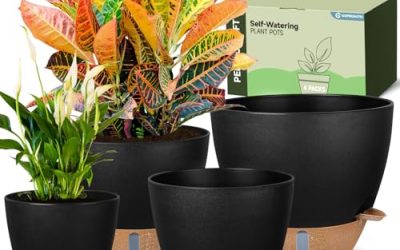
The Bloem Ariana proves that planter technology is not only for big containers. This is an 8 inch round self-watering planter, model AP0831, in the Deep Sea color on the listing we checked. The product information lists dimensions of about 8.5 inches wide and 6.8 inches high, a capacity figure of 4 quarts in the specifications and about 1 gallon in the description, polypropylene construction, and a weight of just a few ounces unfilled. It is floor standing and listed for indoor and outdoor use.
The interesting part is inside. Bloem’s description explains that a hidden reservoir at the bottom holds roughly 1 to 3.5 inches of water depending on planter size, and a self-watering insert keeps soil and roots above that reservoir while moisture moves up as the potting mix dries. The description also notes a sealed bottom to help prevent leakage indoors, optional knock-out drainage holes for outdoor use, UV protection for fade resistance, and a self-watering disk included in the box. For a herb on a kitchen windowsill or a flowering plant on a balcony table, that system stretches the time between waterings and reduces the saucer-of-water mess that plain pots create indoors.
Set expectations by size. An 8 inch pot suits a herb plant, a small flowering plant, a young houseplant or a single patio bedding plant. It will not suit a tomato, a shrub or anything that wants to spread. Roots fill small pots quickly in summer, so check moisture more often than the self-watering label might tempt you to, and move plants up a size when roots crowd the drainage area. The listing we read also showed no featured offer at the time of that crawl, so check the current sellers, price and availability on the product page rather than assuming the 8 inch Deep Sea variant is the one in stock; the Ariana range includes other sizes and colors.
Who should buy it: beginners, indoor gardeners and anyone who wants an inexpensive, light pot with genuine self-watering help for herbs and small flowers. Who should look elsewhere: anyone planting larger specimens, or anyone who wants a decorative ceramic or metal finish rather than practical colored resin.
What to Consider Before Buying a Garden Planter
Size the pot to the plant, not the space
Roots need room for a full season of growth, not just room for the plant on the day you buy it. Check the planter’s capacity and internal depth against the plant’s expected size, and remember that a bigger soil volume also buffers water and temperature swings. When a listing gives both a specification capacity and a different figure in its description, as small pots sometimes do, trust the dimensions and plan conservatively.
Drainage and reservoirs solve opposite problems
Drainage stops roots sitting in water after rain; a reservoir stops plants drying out between waterings. The best container planters manage both, with overflow drainage above a reservoir, a drainage plug you control, or knock-out holes you open for outdoor use. Decide which problem your spot has: a sheltered indoor corner usually needs leak protection most, while an exposed patio needs overflow first.
Weight and material decide maintenance
Resin planters are light to carry home and deceptively heavy once filled with wet soil, so position raised beds and tall pots before filling, and think about total load on a balcony. The resin and polypropylene planters here are described as weather resistant and UV protected and need little more than a rinse; timber needs treatment and terracotta can crack in frost, so buy those materials knowing the upkeep they ask for.
Frequently Asked Questions
Do self-watering planters really work?
They hold a reservoir below the soil and let the potting mix draw moisture up as it dries, as described in the Bloem and Mayne listings. They stretch the interval between waterings, but reservoirs still empty in hot weather, so gauges and regular checks matter.
How big should a planter be for vegetables?
For most container vegetables, more soil is kinder. A raised bed like the 31.7 gallon Keter gives herbs, salad leaves or a couple of fruiting plants room to grow, with a reservoir to support them. Small pots dry out too fast for hungry vegetables.
Can I leave resin planters outside all year?
The listings in this guide describe their materials as weather resistant and UV resistant, which is the right starting point for year-round outdoor use. In hard frosts, any planter full of wet soil is under stress, so improving drainage before winter and avoiding completely waterlogged compost will help both the planter and the plant.
Why does my planter need drainage if it has a reservoir?
Because rain adds water whether you planned it or not. Overflow drainage, plugs and knock-out holes give excess water an exit before it suffocates roots.
Verdict
Choose the Keter Easy Grow if you want to grow vegetables and herbs at a comfortable height with a reservoir and gauge doing part of the watering work. Choose the Mayne Fairfield if your project is a flower display under a window and you can fit its brackets properly. Choose the Veradek V-Resin pair if you are dressing a doorway or patio and want tall, modern planters that stay light until planted. Choose the Bloem Ariana if you need a small, practical self-watering pot for herbs and flowers indoors or out. In every case, confirm the size, color, included parts and current price on the product page before ordering, because planter listings commonly group several variants under one page.