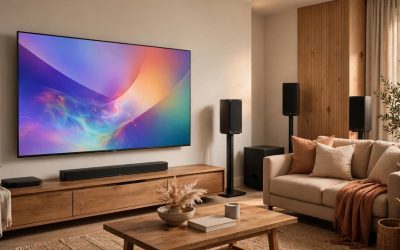
Key takeaways
- Five AV receivers for home theater, from a budget 5.2-channel pick to premium 7.2-channel Dolby Atmos models, with HDMI 2.1 and room calibration compared.
An AV receiver is the hub of a home theater. It takes video from a streaming box, a game console, and a Blu-ray player, sends the picture to the TV or projector, and drives every speaker in the room. It also decodes Dolby Atmos and DTS:X, so sound moves around the listener instead of coming from one flat direction.
This guide compares five receivers for the range most living rooms need: two 5.2-channel models for smaller rooms and simpler setups, and three 7.2-channel models for larger rooms and height channels. Every pick supports HDMI 2.1 video passthrough, and every pick was checked against a real Amazon listing before it was included.
As an Amazon Associate, we earn from qualifying purchases.
Quick Answer
For a first home theater, the Denon AVR-S570BT is the simplest route to 5.2-channel surround with 8K passthrough. The Yamaha RX-V4A adds Wi-Fi and MusicCast streaming. For Dolby Atmos height channels, the Denon AVR-X1800H is the most balanced 7.2-channel pick, while the Sony STR-AN1000 and Yamaha RX-A4A suit larger rooms.
Denon AVR-S570BT
The Denon AVR-S570BT is the budget pick in this guide, and it covers the basics well. It is a 5.2-channel receiver, which means five speaker channels plus two subwoofer outputs. That suits a front trio with two surrounds and a second subwoofer. Rated output is 70 watts per channel into 8 ohms with two channels driven.
Video handling is the strong point for the money. All four HDMI inputs and the output support 8K at 60Hz and 4K at 120Hz, with up to 40 gigabits per second of bandwidth, and eARC sends TV audio back over a single cable. Dolby Vision, HDR10+, and HLG passthrough are supported. Setup is guided by Denon HD Setup Assistant, and Bluetooth is built in for music from a phone. There is no Wi-Fi and no HEOS multi-room streaming, so music is limited to Bluetooth and wired sources.
Specs
- Channels: 5.2
- Power: 70 watts per channel, 8 ohms, 20 Hz to 20 kHz, 0.08 percent THD, 2 channels driven
- HDMI: 4 inputs, 1 output, HDMI 2.1, 8K at 60Hz, 4K at 120Hz, eARC
- Streaming: Bluetooth
- Room setup: Denon HD Setup Assistant
- ASIN: B0B9QF1L4K
Yamaha RX-V4A
The Yamaha RX-V4A is the mid-range 5.2-channel receiver in this guide. It matches the Denon above on channel count, but adds full network streaming. Wi-Fi, Bluetooth, AirPlay 2, and MusicCast are all built in, so music can come from a phone, a network drive, or another MusicCast speaker. Voice control works with Alexa, and the receiver can send audio to Bluetooth headphones.
Power is rated at 80 watts per channel into 6 ohms with two channels driven, and 115 watts maximum. Four HDMI inputs and one output carry 8K at 60Hz and 4K at 120Hz, with HDCP 2.3 and eARC. Gaming features include auto low latency mode, variable refresh rate, and quick frame transport. YPAO measures the room with a supplied microphone, and CINEMA DSP 3D widens the front stage. At 8.8 kilograms, measure the shelf before ordering. Confirm at checkout: a newer listing variant carries the suffix AG2-1, a separate listing.
Specs
- Channels: 5.2
- Power: 80 watts per channel, 6 ohms, 20 Hz to 20 kHz, 0.06 percent THD, 2 channels driven
- HDMI: 4 inputs, 1 output, HDMI 2.1, 8K at 60Hz, 4K at 120Hz, eARC
- Streaming: Wi-Fi, Bluetooth, AirPlay 2, MusicCast
- Room setup: YPAO
- Weight: 8.8 kg
- ASIN: B08CKGYLNS
Denon AVR-X1800H
The Denon AVR-X1800H is the mid-range pick here for a room that will grow. Seven channels support a 7.2 layout or a 5.2.2 layout with two height speakers for Dolby Atmos and DTS:X. Rated output is 80 watts per channel into 8 ohms with two channels driven.
Six HDMI inputs, three of which support 8K, plus one output, which matters when a console, a streaming box, a Blu-ray player, and a cable box all need a port. Video passthrough covers 8K at 60Hz and 4K at 120Hz, with variable refresh rate, auto low latency mode, and quick frame transport. Dolby Vision, HDR10+, and Dynamic HDR pass through. HEOS is built in for streaming and multi-room audio, and Audyssey MultEQ measures the room from several listening positions. A phono input and two subwoofer pre-outs are included. One caution: a separate Indian-market listing carries a different code, B0CGRSD5RF.
Specs
- Channels: 7.2, supports 7.2 or 5.2.2 layouts
- Power: 80 watts per channel, 8 ohms, 20 Hz to 20 kHz, 0.08 percent THD, 2 channels driven
- HDMI: 6 inputs (3 x 8K), 1 output, HDMI 2.1, 8K at 60Hz, 4K at 120Hz, eARC
- Streaming: HEOS built-in, Wi-Fi, Bluetooth, AirPlay 2
- Room setup: Audyssey MultEQ
- Inputs: Phono input, 2 subwoofer pre-outs
- ASIN: B0CFWQP9MC
Sony STR-AN1000
The Sony STR-AN1000 is the premium receiver here on paper, and it suits a large room with demanding speakers. It is a 7.2-channel receiver rated at 165 watts into 6 ohms with one channel driven, and 120 watts per channel in stereo. Six HDMI inputs and two outputs support HDMI 2.1, with 8K and 4K at 120Hz passthrough, so it can feed a TV and a projector from the same box. Dolby Atmos and DTS:X are included, with Dolby Vision, HDR10, HLG, and IMAX Enhanced.
Sony Digital Cinema Auto Calibration IX measures the room, and 360 Spatial Sound Mapping creates phantom speakers between the physical ones. Streaming covers Bluetooth, Wi-Fi, Chromecast, Spotify Connect, and AirPlay. Two points need care. First, the listing dimensions in the product information block read 19.5 x 15.56 x 8.19 inches, while a mirror listing shows different figures, so confirm the depth before ordering. Second, several bundle listings carry their own codes and include a protection plan or a cable, so confirm the standalone listing and its code.
Specs
- Channels: 7.2
- Power: 165 watts, 6 ohms, 1 kHz, 1 channel, 0.9 percent THD; 120 watts per channel in stereo
- HDMI: 6 inputs, 2 outputs, HDMI 2.1, 8K, 4K at 120Hz, eARC
- Streaming: Bluetooth, Wi-Fi, Chromecast, Spotify Connect, AirPlay
- Room setup: Digital Cinema Auto Calibration IX, 360 Spatial Sound Mapping
- Dimensions: 19.5 x 15.56 x 8.19 inches
- ASIN: B0BSLX8YR5
Yamaha RX-A4A AVENTAGE
The Yamaha RX-A4A is the premium flagship pick here, for a serious theater room. It is a 7.2-channel AVENTAGE receiver rated at 110 watts per channel into 8 ohms with two channels driven, with an ESS SABRE ES9007S DAC. The AVENTAGE line adds a fifth foot, the A.R.T. Wedge, meant to reduce vibration from the transformer. Seven HDMI inputs and three outputs, the most here, carry 8K at 60Hz passthrough at up to 40 gigabits per second.
Three inputs and one output support the latest HDMI features for next-generation consoles, including 4K at 120Hz, auto low latency mode, variable refresh rate, and quick frame transport. Sources disagree on whether all seven inputs or only three carry the full gaming feature set, so confirm the layout first. Surround:AI adjusts sound processing in real time, and CINEMA DSP HD3 adds 24 sound-field programs. YPAO-R.S.C. calibrates the room, and a 7.2-channel pre-out lets an external amplifier take over later. One retailer showed it temporarily out of stock, so confirm the offer is live before ordering.
Specs
- Channels: 7.2
- Power: 110 watts per channel, 8 ohms, 20 Hz to 20 kHz, 0.06 percent THD, 2 channels driven
- HDMI: 7 inputs, 3 outputs, HDMI 2.1, 8K at 60Hz, 4K at 120Hz, eARC
- Streaming: Wi-Fi, Bluetooth, AirPlay 2, Spotify Connect, MusicCast
- Room setup: YPAO-R.S.C. with 3D multi-point measurement, Surround:AI
- Inputs: Phono input, 7.2-channel pre-out, Zone 2
- ASIN: B08DXF1CP6
How to choose
Start with channel count. A 5.2-channel receiver covers a front trio and two surrounds, enough for most living rooms. A 7.2-channel receiver adds two channels, which can become rear surrounds or two height speakers for Dolby Atmos. If the room will never have height speakers, a 5.2-channel model saves money.
Count HDMI inputs next, and check how many support 8K. A console, a streaming box, and a Blu-ray player already fill three ports, so four inputs is the practical minimum. Confirm how many inputs carry 8K for a console at 4K and 120Hz rather than assuming all of them do. Two HDMI outputs are worth having when a TV and a projector share one receiver.
Power figures need care because brands measure them differently. Compare the two-channel-driven figure at 8 ohms, and ignore single-channel figures at 6 ohms, which always look larger. For most rooms, 70 to 80 watts per channel into 8 ohms is enough. Room calibration makes the biggest audible difference after the speakers, so run it after the speakers are in their final positions. Finally, check streaming: Bluetooth covers a phone, but Wi-Fi, AirPlay, and HEOS or MusicCast matter when music comes from a network or another room.
Who should skip
Skip an AV receiver entirely when a soundbar already covers the room and there is no plan to add separate speakers. Skip the 7.2-channel models when the room is small and the seating is close to the TV, since rear and height channels need space behind and above the listener to work. Skip the premium picks when the speakers are small satellites, because the extra power and pre-outs will go unused.
Frequently Asked Questions
How many channels do I need for Dolby Atmos?
Five channels plus a subwoofer can carry a basic Atmos track through height virtualization, but a 7.2-channel receiver with two real height speakers gives clearer sound from above. The Denon AVR-X1800H, Sony STR-AN1000, and Yamaha RX-A4A all support a 5.2.2 layout.
Do all HDMI inputs on these receivers support 4K at 120Hz?
No. The number of 8K-capable inputs varies by model, and on some only some inputs carry the full feature set. Check the listing and manual before connecting a console, and use the input the maker marks for gaming.
Does a receiver need Wi-Fi, or is Bluetooth enough?
Bluetooth is enough when music comes from a phone in the same room. Wi-Fi adds streaming services, multi-room audio, AirPlay, and firmware updates, so it is worth having when the receiver is the main music source.
Can I use a 7.2-channel receiver with only five speakers?
Yes. A 7.2-channel receiver works fine with five speakers and one subwoofer, and unused channels stay idle. That leaves room to add rear or height speakers later.
Final verdict
For most buyers, the Denon AVR-X1800H is the pick. It covers 7.2 channels and Dolby Atmos height speakers, has six HDMI inputs with three 8K-capable ports, and includes HEOS streaming and Audyssey calibration. The Denon AVR-S570BT is the better choice for a first theater on a tight setup, and the Yamaha RX-V4A suits a buyer who wants network streaming in a 5.2-channel box. For a large room, the Sony STR-AN1000 brings the most power and a second HDMI output, while the Yamaha RX-A4A is the most complete receiver here for a dedicated theater. Match the channel count to the room first, then the HDMI layout.