Our Short List of 3

- Best for: 3.6L owners who want a documented gain figure and a long filter service interval.
- Fitment: 2011-2023 Dodge Challenger 3.6L V6, per listing (also Charger and Chrysler 300)
- Filter media: oiled cotton gauze, washable and reusable
- Replacement filter: RF-1042
- Intake tube: high-density polyethylene, black

- Best for: V6 owners in hot climates who want a sealed housing and an oil-free filter.
- Fitment: 2011-2021 Dodge Challenger 3.6L V6, per listing (also Charger 2011-2021 and Chrysler 300 2011-2014)
- Filter media: Pro DRY S dry synthetic, oil-free and washable
- Filter part number: 21-91092
- Housing: one-piece sealed roto-molded design with auxiliary air scoop
- Best for: 5.7L R/T owners who want a sealed housing, a dry filter and no calibration change.
- Fitment: 2011-2023 Dodge Challenger 5.7L V8, per listing (also Charger 5.7L)
- Filter media: SuperNano-Web dry filter, twist-lock fitment
- Housing and tube: roto-molded polyethylene
- Listing claim: gains of up to 19 horsepower and 21 lb-ft of torque, no tune required
All 4 Picks at a Glance
| Product | Specs | Action |
|---|---|---|
| K&N 63-1564 AirCharger Cold Air Intake |
| Check price on Amazon |
| aFe Momentum GT 51-72201 Cold Air Intake |
| Check price on Amazon |
| Injen Evolution EVO5100 Cold Air Intake |
| Check price on Amazon |
 EVIL ENERGY Cold Air Intake Kit for 5.7L Challenger |
| Check price on Amazon |
Key takeaways
- Four cold air intakes that fit the Dodge Challenger, compared by engine fitment, filter media and housing design, with the checks to run before ordering.
The first decision with a Challenger intake is not which brand to buy, but whether a kit was built for your engine. The car left the factory with a 3.6L V6, a 5.7L HEMI V8 or a 6.4L HEMI V8, and intake kits are molded for one engine family, one throttle body position and a set of model years. A V6 kit will not bolt onto a HEMI car, so fitment narrows the field before sound, filter media or housing style even enter the picture.
This guide is written for SXT and GT owners with the 3.6L V6 and for R/T owners with the 5.7L HEMI who want a bolt-on kit for the factory calibration. Every product below was picked from the specifications on its Amazon listing: the stated engine and years, the filter media, the tube material, and what the box includes. The 6.4L cars take their own set of kits, so Scat Pack owners should read this as a fitment lesson, not a shopping list.
Quick Picks
As an Amazon Associate we earn from qualifying purchases.
| Product | Best for | Key spec from title |
|---|---|---|
| K&N 63-1564 AirCharger | V6 owners who want documented gain figures | Oiled cotton filter, polyethylene tube |
| aFe Momentum GT 51-72201 | V6 owners who want a sealed box and dry media | Pro DRY S dry filter, sealed housing |
| Injen Evolution EVO5100 | 5.7L owners who want a dry filter, no tune | SuperNano-Web dry filter, roto-molded housing |
| EVIL ENERGY 5.7L Intake Kit | 5.7L owners who want a shield and pre-filter included | Washable synthetic filter, heat shield in the box |
How to Choose
Match the Kit to Your Engine Before Anything Else
Challenger intakes are engine-specific parts, not model-specific ones. The 3.6L V6 breathes through a different throttle body position and intake routing than the 5.7L HEMI, and the 6.4L HEMI differs again, so a listing that says Challenger without naming an engine size is a listing to close. Read the year range just as closely: several kits in this guide stop at 2020 or 2021 even though the car stayed in production, and hood style matters too, since Shaker cars draw air through the scoop and are excluded from some kits. Your engine code and model year decide the shortlist.
Decide Between an Open Filter and a Sealed Box
Two layouts dominate this market. An open element sits behind a heat shield that walls it off from the fan wash and exhaust side of the bay, which keeps the install simple and the intake note loud under throttle. A sealed box closes the filter inside a housing that draws from a duct or scoop, which better isolates the incoming charge from engine-bay heat on a hot day or in slow traffic. Neither layout wins everywhere: the open design is easier to service and inspect, while the sealed design asks you to open the housing for filter checks but holds intake temperatures steadier.
Pick a Filter Media You Will Actually Maintain
Oiled cotton gauze is the traditional performance media. It flows freely and can be washed and re-oiled for the life of the car, but the service has to be done correctly, because excess oil can migrate downstream toward the airflow sensor. Dry synthetic media skips the oil entirely: you wash it, let it dry fully and refit it, which suits owners who want the simplest possible service routine. Both media types appear in the listings below, and both are reusable. The honest question is which service routine you will still be following at the third or fourth cleaning.
Check Emissions Notes and What the Install Involves
Some listings in this category carry a California restriction line, and that line decides whether a kit can go on a road car in states that follow California rules, so read it before ordering rather than after the box arrives. Beyond legality, look at what the install actually changes: most kits here reuse factory mounting points, need only basic hand tools and are shaped for the stock calibration, with makers quoting under an hour of work. Also confirm what arrives in the box, because a pre-filter, couplers and clamps are included in some kits and left as separate purchases in others.
The 4 Best Options
K&N 63-1564 AirCharger Cold Air Intake
- Best for: 3.6L owners who want a documented gain figure and a long filter service interval.
- Fitment: 2011-2023 Dodge Challenger 3.6L V6, per listing (also Charger and Chrysler 300)
- Filter media: oiled cotton gauze, washable and reusable
- Replacement filter: RF-1042
- Intake tube: high-density polyethylene, black
3.6L owners who want a documented gain figure and a long filter service interval.
the listing flags a California restriction for this kit, and applications are listed as select models, so confirm your exact year and trim.
The 63-1564 is the established V6 choice, built by the brand that has published its dynamometer figures for decades. K&N pairs a roto-molded polyethylene tube with its layered oiled cotton filter and a heat shield, and the listing attaches a specific estimated gain to a specific engine speed rather than a vague promise. For a 3.6L owner who wants the intake decision backed by published testing and a filter that only needs attention at long intervals under normal highway use, this is the reference point the rest of the V6 field gets measured against.
aFe Momentum GT 51-72201 Cold Air Intake
- Best for: V6 owners in hot climates who want a sealed housing and an oil-free filter.
- Fitment: 2011-2021 Dodge Challenger 3.6L V6, per listing (also Charger 2011-2021 and Chrysler 300 2011-2014)
- Filter media: Pro DRY S dry synthetic, oil-free and washable
- Filter part number: 21-91092
- Housing: one-piece sealed roto-molded design with auxiliary air scoop
V6 owners in hot climates who want a sealed housing and an oil-free filter.
the listed fitment ends at the 2021 model year, so later V6 cars fall outside this listing.
Where the K&N leaves its filter open behind a shield, the Momentum GT seals its filter inside a one-piece roto-molded housing with an auxiliary air scoop, and a urethane plug is included for owners who want that scoop blocked in cold weather. The Pro DRY S media is a dry synthetic that never needs oil, which makes the service routine a wash and a full dry rather than a careful re-oiling. For V6 drivers who spend time in traffic or hot climates and would rather keep under-hood heat away from the intake charge, this sealed layout is the deliberate alternative.
Injen Evolution EVO5100 Cold Air Intake
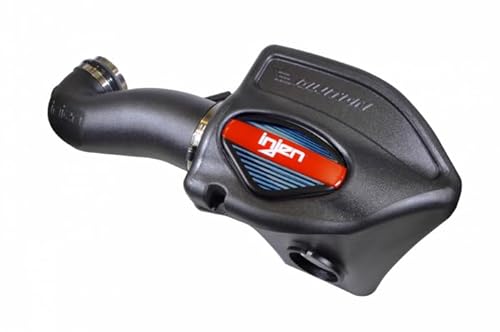
- Best for: 5.7L R/T owners who want a sealed housing, a dry filter and no calibration change.
- Fitment: 2011-2023 Dodge Challenger 5.7L V8, per listing (also Charger 5.7L)
- Filter media: SuperNano-Web dry filter, twist-lock fitment
- Housing and tube: roto-molded polyethylene
- Listing claim: gains of up to 19 horsepower and 21 lb-ft of torque, no tune required
5.7L R/T owners who want a sealed housing, a dry filter and no calibration change.
the gain figures are the maker’s own claims in the listing, and the box ships from a marketplace seller, so check the seller name and contents on arrival.
The EVO5100 is the sealed-box answer for the 5.7L R/T, and its listing leads with two things V8 owners ask about: a dry filter and no tuning requirement. Injen molds both the housing and the intake tube from polyethylene, fits a SuperNano-Web dry filter on a twist-lock base so the element can be checked without tools, and states its gain figures plainly in the listing. For an R/T owner who wants a closed housing, a filter that never sees oil and a kit shaped around the stock calibration, this is the most complete 5.7L package in this guide.
EVIL ENERGY Cold Air Intake Kit for 5.7L Challenger
- Best for: owners of 2012-2020 5.7L cars who want a heat shield and pre-filter included in the box.
- Fitment: 2012-2020 Dodge Challenger 5.7L V8, per listing (also Charger 2011-2020 and Chrysler 300 2012-2020)
- Model number: BQM0001008
- Filter media: washable multi-layer synthetic non-woven, reusable
- Included: heat shield and pre-filter
owners of 2012-2020 5.7L cars who want a heat shield and pre-filter included in the box.
the Challenger fitment in this listing stops at 2020, so 2021 and later 5.7L cars need a different kit.
This kit takes the open-element route for the 5.7L cars and bundles the parts owners often end up buying separately: a steel heat shield and a pre-filter that slips over the main element to catch larger debris before it reaches the pleats. The filter itself is a washable, reusable multi-layer synthetic that needs no oil. The stated fitment window is narrower than the Injen’s, ending at 2020 for the Challenger, but for owners inside that window who want the shield and pre-filter in the same box, the listing covers the whole job in one order.
Which One Fits Your Situation
You Drive a 3.6L Car Every Day and Want Proof Before You Pay
Start with the K&N 63-1564. It is the V6 kit in this guide whose listing ties its claim to a measured figure at a stated engine speed, and its cotton filter is built around long service intervals under normal highway driving. If published testing matters more to you than housing style, this is the straightforward V6 answer.
Your V6 Spends Its Life in Traffic and Summer Heat
Choose the aFe Momentum GT 51-72201. The sealed housing and auxiliary scoop are designed to keep the intake charge away from engine-bay heat, which is exactly the condition a daily driver meets in slow traffic. The dry Pro DRY S filter also removes oiling from your service routine, leaving a wash, a full dry and a refit.
You Own a 5.7L R/T and Refuse to Oil Another Filter
The Injen EVO5100 fits that brief. Its SuperNano-Web element is dry, it locks in with a twist for quick checks, and the listing states the system runs on the stock calibration. The sealed polyethylene housing keeps the layout tidy, and the stated fitment runs through the 2023 model year, the widest 5.7L window in this guide.
Your 5.7L Car Is a 2012 to 2020 Model and You Want Everything in One Box
Take the EVIL ENERGY kit. The heat shield and pre-filter arrive with the intake rather than as follow-up purchases, and the synthetic filter washes clean without oil. Just confirm your car falls inside the listed years before ordering, because this listing does not stretch to the final production years, and the whole job should land in a single order.
Common Mistakes
- Ordering by model name alone and ignoring engine size, when the 3.6L, 5.7L and 6.4L cars each take different kits.
- Assuming a kit listed for one HEMI fits the other, when 5.7L and 6.4L fitments are separate listings with separate part numbers.
- Skipping the emissions line in a listing and finding out after delivery that the kit is restricted for road use in your state.
- Over-oiling a cotton gauze filter after washing it, which can foul the airflow sensor downstream and undo the point of the upgrade.
- Treating a maker’s headline gain figure as a promise for every car, when the figure comes from that maker’s own testing on one configuration.
Frequently Asked Questions
Will one of these kits fit both the V6 and the V8 Challenger?
No. Each listing in this guide names one engine family: the K&N and aFe kits cover the 3.6L V6, while the Injen and EVIL ENERGY kits cover the 5.7L V8. Throttle body position and intake routing differ between the engines, so a kit molded for one cannot be adapted to the other with clamps and patience.
Do these intakes need a tune after installation?
The listings for these kits describe systems shaped around the factory calibration, and the Injen listing states its figures are achieved without tuning. That is part of their appeal as bolt-on parts. If your car already runs a custom calibration, tell your tuner about the intake change, because airflow changes and existing maps do not always agree.
How often does the filter on these kits need cleaning?
It depends on the media. K&N describes cleaning intervals of up to 100,000 miles for its cotton filter under normal highway driving conditions, while dusty roads shorten that considerably. Dry synthetic filters from aFe and Injen are washed and dried fully before refitting. Whichever media you choose, a clogged filter quietly erases the airflow the kit was bought for.
Is a sealed box better than an open filter with a heat shield?
Neither layout is better in every case. A sealed box isolates the filter from engine-bay heat more completely, which helps in traffic and hot weather. An open element behind a shield is simpler to inspect and service, and many owners prefer its louder intake note. Match the layout to how the car is actually driven, not to which design sounds more serious.