Our Short List of 3

- Best for: Open small yards split into several zones, where you want mapped, planned mowing without a buried wire.
- Coverage stated in listing: 1/8 acre (about 5,400 sq ft)
- Navigation: RTK positioning plus VisionFence camera
- Zones: up to 12 mowing zones
- Obstacle recognition: 150+ types

- Best for: Sloped or uneven small yards, and owners who keep grass on the longer side.
- Coverage stated in listing: 0.12 acre reception area, up to 0.25 acre maximum
- Navigation: RTK positioning with UltraSense AI Vision
- Slope stated in listing: up to 50 percent
- Cutting height: 2 to 3.5 inches
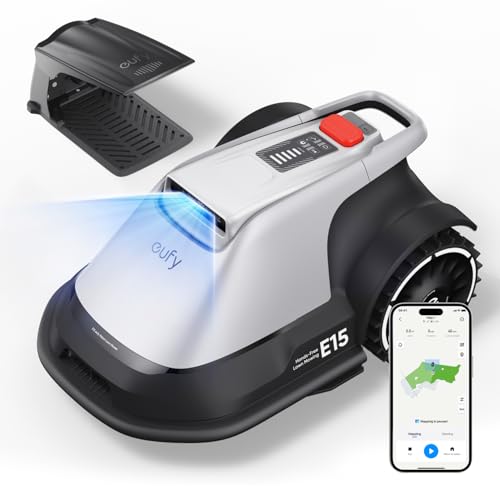
- Best for: Shaded, enclosed small yards where satellite positioning is unreliable, and anyone who wants the least hardware to install.
- Coverage stated in listing: up to 0.2 acres (about 8,700 sq ft)
- Navigation: Pure Vision stereo cameras with GPS, no wire and no RTK
- Mapping: hands-free auto mapping, multi-zone management
- Connectivity: 4G and app control stated in the listing
All 4 Picks at a Glance
| Product | Specs | Action |
|---|---|---|
| Segway Navimow i105N |
| Check price on Amazon |
| Mammotion YUKA Mini 500H |
| Check price on Amazon |
| eufy E15 |
| Check price on Amazon |
 Gardena Sileno Minimo |
| Check price on Amazon |
Key takeaways
- Four robotic lawn mowers sized for small yards compared on coverage, navigation and setup: wire-free RTK, camera guidance and a quiet wire-guided pick.
Buying a robot mower for a small yard is mostly a sizing and navigation decision, not a power one. A model built for half an acre wastes its dock space, mapping time and turning room on a townhouse lawn, while an undersized unit falls behind after a week of fast spring growth. The second decision is how the machine finds its way around: buried wire, satellite positioning or cameras, and the right answer depends on how much open sky and shade your yard has.
This roundup is for owners of compact lawns, roughly a tenth of an acre up to a fifth, including yards split into a front patch, a back lawn and a narrow side strip. Every pick below was chosen from the coverage figure, navigation type and setup hardware stated in its own Amazon listing, so the shortlist reflects what each maker actually promises for a small space.
Quick Picks
As an Amazon Associate we earn from qualifying purchases.
| Product | Best for | Key spec from title |
|---|---|---|
| Segway Navimow i105N | Wire-free mapping on open small lawns | RTK+Vision, 1/8 acre |
| Mammotion YUKA Mini 500H | Sloped yards and taller grass | 50 percent slope, 2 to 3.5 in cut |
| eufy E15 | Shaded yards with weak satellite signal | Pure Vision, no RTK antenna |
| Gardena Sileno Minimo | Quiet running on simple lawns | 57 dB(A), boundary wire |
How to Choose
Match the Stated Coverage to Your Grass, Not Your Lot
Manufacturers rate these machines by the area of grass they can keep up with, and that number is always smaller than your property size once the house, driveway, beds and paths come out. Measure the mowable grass itself, then pick a mower whose stated coverage meets or modestly exceeds it. Running a robot near the top of its range is fine in slow growth, but in a wet spring it mows almost nonstop just to hold its schedule, which wears blades and battery faster. A small yard also rewards a compact machine that can turn in tight corners without scuffing the edges.
Pick the Navigation That Suits Your Sky and Shade
Boundary-wire mowers follow a cable you peg out once, and they keep working under trees where satellites cannot see. RTK models replace the wire with a small antenna and centimetre-level satellite positioning, but they need open sky above both the antenna and most of the lawn. Camera-guided machines read the lawn edge visually, so they cope with shade and need no antenna, yet they depend on visible borders and decent light. Look at your own yard at midday: heavy tree cover and tall fences argue for wire or vision, while a plain open rectangle is easy ground for RTK.
Check Slopes, Edges and Grass Height Against the Listing
Small yards often hide the hardest terrain: a bank by the driveway, a steep strip along a fence, or steps between lawn levels. Compare the slope figure in each listing with the steepest corner you own, not the average. Cutting height matters just as much. High-cut models leave grass long and suit informal lawns, while low-cut ranges keep a tighter finish. Several listings also state lawn limits up front, such as maximum grass height before the first run or the largest step the wheels can climb between zones, and those small print lines decide whether a mower works at your address.
Plan the Dock, the Power Point and the Upkeep
Every robot here needs a level dock spot with an outdoor socket in reach of its power supply, and wire-free models add an antenna position with a clear view upward. Think about where that dock sits in winter and whether the route from dock to lawn crosses gravel or paving the wheels must handle. Upkeep is light but real: razor blades dull and need swapping, boundary wire can be cut by edging tools, and app control depends on Wi-Fi or a mobile signal reaching the dock. Anti-theft tracking and PIN locks are worth having on an open front yard.
The 4 Best Options
Segway Navimow i105N
- Best for: Open small yards split into several zones, where you want mapped, planned mowing without a buried wire.
- Coverage stated in listing: 1/8 acre (about 5,400 sq ft)
- Navigation: RTK positioning plus VisionFence camera
- Zones: up to 12 mowing zones
- Obstacle recognition: 150+ types
Open small yards split into several zones, where you want mapped, planned mowing without a buried wire.
RTK positioning needs open sky above the antenna and the lawn, and the listing states no slope figure, so check any bank against the seller’s limits before ordering.
The Navimow i105N is the wire-free pick for a small, mostly open lawn that is broken into pieces. Its listing pairs RTK satellite positioning with a camera that recognises more than 150 types of garden obstacles, so it holds a planned line across the open grass and still threads around planters and toys. Assisted mapping in the app lets you draw virtual boundaries instead of burying cable, and the mower manages up to twelve separate zones, which suits a front patch, a back lawn and a side strip under one schedule.
Mammotion YUKA Mini 500H
- Best for: Sloped or uneven small yards, and owners who keep grass on the longer side.
- Coverage stated in listing: 0.12 acre reception area, up to 0.25 acre maximum
- Navigation: RTK positioning with UltraSense AI Vision
- Slope stated in listing: up to 50 percent
- Cutting height: 2 to 3.5 inches
Sloped or uneven small yards, and owners who keep grass on the longer side.
The high-cut range cannot go below 2 inches, so it is the wrong pick if you want a short, tight finish; RTK still needs a reasonably open view of the sky.
The YUKA Mini 500H is built for the small yard that is not flat. Its listing claims slopes up to 50 percent, well beyond what most compact robots attempt, and pairs RTK positioning with an AI vision system that keeps it oriented where satellite signals drop near walls and trees. The H in the name marks the high-cut version: its stated cutting range runs from 2 to 3.5 inches, which leaves grass longer and healthier on banks and rough patches. Automatic mapping and fifteen zones give it room to handle a yard with several disconnected pieces of lawn.
eufy E15
- Best for: Shaded, enclosed small yards where satellite positioning is unreliable, and anyone who wants the least hardware to install.
- Coverage stated in listing: up to 0.2 acres (about 8,700 sq ft)
- Navigation: Pure Vision stereo cameras with GPS, no wire and no RTK
- Mapping: hands-free auto mapping, multi-zone management
- Connectivity: 4G and app control stated in the listing
Shaded, enclosed small yards where satellite positioning is unreliable, and anyone who wants the least hardware to install.
The cameras need a readable lawn edge and reasonable light, and the listing’s own limits cap starting grass height and slope, so a rough or overgrown yard needs preparation first.
The E15 takes the opposite route to navigation: no wire and no satellite antenna at all. Stereo cameras and AI read the lawn edge directly, build the map on their own and steer around obstacles, with GPS backing up positioning and anti-theft tracking. That makes it the natural pick for a small yard boxed in by trees, fences or the house itself, where RTK signals fade. Its stated coverage reaches a fifth of an acre, the largest in this roundup, and it cuts in parallel lines for a striped finish. Multi-zone management and 4G keep it reachable from anywhere.
Gardena Sileno Minimo
- Best for: Simple, mostly rectangular small lawns in close neighbourhoods where low noise matters more than smart mapping.
- Coverage stated in listing: lawns up to 5,400 sq ft
- Navigation: boundary wire, included in the box
- Control: Bluetooth app with auto-schedule
- Noise stated in listing: 57 dB(A), among the quietest in its class
Simple, mostly rectangular small lawns in close neighbourhoods where low noise matters more than smart mapping.
You have to peg out the boundary wire before the first mow, and Bluetooth control works at short range, so there is no checking progress from across town.
The Sileno Minimo is the traditional answer done well: a boundary-wire mower from Gardena sized exactly for small lawns, and one of the quietest machines in its class according to its listing. At a stated 57 dB(A) it can run early or late without carrying across the street. Control is by Bluetooth app with automatic scheduling, and the included wire kit defines the mowing area once, after which the mower simply follows its timetable. For a simple rectangle of grass with clear edges, that older formula is still the least demanding to live with day to day.
Which One Fits Your Situation
Your Lawn Is a Few Separate Patches of Grass
A front strip, a back lawn and a passage down the side of the house is the classic small-yard layout, and zone management is what makes it work. The Navimow i105N handles up to twelve zones under one map, and the YUKA Mini 500H stretches to fifteen. Choose between them on terrain: flat and open suits the Segway, while banks between levels point to the Mammotion and its slope figure.
Your Yard Sits Under Trees and Tall Fences
Satellite positioning weakens exactly where small urban yards sit, in the shadow of the house and under a canopy. The eufy E15 reads its boundaries with cameras instead of satellites, so shade stops being a setup problem. If your lawn is shaded and also very simple in shape, the wire-guided Gardena Minimo is the other safe answer, since a buried cable never loses signal at all.
Your Small Yard Has a Real Bank or Slope
Plenty of compact gardens are cut into a hillside, and slope is where small robots struggle first. The YUKA Mini 500H states the strongest slope figure in this group and pairs it with a high cutting range that suits rough, longer grass. Measure your steepest section honestly before ordering, because a mower that cannot climb back to its dock turns automation into a rescue routine.
You Want the Quietest, Simplest Routine
If the lawn is one clear rectangle and the neighbours are close, the Gardena Sileno Minimo keeps life simple: one wire installation, a schedule set in the app, and running noise low enough for early mornings. It gives up mapped zones and remote reach, but for a single patch of grass those are features you would rarely open the app to use.
Common Mistakes
- Sizing the mower to the whole property instead of the actual grass area, then wondering why it never finishes its schedule.
- Placing the RTK antenna or dock where a wall, hedge or tree blocks the view of the sky the positioning depends on.
- Skipping the first manual cut, so the robot faces grass taller than the starting height its listing allows.
- Judging slopes by the gentle middle of the lawn instead of the steep corner by the driveway or fence.
- Forgetting the dock needs an outdoor socket nearby, level ground and a clear drive-on path to the lawn.
Frequently Asked Questions
How small does a yard have to be for these mowers?
The picks here are stated for lawns from about 5,400 sq ft up to a fifth of an acre of actual grass. Below that range they still work well, since a robot simply finishes sooner and charges less often. What matters is matching the stated coverage to your mowable area and choosing navigation that fits your shade and layout.
Does a wire-free mower really need nothing buried or installed?
There is no perimeter cable, but you still install a charging dock and, on RTK models, a small antenna with open sky above it. Camera-guided models such as the E15 skip the antenna as well. Every type needs an outdoor socket within reach of the dock, a level parking spot and a clear route onto the grass.
How often do the blades need changing?
These machines cut with small razor-style blades that dull gradually rather than failing at once, so most owners swap them when the grass tips start to look torn. Some listings include spare blades in the box, as the Navimow i105N does. Check the blade type in the listing before ordering spares, because fittings differ between brands.
Can one robot mower handle a front and back yard?
Yes, as long as the listing supports multiple zones and the mower has a path between them or you carry it across. Zone counts in this roundup run from twelve to fifteen on the wire-free models, and each zone can keep its own schedule and cutting direction, which suits lawns split by the house.