Our Short List of 3

- Best for: Hunters with heavier traditional setups who want bleeder blades and a strong blood trail.
- Brand: Magnus
- Weight: 150 grains
- Blades: 4, main blade plus bleeder blades
- Blade material: Knife-grade stainless steel

- Best for: Mid-weight traditional bows where a serrated edge and bleeder blades aid trailing.
- Brand: Magnus
- Model number: SBC125-4
- Weight: 125 grains
- Blades: 4, main blade plus bleeder blades

- Best for: Two-blade purists and lighter draw weights where depth of penetration comes first.
- Brand: Magnus
- Part number: KBS150-2
- Weight: 150 grains
- Blades: 2
All 3 Picks at a Glance
| Product | Specs | Action |
|---|---|---|
| Magnus Stinger 4-Blade Broadhead, 150 Grain |
| Check price on Amazon |
| Magnus Stinger Buzzcut 4-Blade Broadhead, 125 Grain |
| Check price on Amazon |
| Magnus Killer Bee Stinger 2-Blade Broadhead, 150 Grain |
| Check price on Amazon |
Key takeaways
- Three traditional fixed-blade broadheads for deer compared on blade count, grain weight and sharpening, all screw-in cut-on-contact heads for stickbows.
A traditional bow kills by cutting, not by shock. At longbow and recurve speeds there is no surplus energy to waste, so the head has to begin slicing the instant it touches hide, fly exactly where your field points fly, and hold together through ribs. Choosing a traditional broadhead is therefore a matching exercise: blade count, grain weight, and edge style all have to suit your draw weight, your arrow build, and the deer you actually hunt.
This shortlist is for longbow and recurve hunters shooting wood, carbon, or aluminum arrows at deer inside traditional ranges. Every pick is a screw-in, cut-on-contact fixed blade from the Magnus Stinger family, the traditional line whose Amazon listings could be confirmed for this roundup, chosen from the weights, blade counts, and specifications printed on those product pages.
Quick Picks
As an Amazon Associate we earn from qualifying purchases
| Product | Best for | Key spec from title |
|---|---|---|
| Magnus Stinger 4-Blade Broadhead, 150 Grain | Heavy traditional arrow builds | 150-grain 4-blade, pack of 3 |
| Magnus Stinger Buzzcut 4-Blade Broadhead, 125 Grain | A serrated main edge | 125-grain 4-blade, pack of 3 |
| Magnus Killer Bee Stinger 2-Blade Broadhead, 150 Grain | Two-blade simplicity | 150-grain 2-blade, pack of 3 |
How to Choose
Blade Count and the Cutting Trade-Off
Two-blade heads are the traditional default because they ask the least of the bow: a single pair of edges slips between ribs, keeps momentum, and drives deep even from modest draw weights. Four-blade versions add a pair of small bleeder blades behind the main edge. Those bleeders open a wider wound channel and usually leave a heavier blood trail, which matters when a deer runs into thick cover. The cost is drag and a little lost penetration, so the trade only pays when your setup carries energy to spare. All three picks below are cut-on-contact designs, meaning the tip itself is the leading edge and cutting begins on contact rather than after a punch-through point does its work.
Grain Weight Matched to Your Arrow Build
Traditional heads run heavier than compound heads because stickbow arrows are built around momentum and front-of-center balance. A 125-grain head suits lighter bows and faster, flatter-shooting arrow builds, while 150 grains is the classic deer weight for bows in the upper traditional range and for hunters who build arrows well past 500 grains total. The governing rule is simple: hunt with the same grain weight you tuned and practiced with. Switching weights changes spine behavior and impact point, so a head that matches your field points in weight keeps your practice honest and your hunting arrows landing where the summer arrows did.
Edge Style and Sharpening
Traditional heads are meant to be resharpened and reused, so edge style is a maintenance decision as much as a cutting one. A plain straight edge hones quickly on a file, stone, or ceramic rod, and most hunters can restore one in minutes at camp. The serrated Buzzcut edge cuts with a tearing action that many hunters credit for stronger blood trails, and it sharpens the same way along the main bevel, but it asks for a little more care to keep the serrations clean. Whichever style you choose, check every edge before opening day: a head that will not shave hair or catch a thumbnail is not ready to hunt.
Ferrule Strength and Spin Truth
A broadhead that wobbles cannot fly straight, no matter how sharp it is. Screw each head onto your hunting arrows and spin them on a flat surface or a spinner before season; the tip should trace a single point with no visible orbit. Misalignment usually traces back to a crooked insert or a bent ferrule, and both are fixable before they cost a deer. Ferrule material matters at impact as well. Aluminum ferrules keep weight down and fly beautifully, but a steel-ferrule head shrugs off heavy bone contact with less risk of bending, which is worth weighing if your shots meet shoulders.
The 3 Best Options
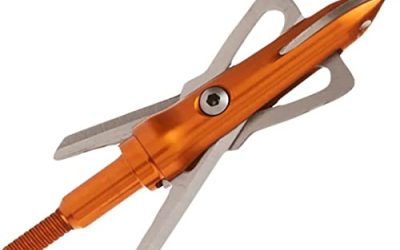
Magnus Stinger 4-Blade Broadhead, 150 Grain
- Best for: Hunters with heavier traditional setups who want bleeder blades and a strong blood trail.
- Brand: Magnus
- Weight: 150 grains
- Blades: 4, main blade plus bleeder blades
- Blade material: Knife-grade stainless steel
Hunters with heavier traditional setups who want bleeder blades and a strong blood trail.
The four-blade profile spends more energy than a two-blade head, so it is a poor match for light draw weights.
This is the heavyweight anchor of the group and the head that fits the classic traditional deer setup: a bow in the upper draw-weight range, a heavy arrow, and shots kept inside twenty yards. The 150-grain weight keeps front-of-center balance where traditional hunters want it, and the bleeder blades behind the main edge open the kind of wound channel that shortens blood trails in thick woods. If your arrow build already carries momentum to spare and your priority is a clear trail to follow after the shot, this is the configuration the Stinger line is known for.
Magnus Stinger Buzzcut 4-Blade Broadhead, 125 Grain
- Best for: Mid-weight traditional bows where a serrated edge and bleeder blades aid trailing.
- Brand: Magnus
- Model number: SBC125-4
- Weight: 125 grains
- Blades: 4, main blade plus bleeder blades
Mid-weight traditional bows where a serrated edge and bleeder blades aid trailing.
Serrations collect hair and fat after a hit and need a thorough cleaning before the head goes back in the quiver.
The Buzzcut takes the same Stinger layout and cuts its main blade with a chiseled serration, trading the plain edge for a tearing cut through hide and tissue. At 125 grains it suits mid-weight recurves and longbows whose owners want a flatter trajectory than the 150-grain heads give, without giving up the bleeder blades. Choose it if blood trailing through early-season green cover is your recurring problem and your bow has the energy to push four cutting edges. It sharpens along the main bevel like the plain Stinger, so the serrations add no special tools to your kit.
Magnus Killer Bee Stinger 2-Blade Broadhead, 150 Grain
- Best for: Two-blade purists and lighter draw weights where depth of penetration comes first.
- Brand: Magnus
- Part number: KBS150-2
- Weight: 150 grains
- Blades: 2
Two-blade purists and lighter draw weights where depth of penetration comes first.
A two-blade wound can close up more readily than a four-blade cut, so blood trails may be lighter in sparse cover.
The Killer Bee strips the design back to two blades at the full 150-grain weight, which is the combination traditional hunters reach for when penetration outranks everything else. With no bleeders to feed, more of the arrow’s energy stays pointed at depth, making this the pick for lighter draw weights, for quartering shots you would rather not take with a wider head, and for hunters who simply trust the oldest layout in bowhunting. The main blade is replaceable and resharpenable, so a pack stays in service across many seasons with basic bench care.
Which One Fits Your Situation
Close Treestand Shots in Thick Cover
Take the Stinger Buzzcut 125. Stand shots at deer tend to be close, steep, and followed by a short run into the thickest cover on the property. The serrated main edge and bleeder blades are built for exactly that trailing job, and the 125-grain weight keeps arrow flight flat enough for judging distance through branches and gaps in the canopy.
A Lighter Draw Weight Recurve
Choose the Killer Bee Stinger 2-Blade 150. A bow in the low-to-middle forties gives up penetration margin, and a two-blade head spends the least energy getting through ribs and hide. The full 150 grains keeps momentum up front where a lighter bow needs it most, so the simple head and the heavy weight work together instead of against each other.
Heavy Arrows for Big-Bodied Deer
The Stinger 4-Blade 150 fits a deliberate heavy-arrow build: high total arrow weight, strong front-of-center balance, and a bow with draw weight to drive it. Northern deer carry more mass through the shoulders, and this configuration answers with weight plus the extra cutting edges of the bleeders once the main blade is through.
You Resharpen and Reuse Your Heads
Pick either plain-edge head, the Stinger 4-Blade 150 or the Killer Bee 2-Blade. A straight bevel comes back to hunting sharpness on a file and stone in minutes, season after season, and replaceable main blades cover the rare head that bends. The serrated Buzzcut can be maintained the same way, but the plain edges are the faster bench job.
Common Mistakes
- Hunting with edges straight from the pack without checking them, when a few minutes on a stone is the difference between cutting and pushing through hide.
- Changing broadhead weight in autumn after tuning and practicing all summer with field points of a different weight.
- Skipping the spin check, then blaming the bow or the arrows for flight that a crooked insert caused all along.
- Choosing the widest four-blade head for a light draw weight and losing the penetration the shot needed.
- Practicing with your hunting heads into hard targets until the edges are dull, then carrying those same heads into the woods.
Frequently Asked Questions
Are two-blade or four-blade heads better for deer with a recurve?
Neither wins outright. Two-blade heads penetrate deeper for a given draw weight and are the safer choice for lighter bows. Four-blade heads with bleeders cut a wider wound and usually leave more blood on the ground, which helps in thick cover. Match the head to your bow’s energy and the cover you hunt, not to a general rule.
What grain weight should a traditional hunter pick for deer?
Most traditional deer setups land on 125 or 150 grains. Lighter bows and faster arrow builds suit 125, while heavier bows and deliberate high-momentum builds suit 150. The deciding factor is your field points: hunt the weight you tuned with, because changing weight changes spine behavior and moves your impact point.
Do serrated Buzzcut edges need special sharpening tools?
No. The serrations sharpen as part of the main bevel, so the same file, stone, or ceramic rod you use on a plain Stinger works here. Work the bevel evenly, keep the angle consistent, and clean the serration grooves afterward. The job takes a little longer than a straight edge, but no extra equipment is involved.
Can these screw-in heads be used on wood arrows?
Yes, with the right hardware. Wood shafts take glue-on heads directly, so a screw-in head needs a threaded adapter or an insert fitted to the shaft first. Many traditional hunters keep screw-in heads on carbon or aluminum arrows and reserve glue-on heads for wood, which avoids adapter weight and keeps each arrow type simple.