Key takeaways
- Compare the best battery hydrometers for flooded lead-acid batteries: float, dial and temperature-correcting models, with a specific gravity chart and safe testing steps.
As an Amazon Associate we earn from qualifying purchases.
A voltmeter can tell you a battery’s voltage, but it cannot tell you what is happening inside each individual cell. A battery hydrometer can. By measuring the specific gravity of the electrolyte — how dense the acid is compared with water — a hydrometer shows the true state of charge of a flooded lead-acid battery, cell by cell, and exposes a weak or failing cell long before the battery leaves you stranded. It is one of the oldest tools in the battery trade, and for flooded batteries it is still the most informative test you can run at home.
This guide covers hydrometers for flooded (wet-cell) lead-acid batteries only: car and truck starting batteries with removable caps, golf cart batteries, and the deep-cycle batteries used in RVs, boats and off-grid solar banks. Hydrometers cannot be used on sealed AGM, gel or lithium batteries, because there is no way to draw out a sample of electrolyte. Every specification below is taken from the manufacturer’s published data or the product listing; nothing here is based on detailed research.
Affiliate Disclosure: This article contains affiliate links. If you buy through a link on this page, we may earn a commission at no extra cost to you.
How a battery hydrometer works
As a lead-acid battery discharges, the sulfuric acid in the electrolyte is absorbed into the plates and the remaining liquid moves closer to plain water, so its density falls. Charging reverses the process. A hydrometer measures that density, expressed as specific gravity. A fully charged cell typically reads about 1.265 to 1.280, while a fully discharged cell reads about 1.120 or lower.
Most hydrometers are a clear tube with a rubber squeeze bulb on top and a nozzle that dips into the cell. Squeezing and releasing the bulb draws electrolyte into the tube. Inside, one of three readout systems does the measuring:
- Float type. A weighted glass or plastic float rises in the sample; you read the scale printed on the float at the liquid’s surface. This is the classic design, and the most precise inexpensive option.
- Dial or pointer type. The sample moves a pointer or a set of internal discs, and you read the result directly on a printed scale. These are fast and easy to read, and some are temperature-compensated so the reading needs no correction table.
- Floating disc type. A set of colored discs float or sink depending on density, giving a quick good/fair/recharge indication rather than a fine numeric reading.
Temperature correction: the detail that decides accuracy
Specific gravity changes with temperature, so a reading taken on a cold battery in winter or a hot battery in summer is misleading unless it is corrected. The standard reference point is 80°F (about 27°C). The long-established rule, published in battery service manuals, is to add 0.004 to the reading for every 10°F the electrolyte is above 80°F, and subtract 0.004 for every 10°F below it.
Better hydrometers handle this for you. Some carry a built-in thermometer or a correction scale printed beside the float, and dial-type models such as the EZRED below are built so the reading is direct, with no temperature table required according to the maker. If you test batteries year-round in an unheated garage, built-in temperature correction is the feature most worth paying for. If you only test occasionally in mild weather, a basic float model plus the correction rule above is entirely adequate.
Specific gravity chart: reading your results
Readings below are temperature-corrected values for a typical flooded lead-acid cell at 80°F.
| Specific gravity | State of charge | What it means |
|---|---|---|
| 1.265 – 1.280 | Fully charged | Healthy, charged cell |
| 1.240 | About three-quarters charged | Charge and retest |
| 1.215 | About half charged | Charge soon; deep discharge shortens battery life |
| 1.190 | About one-quarter charged | Recharge promptly |
| 1.155 or below | Effectively discharged | Recharge slowly and retest; check for damage |
Just as important as the numbers themselves is the spread between cells. After a full charge, all cells should read within about 0.025 to 0.050 of each other. One cell reading far lower than the rest points to a failing cell, and no amount of charging will fix it: that battery is near the end of its life. This per-cell diagnosis is exactly what a voltmeter cannot give you, and it is the main reason to own a hydrometer.
The picks
1. OTC 4619 Professional Battery Hydrometer — best for accurate, corrected readings
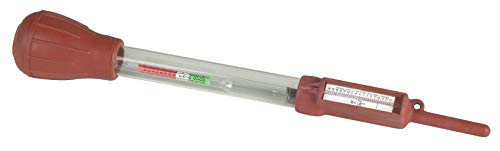
The OTC 4619 is the professional-grade float hydrometer on this list, built for people who test batteries often and want a number they can trust. Its float carries an easy-to-read scale spanning 1.100 to 1.300, divided into three color-coded zones — red, white and green — so a quick glance shows the charge state before you even note the exact figure. What sets it apart from basic float models is the built-in thermometer: instead of showing degrees, it displays the temperature correction factor directly, so you read the raw specific gravity, read the correction, and add or subtract to get the true value, following the maker’s procedure. The flexible rubber suction tube reaches into cells on batteries installed in tight engine bays, and the maker backs the tool with a one-year warranty.
The trade-off is the one shared by all glass float hydrometers: it rewards a careful hand. The float must hang free in the sample, not rest against the tube wall, and the glass construction deserves gentler treatment than an all-plastic tool. For a workshop, a golf cart fleet, or an off-grid battery bank where accurate records matter, it is the pick.
2. EZRED SP101 Battery Hydrometer — best for fast, no-table readings
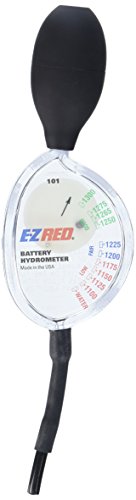
The EZRED SP101 takes the opposite approach to the OTC: instead of a free float and a correction step, it uses an internal pointer system designed, per the maker, to give a direct reading with no difficult float interpretation and no temperature tables required. The scale covers 1.100 to 1.300, the same useful range as the professional float models, and both the customer and the technician can see the state of the battery acid at a glance, which is why this design is a fixture in service stations.
The SP101 is built from ABS plastic, measures about 11.4 inches long, and weighs only 2.4 ounces, so it shrugs off the drops and knocks of garage life better than a glass instrument and stores easily in a toolbox drawer. Its compact shape also suits batteries installed in tight spaces. The compromises are resolution and sample size: readings are taken from the pointer in relatively coarse steps rather than the fine graduations of a float, and the maker notes it needs more electrolyte than small motorcycle batteries hold, so it is aimed at automotive, marine, golf cart and deep-cycle batteries rather than powersports cells. If you want a quick, rugged, good-or-charge answer with no arithmetic, this is the one.
3. Deka Temperature Correcting Battery Hydrometer (00231) — battery maker’s own tool
ASIN: N/A
This hydrometer comes from East Penn, the manufacturer behind the Deka battery line, and it is built around the same job the company’s own service literature describes: precise, temperature-corrected testing of flooded batteries. Per the manufacturer’s catalog, part number 00231 (UPC 083996002319) is a glass-tube hydrometer featuring both temperature and float calibrated readings, so the temperature correction is read from the instrument itself rather than calculated from a separate thermometer and table. That makes it a natural fit for owners of Deka and other flooded deep-cycle batteries who follow the maker’s maintenance schedule, which calls for regular specific gravity checks on every cell.
We are listing this model with “ASIN: N/A” deliberately: the product is confirmed in East Penn’s own catalog and is sold through battery dealers and online tool sellers, but we could not confirm a current Amazon US listing identifier for it at the time of writing, and we do not publish identifiers we cannot verify. Search for it by the part number 00231 and the Deka name. As a glass float instrument it needs the same careful handling as the OTC, and in return it delivers readings in the same accuracy class.
4. Mighty Max Battery Golf Cart / Deep Cycle Battery Hydrometer Tester — simple budget float tester
ASIN: N/A
Mighty Max Battery sells this hydrometer specifically for the golf cart and deep-cycle world, where a single cart can have six or eight cells to check and a maintenance round covers a whole bank of batteries. It is a straightforward float-type tester: a clear plastic tube with an easy-to-read, color-coded float scale spanning 1.100 to 1.300, so each cell gives a quick numeric reading plus a color zone. Roundup coverage of the listing describes it as a compact, lightweight handheld tool intended for 6-volt and 12-volt lead-acid deep-cycle batteries, which covers the 6-volt golf cart batteries and 12-volt deep-cycle batteries most owners test.
There is no temperature compensation on this model, so for accurate records you should note the electrolyte temperature and apply the 0.004-per-10°F correction described above, or simply test at moderate temperatures and compare cells against each other, which is what most cart owners actually need. We could not verify a current Amazon US identifier for this listing at the time of writing — the verifiable listing evidence we found was for another Amazon marketplace, and we do not carry identifiers across marketplaces — so it is listed here as “ASIN: N/A” and is best found by searching the Mighty Max Battery name and the product title. As a second hydrometer kept with the cart or the solar shed, its simplicity is the point.
How to use a hydrometer safely and accurately
Battery electrolyte is sulfuric acid, so treat every test with respect. Wear eye protection and gloves, work in a ventilated space away from sparks and flames (charging batteries vent hydrogen), and keep baking soda and clean water nearby to neutralize drips. Never smoke near a battery being tested or charged.
- Rest the battery. Test after the battery has sat for several hours off charge, or at least well after a drive, so surface charge does not distort the readings.
- Check the electrolyte level first. The plates should be covered. If a cell is low, top up with distilled water only, then charge the battery before testing, because adding water dilutes the sample.
- Prime the hydrometer. Draw electrolyte in and expel it back into the same cell two or three times. This brings the float to the electrolyte’s temperature and wets the tube for a truer reading.
- Take the reading. Draw enough electrolyte to float the float freely, hold the hydrometer vertical at eye level, tap it lightly to free any bubbles, and read the scale at the liquid surface. Return the sample to the same cell.
- Record every cell. Note each cell’s reading and, if your hydrometer is not temperature-compensated, the electrolyte temperature, then apply the correction.
- Rinse the tool. Flush the hydrometer with clean water after use so dried acid does not foul the float or discs, and store it where the tube cannot be crushed.
One more warning: never add acid to a battery to “fix” a low reading, and never test immediately after adding water. Low specific gravity after a full charge means the battery needs charging, equalization (for flooded deep-cycle batteries, following the battery maker’s instructions), or replacement — not new acid.
Buying guide: choosing the right hydrometer
Float vs. dial. Choose a float hydrometer (OTC, Deka) for the finest numeric readings and record-keeping. Choose a dial/pointer model (EZRED) for speed and durability when a clear charge-state answer matters more than the third decimal place.
Temperature handling. If your batteries live outdoors or in an unheated space, prioritize a model with a built-in thermometer, correction scale, or temperature-compensated readout. Otherwise you must correct manually, and most owners simply forget.
Reach and sample size. Long, flexible nozzles help with batteries installed in vehicles. Small powersports batteries hold little electrolyte per cell; compact hydrometers suit them better, and some full-size models cannot draw enough sample to work at all.
Build material. Glass floats are accurate and resist acid etching but break if dropped. All-plastic tools survive workshops better. Either way, rinse after every use.
What a hydrometer cannot do. It cannot test sealed AGM, gel or lithium batteries, and it cannot measure cranking capacity. Pair it with a load test or a conductance tester when the question is whether an old starting battery can still crank an engine.
Frequently asked questions
Can I use a hydrometer on my AGM battery? No. AGM and gel batteries are sealed, so there is no way to draw an electrolyte sample. Use a voltmeter and a conductance or load tester for sealed batteries. Hydrometers are for flooded batteries with removable cell caps.
Why do my cells read differently from each other? Small differences (up to about 0.025) are normal. A spread of 0.050 or more after a full charge usually means one cell is failing, or the battery needs an equalization charge if it is a flooded deep-cycle type. Retest after charging before condemning the battery.
How often should I test? For golf carts and off-grid banks, monthly during the season is a sensible rhythm, and always before long storage. For a car starting battery, test when starting feels sluggish or at the start of winter.
Is a refractometer better than a hydrometer? A battery refractometer reads specific gravity from a few drops of electrolyte and is also temperature-compensated in many models. It is a good alternative, but it is a different instrument; the tools in this guide are hydrometers, which need a larger sample and reward you with a direct, battery-powered-free reading.
Bottom line
For the most accurate readings with proper temperature correction, choose the OTC 4619 Professional Battery Hydrometer (ASIN: B0050SFVHO). For fast, rugged, no-table checks in a busy garage, the EZRED SP101 (ASIN: B000JFHMRU) is the practical pick. The Deka 00231 (ASIN: N/A) brings a battery maker’s own temperature-correcting float tool, and the Mighty Max Golf Cart / Deep Cycle tester (ASIN: N/A) covers simple fleet and cart maintenance. Whichever you choose, test every cell, correct for temperature, and write the numbers down — that habit, more than the tool itself, is what makes batteries last.