Key takeaways
- Find the best ergonomic executive chairs for creative workstations, with adjustable lumbar support, deep comfortable seats, and all-day comfort for design work.
Creative work keeps you in one seat for hours at a time. Whether you are editing video, retouching photos, illustrating, writing, or building layouts, the best ergonomic executive chairs for creative workstations support your back, shoulders, and arms through long sessions without forcing you into a single rigid posture. A good chair disappears under you. A bad one announces itself by mid-afternoon, with a stiff neck, aching lower back, and restless legs.


The short answer: the Herman Miller Aeron Remastered is the strongest all-round choice for creative professionals who sit for long stretches and want proven ergonomic adjustment, while the BestEra Big and Tall Executive Chair is the best leather executive option for readers who want a high-back look, a headrest, and a footrest for breaks. If you need a wider seat and a much higher weight capacity, the BLISNEST and FANTAWESO big-and-tall models are the chairs to look at. The rest of this guide explains how to choose, then reviews each chair in detail so you can match the seat to your body, your desk, and the way you actually work.
Quick Picks
Our Short List of 3
All 4 Picks at a Glance
| Product | Specs | Action |
|---|---|---|
| Herman Miller Aeron Remastered, Size B, Fully Loaded | Check price on Amazon | |
| BestEra Big and Tall Executive Office Chair With Foot Rest | Check price on Amazon | |
 BLISNEST Big and Tall Office Chair With Footrest | Check price on Amazon | |
 FANTAWESO Big and Tall Office Chair | Check price on Amazon |
How to Choose
A creative workstation asks more of a chair than a standard desk does. You lean in to check fine detail, lean back to review a full layout, reach for a tablet or a second monitor, and sometimes stay put for an entire editing session. The features below matter more than brand names or looks alone.
Lumbar Support That Actually Adjusts
Lower-back support is the single most important feature in an executive chair for creative work. Fixed lumbar padding helps some people and misses others entirely, because every spine curves a little differently. Look for lumbar support you can move up and down, change in firmness, or inflate to the level that fits your back. A chair with adjustable lumbar support lets you fine-tune the fit on the first day and again months later, when your posture or your workload changes. If a chair only offers a loose lumbar pillow, check whether it stays in place when you shift position, since a pillow that slides around is little use during a long session.
Seat Depth and Width
Seat depth decides whether the front edge of the chair presses into the backs of your thighs. If the seat is too deep, you will slide forward and lose back support. If it is too shallow, your thighs hang unsupported and your legs tire. A seat slider is the simplest fix, letting you move the seat pan forward or back until your feet rest flat on the floor with your knees at a comfortable angle. Seat width matters just as much. Illustrators and editors who shift position often need room to move, while a seat that is too wide can leave smaller users without armrest support. Measure your hips and your desk clearance before you order, and compare those numbers with the chair dimensions rather than guessing from photos.
Armrests That Move With Creative Work
Creative work is not one posture. You type, you draw with a stylus, you hold a tablet, you reach for reference material, and you lean back to think. Armrests that only move up and down can leave your shoulders hunched when you switch tasks. Four-dimensional armrests, which adjust in height, width, depth, and angle, let you bring support to your elbows in each of those positions. Flip-up armrests are a useful alternative in a creative workstation, because they swing out of the way when you pull close to a drawing tablet or a wide monitor setup. Padded armrests are worth seeking out as well, since hard plastic edges become uncomfortable during long sessions.
Recline, Tilt, and Movement
Sitting upright all day is not the goal. Healthy sitting means changing position often, and a good executive chair makes that easy. A synchro-tilt mechanism, which moves the seat and backrest together in a natural ratio, keeps your feet grounded while you recline. A tilt lock lets you hold a leaned-back position when you are reviewing work or taking a call, and a tilt tension control lets you set how easily the chair leans. A backrest that reclines well past upright is useful for short breaks between tasks, especially on chairs with a footrest.
Materials and Airflow
Leather and bonded leather give an executive chair its classic look, and they wipe clean easily, which matters in a studio where coffee, ink, and snacks are never far away. The trade-off is heat. A leather seat can feel warm during a long summer editing session, especially in a room without strong airflow. Mesh backs solve the heat problem by letting air circulate, and they are the reason many creative professionals prefer mesh for all-day use. Fabric sits between the two, offering warmth in winter and more breath than leather. There is no single right answer. If your studio runs warm, favour mesh. If you want the executive look and your room stays cool, leather is a fine choice.
Size, Weight Capacity, and Footprint
Executive chairs are bigger than basic task chairs, and big-and-tall models are bigger still. Check the overall height, width, and depth against your desk, and make sure the chair can roll under your desk or sit comfortably beside it. Weight capacity is a structural rating, not a suggestion, so choose a chair rated comfortably above your body weight rather than right at the limit. A higher capacity usually means a stronger base, a sturdier gas cylinder, and a wider seat, which is good news for larger users and a poor fit for smaller ones. Also check the caster type. Hard-floor casters protect wood and laminate, while standard casters suit carpet. A chair that is right in every other way can still damage a studio floor if the wheels are wrong for the surface.
The Best Ergonomic Executive Chairs for Creative Workstations Reviewed
Each chair below is a real product sold on Amazon US, with its own strengths and limits. Read the fit notes carefully, because the best chair for a video editor in a warm studio is not always the best chair for an illustrator who wants a leather executive look.
Herman Miller Aeron Remastered, Size B, Fully Loaded
The Aeron Remastered has been the benchmark ergonomic chair for creative professionals for years, and it earns that place with engineering rather than styling. The pellicle mesh seat and back suspend you instead of pressing foam against your body, which keeps air moving and reduces heat build-up during long sessions. The fully loaded Size B configuration includes PostureFit SL lumbar support, four-dimensional adjustable arms, a tilt limiter, and forward tilt, giving you more adjustment points than almost any other chair in this guide.
For creative work, the Aeron shines when you sit for hours without a break. The mesh conforms to your shape, the lumbar support targets the natural curve of the lower spine, and the forward tilt helps when you lean in to work on fine detail. The chair is also light and easy to move around a studio, which matters when you roll between a desk, a monitor wall, and a meeting table. The main compromise is style. This is a mesh task chair, not a traditional leather executive chair, so it reads as modern and technical rather than boardroom classic. If the executive look matters to you, this is a partial fit on appearance, even though its ergonomics are the strongest here. It also suits people who run warm better than anyone else in this roundup.
BestEra Big and Tall Executive Office Chair With Foot Rest
The BestEra executive chair is the closest thing in this guide to the classic executive look, with high-back PU leather upholstery, a headrest, and a padded silhouette that suits a home studio or a client-facing office. Its lumbar support and headrest follow the natural curves of the waist and neck, helping you hold a healthy posture during long workdays. The cushion uses upgraded sponge with twenty independent spring packs, which gives the seat a supportive feel that resists flattening over time.
What sets this chair apart for creative work is its range of rest positions. The seat height adjusts across four inches, the backrest reclines from 90 to 135 degrees, and a retractable footrest pulls out when you want to stretch your legs between tasks. That makes it a good choice for editors and writers who work in focused bursts with short breaks, since you can lean back and rest without leaving your workstation. The flip side is size. This is a big-and-tall chair, so it takes up more floor space than a standard task chair and suits larger users best. Smaller users should check the seat dimensions carefully before ordering, because a seat that is too deep or too wide can leave your feet dangling and your arms unsupported.
BLISNEST Big and Tall Office Chair With Footrest
The BLISNEST chair is built for larger users who have found standard executive chairs too narrow or too lightly built. Its wide seat, thick cushion, and heavy-duty metal base support up to 650 pounds, and the frame is paired with an SGS-certified gas cylinder and a BIFMA-approved metal base. Padded armrests, a tall backrest, a detachable lumbar support pillow, and a retractable footrest round out a package that is clearly designed for long, comfortable sitting.
In a creative workstation, the wide seat is the real advantage. It gives you room to shift position, cross a leg, or sit sideways for a moment while you think, without feeling perched on the edge of the chair. The detachable lumbar pillow lets you position lower-back support exactly where you need it, or remove it entirely if you prefer the shape of the backrest alone. The tilt mechanism and 360-degree swivel keep movement smooth when you turn between monitors. The partial fit to note is the size and the styling. This chair is oversized by design, so it needs a roomy studio and a desk with enough clearance, and its heavy-duty focus means it is a specialist choice rather than a chair for every body type.
FANTAWESO Big and Tall Office Chair
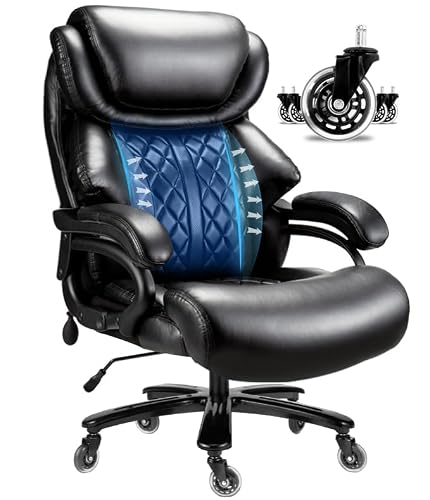
The FANTAWESO chair is the heavyweight of this roundup, with a stated capacity of 800 pounds and an oversized frame to match. Its seat is 6.5 inches thick, combining multi-layer resilient foam with twenty individually pocketed springs, and a waterfall edge at the front helps circulation in the legs during long sessions. An inflatable lumbar support lets you adjust the firmness of the lower-back support by adding or releasing air, so the fit can be tuned to your spine rather than left to chance.
For creative professionals who are larger, or who simply want the most heavily cushioned seat in this guide, this chair offers a level of padding the others do not. The backrest tilts from 90 to 110 degrees with sway and lock modes, the seat height adjusts to suit different desk heights, and rollerblade-style wheels are designed to move smoothly without marking hard floors. A rear storage pocket keeps small items within reach. The trade-off is the same as with any chair built to this scale. It is wide, deep, and heavy, so it suits a spacious studio and a larger user. If you are of average build, the seat may feel too wide and the lumbar support too far forward, so measure first and treat this as a specialist pick rather than a default choice.
What to Check Before You Buy
Measure your desk height, your leg length, and the floor space around your workstation before you order any executive chair. A chair that cannot roll under your desk, or that leaves your elbows well above your keyboard, will fight you every day no matter how good its lumbar support is. Check whether the chair ships with the casters you need for your floor, and whether the assembly is a quick job or a longer one that needs a second pair of hands. Larger executive chairs often arrive in heavy boxes, so confirm you can get the box into your studio and have room to build the chair there.
Read the return policy and the warranty terms before you commit, since a chair is one of the few purchases you cannot fully judge from a listing. Sit in it for a full workday if you can, and pay attention to your lower back, your shoulders, and your thighs rather than your first impression. A chair that feels soft and welcoming for five minutes can still leave you stiff after five hours, while a firmer chair with good lumbar support often feels better the longer you sit. Finally, check that spare parts and replacement casters are available for the model you choose, because a chair you keep for years will eventually need a new wheel or a new gas cylinder.
FAQ
What makes a chair an executive chair rather than a regular office chair?
An executive chair usually has a high back, a headrest, padded armrests, and a more formal look, often in leather or bonded leather. An ergonomic chair is defined by its adjustability instead: lumbar support, seat depth, armrest movement, and tilt. The best ergonomic executive chairs for creative workstations combine both, with the executive styling and the ergonomic adjustment in the same seat. A chair that only looks executive, without real adjustment, is a poor choice for long creative sessions.
How long should a good executive chair last?
A well-built executive chair should last for many years of daily use. The frame, base, and gas cylinder matter most, since those are the parts that carry your weight every day. Look for a metal base, a certified gas cylinder, and a warranty that covers the frame and the mechanism for several years. Cushions and upholstery wear first, so a chair with replaceable casters and available spare parts is a better long-term buy than one with no support after the sale.
Do I need a headrest for creative work?
A headrest helps during breaks and leaned-back review, when you want to rest your neck while looking at a full layout or listening to a call. It matters less during active typing, drawing, or editing, when you sit upright and your head stays forward. If you take regular breaks at your desk, a headrest is worth having. If you work upright all day and rarely lean back, it is a nice extra rather than a necessity.
Is mesh or leather better for long editing sessions?
Mesh is better for airflow and for staying cool during long sessions, which is why many editors and designers choose it for warm studios. Leather looks more executive, wipes clean easily, and feels warmer in a cool room, but it can trap heat over several hours. If your studio runs warm or you sit for very long stretches, favour mesh. If you want the classic executive appearance and your room stays comfortable, leather is a strong choice.
Can a big-and-tall chair work for an average-size user?
It can, but it is not always comfortable. Big-and-tall chairs have wider seats, deeper seat pans, and higher weight capacities, which suit larger users well. An average-size user may find the seat too wide to reach the armrests comfortably, or the seat too deep to sit back against the lumbar support with feet flat on the floor. If you are of average build, choose a standard-size executive chair with good adjustment, and only move to a big-and-tall model if you genuinely need the extra width or capacity.
Bottom Line
The best ergonomic executive chairs for creative workstations are the ones that fit your body, your desk, and your working rhythm. The Herman Miller Aeron Remastered is the pick for most creative professionals who want the strongest ergonomics and the coolest seat for long sessions, even though its mesh styling is a partial fit for the traditional executive look. The BestEra Big and Tall Executive Chair is the best choice for readers who want leather, a headrest, and a footrest in a classic executive package. The BLISNEST and FANTAWESO chairs are specialist picks for larger users who need a wide seat, a high weight capacity, and thick cushioning. Measure your space, check the adjustment range, and choose the chair that supports the way you actually work, not just the one that looks best in a photo.
Disclosure: As an Amazon Associate, we may earn from qualifying purchases.