Key takeaways
- Five media players that play movies and music from a hard drive or home server on any TV, from a compact 4K box to a full 8K player with lossless audio.
The best media player for a TV is the Zidoo Z9X Pro, because it plays the files a household already owns, from a hard drive or a home server, with full Dolby Vision and HDR10+ picture, lossless audio passed through untouched to a receiver or soundbar, a poster wall that turns a folder of files into a browsable library, and a wired network connection fast enough for high-bitrate 4K rips that make a wireless stick stutter. A streaming device is built for apps, and it does that job well, but it treats a personal collection as an afterthought, if it handles it at all. A media player is built the other way around. It is made for the household that has movies on a drive, music on a server, or a library of discs already ripped to files, and it plays those files on the big screen at their full quality, with the menus, the chapters, the subtitles, and the surround sound intact, instead of squeezing them through a service that compresses everything first.
The five picks in this guide solve the local-playback problem in five different ways, and the right one depends on how large the library is and how much the household cares about picture and sound quality. The Zidoo Z9X Pro is the default pick, because it is the most balanced box here, pairing strong format support with a library interface that needs no extra software. The Zidoo Z9X 8K is the pick for a household building toward an 8K set, because it carries the newest processor in this guide and the most memory of any Zidoo here. The Dune HD Pro 8K Plus is the pick for a household that wants the most polished 8K player and the best remote in this guide, with a metal case and a backlit controller. The Ugoos AM6B Plus is the pick for a household that wants a capable local player on a budget and does not mind an older version of Android. The NVIDIA Shield TV Pro is the pick for a household that wants a media player that also runs a Plex server, plays games, and handles streaming apps with full certification.
Start with the How to Choose section if the household has never owned a media player, because three checks decide everything before any box is ordered: where the files live, what formats they are in, and what the television and sound system can actually show and play. A box that cannot read the household’s file types is a box that goes back, a box on a weak wireless link will stutter on the biggest files, and a box plugged into the wrong HDMI input will never deliver the sound it promises. The quick comparison table puts the five picks side by side, and each product section lists the full published specs.
As an Amazon Associate, we earn from qualifying purchases.
Table of Contents
- How to Choose a Media Player for a TV
- Quick Comparison
- 1. Zidoo Z9X Pro
- 2. Zidoo Z9X 8K
- 3. Dune HD Pro 8K Plus
- 4. Ugoos AM6B Plus
- 5. NVIDIA Shield TV Pro
- Before You Buy: Checks for TV Media Players
- Frequently Asked Questions
- Conclusion
- Product and ASIN Reference
How to Choose a Media Player for a TV
Start from where the files live, because that decides the connection the box needs. A media player is only as good as its route to the library. A household that keeps movies on a USB hard drive needs a box with fast USB ports and the ability to read large drives, and every pick in this guide has at least one USB 3.0 port for that job. A household that keeps files on a network drive or a home server needs a box with a wired Ethernet port, because a high-bitrate 4K file can overwhelm a wireless link in a way a streamed show never does, and every pick here carries gigabit Ethernet except for the detail that the wireless-only route is never the right first choice for a big library. A household that runs a Plex or similar server needs a box that works as a client, and ideally as the server itself, which is the one job only the Shield TV Pro does in this guide. Before ordering, count the drives, note whether they sit beside the television or in another room, and buy the box whose ports match that layout, because a box with no free USB port and no wired network is a box that cannot reach the library at all.
Match the video formats, because a player that cannot decode the household’s files is a player that shows an error. The files in a personal library come in more shapes than any streaming app ever serves, and the format list is the spec sheet that matters most. Every pick here plays 4K files with high dynamic range, but they split on the details. The two Zidoo boxes and the Dune HD player handle full disc copies, including folder structures and disc image files, with Dolby Vision and HDR10+ picture, and the Dune HD player and the Zidoo Z9X 8K go further with 8K decoding for households already collecting 8K material. The Ugoos box covers the common 4K formats with H.265 decoding and high dynamic range, which is enough for most libraries, while the Shield TV Pro adds AI-enhanced upscaling that sharpens older files on a 4K screen. Check the library before ordering: if it holds disc copies with menus, buy a Zidoo or a Dune HD box, and if it holds mostly standard 4K files, any pick here will play them.
Check the audio path, because the best picture in this guide is wasted on a sound system the box cannot feed. A media player earns its place in a home theater by passing lossless audio through to a receiver or soundbar untouched, so the surround sound the disc carried arrives exactly as recorded. The Zidoo boxes and the Dune HD player are built for that job, with high-definition audio passthrough over HDMI, including the object-based formats that put sound overhead and around the room. The Shield TV Pro carries Dolby Atmos as well, which makes it the strongest pick for a household whose sound system is a soundbar rather than a full receiver. The Ugoos box covers the common surround formats and adds an analog audio output for an older setup. Before ordering, look at how the sound system connects: a receiver with HDMI inputs takes any pick here, a soundbar with a single HDMI input wants a box with audio passthrough over that same cable, and a setup with no surround sound at all does not need the premium audio features and can buy on picture alone.
Mind the network and the storage, because a local library is only useful if the box can reach it quickly. A media player that buffers is a media player that fails at its one job, and the two numbers that prevent buffering are the network speed and the memory inside the box. Every pick here has gigabit Ethernet, which is the right connection for a library on a home server, and Wi-Fi 6 on the Zidoo boxes, the Dune HD player, and the Ugoos box for households that cannot run a cable. Memory matters too: the Dune HD Pro 8K Plus carries 8GB of memory and 64GB of storage, the Zidoo Z9X 8K carries 6GB and 64GB, the Zidoo Z9X Pro and the Ugoos box carry 4GB and 32GB, and the Shield TV Pro carries 3GB and 16GB. More memory means a smoother library interface and room for apps and artwork, and more storage means room for the apps themselves. A household with a large library should treat 8GB of memory and 64GB of storage as the comfortable floor, while a household with a small library and a single drive will be fine with less.
Weigh the software, because the library interface is what the household actually looks at every night. A folder of files is not a library until something turns it into posters, descriptions, and a search box, and the five picks take different routes to that. The Zidoo boxes build a poster wall from the files themselves, scraping artwork and details automatically, so the collection looks like a streaming service without any extra software. The Dune HD player runs its own media center interface alongside Android, with the same poster-wall idea and a reputation for stable playback of demanding files. The Ugoos box runs plain Android, which means the household installs its own player app, and it can also boot a dedicated media-center system from a USB drive for a simpler, playback-only experience. The Shield TV Pro runs the full certified Android TV platform with a Plex server built in, which makes it the only pick here that can serve the library to other rooms and other devices. Decide how much setup the household wants: a poster wall out of the box wants a Zidoo or a Dune HD player, and a household that enjoys setting up its own apps will be happy with the Ugoos box or the Shield TV Pro.
Size the box and the remote, because a media player lives in the living room, not on a desk. The five picks range from a compact square that hides behind the television to a metal slab that sits proudly on a shelf, and the difference matters for a household with a crowded media cabinet. The Ugoos box is the smallest, at roughly four and a half inches square, and the Shield TV Pro is a slim rectangle that slides under a television. The Dune HD player is a solid metal case with a front display, and the two Zidoo boxes sit between those extremes. The remote matters as much as the case: the Dune HD remote is the best in this guide, with a backlight, voice search, an air mouse, and the ability to learn commands from the television remote, while the Shield TV Pro remote is slim and backlit with a locator feature, and the Zidoo and Ugoos remotes are straightforward infrared controllers. A household that watches with the lights off should weigh the backlit remotes heavily, because fumbling for a button in the dark is the kind of small annoyance that adds up every night.
Quick Comparison
| Product | Processor | Memory and Storage | Top Video | Library Software | Tier |
|---|---|---|---|---|---|
| Zidoo Z9X Pro | Quad-core 64-bit | 4GB, 32GB | 4K Dolby Vision, HDR10+ | Poster wall | Mid-range |
| Zidoo Z9X 8K | Amlogic S928X-K | 6GB, 64GB | 8K Dolby Vision, HDR10+ | Poster wall | Premium |
| Dune HD Pro 8K Plus | Amlogic S928X-K/J | 8GB, 64GB | 8K Dolby Vision, HDR10+ | Dune HD media center | Premium |
| Ugoos AM6B Plus | Amlogic S922X-J | 4GB, 32GB | 4K HDR, H.265 | Android, media-center option | Budget |
| NVIDIA Shield TV Pro | Tegra X1+ | 3GB, 16GB | 4K Dolby Vision, AI upscaling | Android TV, Plex server | Mid-range |
1. Zidoo Z9X Pro
The Zidoo Z9X Pro is the media player to buy first for a TV, because it plays the files a household already owns, from a hard drive or a home server, with full Dolby Vision and HDR10+ picture, lossless audio passed through untouched to a receiver or soundbar, a poster wall that turns a folder of files into a browsable library, and a wired network connection fast enough for high-bitrate 4K rips that make a wireless stick stutter. It is the most balanced box in this guide, and that balance is the reason it is the default pick: it does the local-playback job completely, without asking the household to install extra software or to accept a weaker format list in exchange for a lower tier. The Z9X Pro sits in the middle of the Zidoo range, above the older base model and below the 8K flagship, and that middle spot is where most libraries actually live, in 4K with high dynamic range, rather than in 8K.
The video handling is the core of the case. The Z9X Pro decodes 4K files at 60 frames per second with Dolby Vision and HDR10+, and its VS10 picture engine maps high dynamic range material onto the television in a way that keeps bright highlights and dark shadows readable at the same time. It plays disc folder structures and disc image files, so a household that ripped its collection keeps the menus and the chapters rather than losing them to a single flat file, and it handles the common container formats, including MKV, without a conversion step. The HDMI 2.1 output carries the picture to the television at full quality, and the gigabit Ethernet port carries the files from the server without the buffering that a wireless link introduces on the largest rips. A USB 3.0 port takes a hard drive directly, so a household with no server at all can still plug a drive into the box and watch.
The audio handling is the other half of the case, and it is where a media player proves it belongs in a home theater rather than on a bedroom set. The Z9X Pro passes high-definition audio through over HDMI untouched, so a receiver decodes the surround track exactly as it was recorded, including the object-based formats that place sound overhead. That passthrough is the detail that separates a media player from a streaming stick, because a stick decodes and re-encodes on the way through, while the Zidoo hands the track to the receiver whole. The poster wall is the third piece: the box scans the library, fetches artwork and descriptions, and presents the collection as a grid of posters with search and filtering, so finding a film takes seconds instead of scrolling through file names. It runs Android 11, which covers the apps a household might still want alongside its local files, and it pairs over Bluetooth 5.2 with headphones or a keyboard, with Wi-Fi 6 for households that cannot run a cable.
The Z9X Pro also suits the household that shares one television between viewers with different tastes, because the poster wall gives everyone the same easy browsing, the box moves easily from the living room to a bedroom set, and the same library serves every room it visits. The trades are two, and both are worth naming plainly. The box tops out at 4K, so a household already collecting 8K material should look at the Zidoo Z9X 8K or the Dune HD Pro 8K Plus instead, and its 4GB of memory and 32GB of storage are adequate rather than generous, so a household with a very large library and many apps should look at the Dune HD player with its 8GB of memory. Buy the Zidoo Z9X Pro if the household wants the most balanced local media player for a TV and a library in 4K, and buy the Zidoo Z9X 8K if the household wants the same job done with headroom for 8K.
Specs
- Processor: quad-core 64-bit processor with VS10 picture engine
- Memory: 4GB RAM
- Storage: 32GB internal storage
- Operating system: Android 11
- Video: 4K at 60 frames per second, Dolby Vision, HDR10+, disc folder and disc image playback
- Audio: high-definition audio passthrough over HDMI
- Network: gigabit Ethernet, Wi-Fi 6, Bluetooth 5.2
- Ports: USB 3.0, HDMI 2.1 output
- Library: poster wall with automatic artwork and details
- Tier: Mid-range
2. Zidoo Z9X 8K
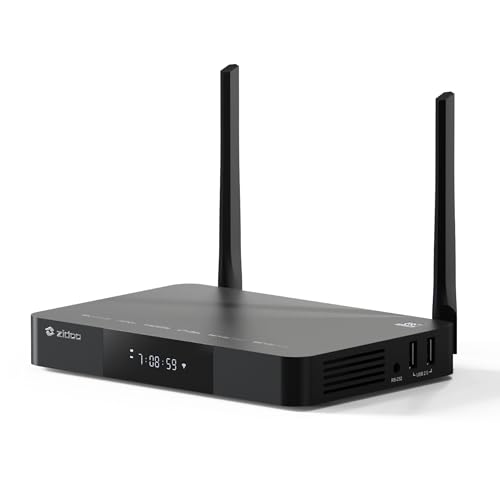
The Zidoo Z9X 8K is the pick for a household building toward an 8K television, because it carries the newest processor in the Zidoo range, decodes 8K video with Dolby Vision and HDR10+, and doubles the memory and storage of the default pick, so a large library and a growing collection of high-resolution files both have room to grow. It is the flagship of the Zidoo line in this guide, and that position shows in the hardware: a newer media processor, more memory for a smoother library interface, and a video engine built for the most demanding files a household is likely to own. A household that buys an 8K set in the next year or two will not need to replace this box when the television arrives, and a household with a 4K set today still benefits, because the extra headroom makes 4K playback effortless and the library interface faster.
The processor is the detail that sets this pick apart. It uses the Amlogic S928X-K media processor, a newer chip than the one in the default pick, paired with 6GB of memory and 64GB of storage, which is the largest memory and storage combination of any Zidoo in this guide. The video engine pairs a VPU video engine with the VS10 picture engine, so 8K files decode cleanly and high dynamic range material keeps its highlights and shadows intact. It plays 4K Ultra HD Blu-ray folder structures and disc image files, which is the format a household with a ripped disc collection actually stores, and it handles Dolby Vision and HDR10+ across those files. The box runs Android 11, which covers the apps a household might still want, and it connects over gigabit Ethernet for a server library, with Wi-Fi for households that cannot run a cable, and USB ports for a drive plugged in directly.
The Z9X 8K also suits the household whose library is still growing, because the 64GB of storage leaves room for apps and artwork, the 6GB of memory keeps the poster wall smooth even with thousands of titles, and the newer processor leaves headroom for firmware improvements that make demanding formats play better over time. The poster wall works the same way as on the default pick, scanning the library and presenting it as a grid of posters with search and filtering, so the household gets the same easy browsing with a faster box underneath. The trades are two, and both are worth naming plainly. This is the most expensive Zidoo in this guide, and a household whose library is entirely 4K will not see a difference on screen today, so the default pick is the better buy for that household. It is also a newer model, so its firmware is still maturing, and a household that wants the longest track record should look at the Z9X Pro instead. Buy the Zidoo Z9X 8K if the household wants headroom for 8K and the largest Zidoo library in this guide, and buy the Dune HD Pro 8K Plus if the household wants the same 8K capability with more memory and a better remote.
Specs
- Processor: Amlogic S928X-K media processor with VPU and VS10 video engines
- Memory: 6GB RAM
- Storage: 64GB internal storage
- Operating system: Android 11
- Video: 8K HDR, 4K Dolby Vision, HDR10+, 4K Ultra HD Blu-ray folder and disc image playback
- Audio: high-definition audio playback for home theater sound systems
- Network: gigabit Ethernet, Wi-Fi, USB ports for direct drive playback
- Library: poster wall with automatic artwork and details
- Tier: Premium
3. Dune HD Pro 8K Plus

The Dune HD Pro 8K Plus is the pick for a household that wants the most polished 8K media player in this guide, because it pairs the same class of 8K processor as the Zidoo flagship with more memory, a metal case, and the best remote here, and it runs a media center interface that has been refined over years of Dune HD players. It is the premium pick for a household that treats the media player as a piece of home theater equipment rather than a gadget, and that shows in the build: a solid metal case, a clean front, and a remote that is backlit, carries voice search, works as an air mouse, and can learn commands from the television remote. A household that watches with the lights off will notice the remote on the first night, and a household with a large library will notice the 8GB of memory every time the library loads.
The hardware is the strongest in this guide on paper. The Amlogic S928X-K/J media processor with the Dolby Vision VS10 engine decodes 8K video at 60 frames per second and outputs it over HDMI 2.1a, with support for the AV1 codec that newer files increasingly use, and it handles Dolby Vision profile 7 files, the double-layer format that carries the full enhancement data from a disc copy. The 8GB of memory and 64GB of storage are the largest in this guide, so the library interface stays smooth with thousands of titles and there is room for apps and artwork. The connections cover every route to a library: gigabit Ethernet for a home server, Wi-Fi 6 for a wireless setup, a USB 3.0 port and a USB 2.0 port for drives plugged in directly, and an optical audio output for a sound system that takes its audio separately. The Bluetooth 5.2 link pairs with headphones or a keyboard, and the box runs Dune HD OS alongside Android 11, so the household gets a dedicated media center and the Android apps in one box.
The software is the other half of the case, and it is where Dune HD earns its reputation. The media center interface organizes the library into posters and collections, plays disc copies with their menus intact, and handles the demanding formats, including high-bitrate files and lossless audio, without stuttering. The remote deserves its own mention: the latest batches ship with a Bluetooth remote that carries a microphone for voice search, works as an air mouse for pointing at the screen, learns infrared commands from the television remote, and lights its keys for dark-room use, which makes it the most complete controller in this guide. The honest trade is one the maker states plainly: the box has no Android TV certification and no guaranteed compatibility with particular streaming services, so a household that wants certified streaming apps with full high-resolution support should keep a streaming device alongside it, and the Dune HD player should be bought for what it is, a local media player first. Buy the Dune HD Pro 8K Plus if the household wants the most polished 8K player and the best remote in this guide, and buy the Zidoo Z9X 8K if the household wants the same 8K capability with a simpler setup.
Specs
- Processor: Amlogic S928X-K/J media processor with Dolby Vision VS10 engine
- Memory: 8GB RAM
- Storage: 64GB internal storage
- Operating system: Dune HD OS plus Android 11
- Video: 8K at 60 frames per second, 4K Dolby Vision, HDR10+, AV1 codec, Dolby Vision profile 7
- Audio: high-definition audio, optical digital audio output
- Network: gigabit Ethernet, Wi-Fi 6, Bluetooth 5.2
- Ports: USB 3.0, USB 2.0, HDMI 2.1a output
- Remote: Bluetooth remote with voice search, air mouse, infrared learning, backlight on latest batches
- Case: metal case, 6.3 x 4.53 x 1.02 inches, 2.44 pounds
- Tier: Premium
4. Ugoos AM6B Plus

The Ugoos AM6B Plus is the pick for a household that wants a capable local media player on a budget, because it pairs a strong processor with 4GB of memory, gigabit Ethernet, and USB 3.0, so it plays high-bitrate 4K files from a drive or a server without the stuttering that cheaper boxes show, and it does so in the smallest case in this guide. It is the enthusiast pick here, and that is its appeal: it gives a household the hardware that matters for local playback, the processor, the memory, the wired network, and the fast USB port, without charging for the polish of the premium boxes. A household that already runs its own media software, or is happy to install it, gets a box that plays the files and stays out of the way.
The hardware is the practical advantage. The Amlogic S922X-J processor pairs four high-performance cores with two efficiency cores, with Mali graphics, 4GB of LPDDR4 memory, and 32GB of storage, which is enough headroom for 4K playback at 60 frames per second with H.265 decoding and high dynamic range. The gigabit Ethernet port is the detail that matters most for a library on a home server, because it carries high-bitrate files without buffering, and the Wi-Fi 6 link covers households that cannot run a cable. The USB 3.0 port takes a hard drive directly, the Bluetooth 5.0 link pairs with headphones or a keyboard, and the DLNA support lets the box find media shared from other devices on the home network. The box ships with an infrared remote, two dual-band antennas, a power adapter, and an HDMI cable in the box, so the household needs nothing else to start watching, and the whole unit measures roughly four and a half inches square and under an inch thick, at 10.4 ounces, so it hides behind the television or sits unnoticed on a shelf.
The AM6B Plus also suits the household that likes to choose its own software, because it runs Android and can boot a dedicated media-center system from a USB drive, turning the box into a playback-only device with a simple library interface and no Android apps in the way. That flexibility is the reason enthusiasts recommend it: the same hardware serves a household that wants a simple player and a household that wants to tune every setting. The trades are two, and both are worth naming plainly. The box runs Android 9.0, which is an older version than any other pick here, and the listing makes no statement about store certification or content protection levels, which decide whether commercial streaming services will deliver high-resolution content to the box at all, so a household that wants streaming apps should not buy this box for that job. It also has no poster wall of its own, so the household installs its own library app or boots the media-center system. Buy the Ugoos AM6B Plus if the household wants a capable local player on a budget and is comfortable setting up its own software, and buy the Zidoo Z9X Pro if the household wants a poster wall out of the box.
Specs
- Processor: Amlogic S922X-J hexa-core processor with Mali graphics
- Memory: 4GB LPDDR4 RAM
- Storage: 32GB internal storage
- Operating system: Android 9.0, with a media-center system bootable from USB
- Video: 4K at 60 frames per second, H.265 decoding, high dynamic range
- Audio: surround sound formats, analog audio output, DLNA media sharing
- Network: gigabit Ethernet, Wi-Fi 6, Bluetooth 5.0
- Ports: USB 3.0, HDMI output, with HDMI cable included
- Accessories: infrared remote, two dual-band antennas, power adapter, HDMI cable
- Dimensions: 4.61 x 4.61 x 0.79 inches, 10.4 ounces
- Tier: Budget
5. NVIDIA Shield TV Pro

The NVIDIA Shield TV Pro is the pick for a household that wants a media player that also runs a Plex server, plays games, and handles streaming apps with full certification, because it is the only pick in this guide that serves a library to other rooms and other devices while also playing it on the television in front of it. It is the most versatile box here, and that versatility is the reason it earns its place: a household that buys it gets a local media player, a home server, a game streamer, and a certified streaming device in one slim rectangle. The Shield TV Pro has been on the market since 2019, which gives it the longest track record in this guide, and that record is the reason households keep recommending it for a mixed library of local files and streaming apps.
The Plex server is the detail that sets this pick apart. The Shield TV Pro runs a Plex Media Server on the box itself, so the household plugs a hard drive into one of its two USB 3.0 ports, and the server organizes the library and streams it to phones, tablets, and other televisions in the house, while the box itself plays the same library on the main television. No other pick here does that, and for a household with more than one screen, it removes the need for a separate computer running all day. The video handling covers 4K high dynamic range with Dolby Vision and Dolby Atmos sound, and the AI-enhanced upscaling sharpens older high-definition files on a 4K screen, which is a real benefit for a library that holds years of older material. The box runs the full certified Android TV platform, so streaming apps deliver their highest quality, and it carries Google Assistant and Alexa voice control, with a remote that is slim, backlit, and has a locator feature for the household that loses remotes down the side of the couch.
The Shield TV Pro also suits the household that plays games on the television, because it streams games from the cloud service and from a computer in another room, and it pairs with controllers over Bluetooth. The two USB 3.0 ports take drives, keyboards, and tuners, the gigabit Ethernet port carries the library from a server, and the 3GB of memory and 16GB of storage run the platform smoothly for its main jobs. The trades are two, and both are worth naming plainly. The 16GB of storage fills quickly once apps and artwork pile up, so a household with many apps should plan on a USB drive for expansion, and the box is a 2019 model, so its processor and memory are older than the 8K picks here, which means it will not decode 8K files. Buy the NVIDIA Shield TV Pro if the household wants one box that plays local files, serves them to the whole house, and runs certified streaming apps, and buy the Zidoo Z9X Pro if the household wants the strongest disc-copy playback and a poster wall with no server setup.
Specs
- Processor: Tegra X1+ processor
- Memory: 3GB RAM
- Storage: 16GB internal storage, expandable over USB
- Operating system: Android TV with built-in Plex Media Server
- Video: 4K HDR, Dolby Vision, AI-enhanced upscaling
- Audio: Dolby Atmos, surround sound passthrough
- Network: gigabit Ethernet, Wi-Fi, Bluetooth
- Ports: two USB 3.0 ports, HDMI output
- Voice: Google Assistant built in, works with Alexa
- Dimensions: 1.02 x 6.26 x 3.86 inches, 2.1 pounds
- Tier: Mid-range
Before You Buy: Checks for TV Media Players
Check the live offer, because listing records lag. The Zidoo Z9X Pro rests on an Amazon listing record about 250 days old. The Zidoo Z9X 8K rests on an Amazon listing record about 218 days old. The Dune HD Pro 8K Plus rests on an Amazon listing record about 204 days old. The Ugoos AM6B Plus rests on an Amazon listing record about 353 days old. The NVIDIA Shield TV Pro rests on an Amazon listing record about 195 days old, with the listing showing Amazon as the seller on the freshest copy. Those ages are the reason to glance at the live page before ordering: a media player that was widely stocked a year ago can be a third-party listing today, and the seller matters as much as the model name. Confirm the seller, the included accessories, and the return window before ordering, and keep the receipt until the first file plays.
On safety recalls, the 2019 Shield TV Pro in this guide is not covered by the Shield recalls on record. The recall record names three separate Shield matters, and none of them covers the pick here. The federal recall from 2015 covers Shield tablet computers, with batteries that could overheat, and it names tablet models only. A manufacturer replacement program from 2015 covers a small number of the original Shield Pro units with a 500GB hard drive that could fail during a system update, and the 2019 Shield TV Pro in this guide carries 16GB of storage and no hard drive. A voluntary recall of European plug heads covers adapters shipped with Shield tablets and televisions between July 2014 and May 2017, which ends years before the 2019 model. No recall notice was found naming any Zidoo, Dune HD, or Ugoos media player, or the media player class as a whole. The practical lesson is the same one that record carries: buy the box from a seller the household recognises, use the power adapter the maker ships with it, and keep the box ventilated on an open shelf rather than sealed inside a closed cabinet.
Test with a real file on day one, on the exact setup the household will use. Copy a demanding file onto a drive, plug it into the box, and play it end to end, because a box that plays a short clip can still stutter on a full-length high-bitrate film. Test the subtitles, test the audio track selection, and test the chapter skip, because a library is only useful if all three work. If the file lives on a server, test it over the network the household will actually use, wired first and wireless second, because a file that plays over a cable can still buffer over Wi-Fi through two walls. If the box cannot play a file, check the file format before blaming the box, because a single unusual codec can be the cause, and a quick conversion of that one file is cheaper than returning the player.
Wire the network where the files are big. A high-bitrate 4K file needs a steady connection more than a fast one, and a cable gives both. Run an Ethernet cable to the box if the router is in the same room, and use the wireless link only where a cable cannot reach. If the library lives on a network drive, check that the drive and the box sit on the same network, and check that the drive can serve files as fast as the box can play them, because an old drive on a slow port will starve even the best player. Keep the drive awake during movie night, because a drive that spins down mid-film will pause the picture while it wakes up.
Keep the TV remote for the first week. A media player replaces the streaming apps and much of the browsing, but it does not replace every television function on every set, and the first week is the time to learn which jobs still need the original remote, such as opening the television settings menu or switching an input the player cannot reach. Put the remote in a drawer rather than throwing it away, and bring it back out if a job turns out to need it. After a week of daily use, the household will know whether the player has truly become the main way the television is used or whether the two devices share the coffee table, and either answer is fine as long as it is the household choice rather than a surprise.
Frequently Asked Questions
What is the difference between a media player and a streaming device?
A streaming device is built for apps, and it plays shows and movies from services over the internet. A media player is built for files the household already owns, on a hard drive or a home server, and it plays those files at their full quality, with disc menus, chapters, subtitles, and lossless surround sound intact. The two overlap, because a media player can run apps and a streaming device can sometimes play a file, but the priorities are reversed. Buy a streaming device if the household watches services, and buy a media player if the household owns a library.
Do I need a media player if my TV already has apps?
The apps on a television cover streaming, and they do it well, but they do not cover a personal library. A television app cannot play a disc copy with its menu, it cannot pass lossless audio through untouched, and it often cannot read the file types a library holds. A media player adds that capability without replacing the apps, and it also adds a library interface that organizes the collection into posters with search. A household with no local files does not need one, and a household with a library of any size will use one every night.
Can a media player play movies from a USB drive or a home server?
Yes, and that is the job every pick in this guide is built for. Plug a hard drive into a USB port and the box plays the files on it, or point the box at a shared folder on a home server and it plays the files over the network, with gigabit Ethernet as the best connection for the largest files. The Shield TV Pro goes further, running a server on the box itself, so the library it plays on the main television is also available on other screens in the house. Check the file format first, because a box that cannot decode a format will show an error rather than a picture.
Will a media player work with my soundbar or receiver?
Yes, if the box connects over HDMI and the sound system takes its audio from that same connection. The Zidoo boxes, the Dune HD player, and the Shield TV Pro all pass surround sound through over HDMI, so a receiver or a soundbar decodes the track exactly as recorded, including the object-based formats that place sound overhead. The Dune HD player also carries an optical audio output for a sound system that takes its audio separately, and the Ugoos box adds an analog audio output for an older setup. Plug the box into the receiver first where one exists, and into the soundbar where the soundbar is the hub, and test a film with a surround track on day one.
Conclusion
The Zidoo Z9X Pro is the media player to buy first for a TV: a balanced box with full Dolby Vision and HDR10+ picture, lossless audio passthrough, a poster wall that needs no extra software, and a wired connection fast enough for high-bitrate 4K files. The Zidoo Z9X 8K is the pick for a household building toward an 8K set, with the newest Zidoo processor and the most memory and storage of any Zidoo here. The Dune HD Pro 8K Plus is the pick for a household that wants the most polished 8K player, the most memory in this guide, and the best remote. The Ugoos AM6B Plus is the pick for a household that wants a capable local player on a budget and is comfortable setting up its own software. The NVIDIA Shield TV Pro is the pick for a household that wants one box that plays local files, serves them to the whole house, and runs certified streaming apps. Check where the files live first, test a real file on day one, and any of the five will turn the television from a screen that shows services into a screen that plays the library the household already owns.