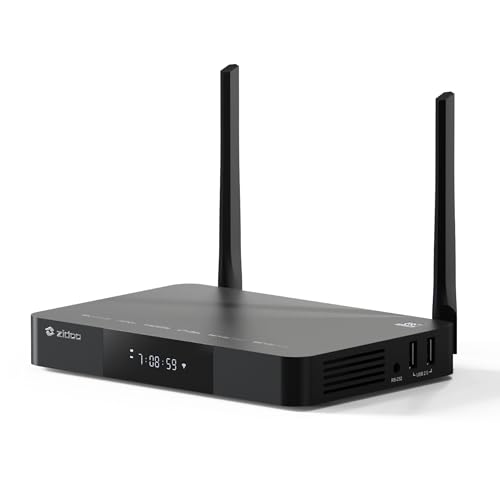
Key takeaways
- Five digital TV converter boxes that bring free over-the-air channels to older TVs, from a compact dongle to a full-featured recording box with HDMI out.
The best digital TV converter box for an older TV is the Mediasonic HomeWorx HW130STB, because it tunes free over-the-air ATSC broadcasts and unencrypted Clear QAM cable channels, outputs a sharp high-definition picture over HDMI, feeds an analog-era set through its composite and antenna outputs, records live TV to a USB drive, and does all of it with a plain remote and an on-screen guide that anyone in the household can follow. An older television is not a useless television. The panel still works, the speakers still work, and the tuner inside it simply speaks a language that no longer exists: analog broadcasts ended years ago, and the digital signals that replaced them need a digital tuner to decode. A converter box is that tuner, in a small box that sits between the antenna and the set, and it restores free local channels, network shows, local news, and live sports to a television that was written off as obsolete, with no monthly bill attached to any of it.
The five picks in this guide solve the older-TV problem in five different ways, and the right one depends on the set in the room and the household using it. The Mediasonic HomeWorx HW130STB is the default pick, because it is the most proven box in this guide, it connects to almost any set through HDMI, composite, or the antenna jack, and it records. The Mediasonic HomeWorx HW135STB is the pick for a household that wants the same job done by a dongle that hides behind the set and draws power from a USB-C connection. The ZJBOX 2024 Mini Digital Converter Box is the pick for a wall-mounted set, because its stick form tucks out of sight and its separate infrared receiver keeps the remote working when the box itself is hidden. The OWERSLYN 1080P Mini ATSC Tuner Box is the pick for a household that wants a compact stick with the widest set of outputs, including component video for sets that have it. The Mediasonic HomeWorx HW180STB is the premium pick, with Dolby Digital audio, emergency alert support, front-panel controls, and the longest warranty in this guide, and it is the pick for the main living-room set that gets used every night.
Start with the How to Choose section if the set in question is genuinely old, because three checks decide everything before any box is ordered: which inputs the television actually has, whether the household has an antenna, and whether anyone wants to record. A set with only an antenna jack needs a box with a channel 3 or 4 output, a set with HDMI takes any pick in this guide, and a household with no antenna at all needs one before any converter box can do anything. The quick comparison table puts the five picks side by side, and each product section lists the full published specs.
As an Amazon Associate, we earn from qualifying purchases.
Table of Contents
- How to Choose a Digital TV Converter Box
- Quick Comparison
- 1. Mediasonic HomeWorx HW130STB
- 2. Mediasonic HomeWorx HW135STB
- 3. ZJBOX 2024 Mini Digital Converter Box
- 4. OWERSLYN 1080P Mini ATSC Tuner Box
- 5. Mediasonic HomeWorx HW180STB
- Before You Buy: Checks for Digital TV Converter Boxes
- Frequently Asked Questions
- Conclusion
- Product and ASIN Reference
How to Choose a Digital TV Converter Box
Match the outputs to the television, because the connection decides everything. Every pick in this guide outputs high-definition video over HDMI, and that is the connection to use whenever the set has a free HDMI port, because it carries the sharpest picture and the simplest setup. But an older set may not have HDMI at all, and that is where the picks split. The HW130STB and the HW180STB carry composite video and an antenna output that feeds a set on channel 3 or 4, which covers the oldest sets in this guide, including tube televisions with nothing but an antenna jack. The iView-style component output matters for a different group: sets from the flat-panel transition years that have red, green, and blue component jacks but no HDMI, and the OWERSLYN stick is the pick that still offers component video alongside HDMI and composite. Before ordering, look at the back of the television and list every input it has. Then choose the box whose outputs include at least one of them, and keep a spare input in mind, because a set whose only HDMI port is taken by a streaming stick needs a box that can use a different input.
Confirm the antenna before blaming the box. A converter box does not receive anything on its own. It tunes the signal an antenna delivers, and a household with no antenna, or with an antenna pointed the wrong way, will see an empty channel list no matter which box it buys. The practical order of work is antenna first, box second: connect an indoor antenna to the set or the box, run a channel scan, and count what comes in. A household in a city may pull in dozens of channels with a small indoor antenna, while a household in a rural area may need an outdoor antenna on the roof, and that difference is about geography, not about the box. Every pick in this guide tunes ATSC broadcasts, which is the standard that carries free over-the-air television in the United States today, and the HW130STB, the HW135STB, and the HW180STB also tune unencrypted Clear QAM cable channels, which matters for a household that still has a basic cable feed. Note what none of these boxes does: none of them tunes the newer ATSC 3.0 NextGen TV signals, so a household in a market that has moved to that standard should check whether its local stations still simulcast in the older ATSC format, which most still do.
Decide whether recording matters, because it changes the shape of the box. Every pick in this guide records live TV to a USB drive the household supplies, and that shared feature is one of the reasons converter boxes still earn their keep: they turn a free antenna signal into a simple DVR with no monthly fee. The differences are in capacity and convenience. The HW135STB, the ZJBOX Mini, and the OWERSLYN stick support drives up to 4TB, which is room for a large library of recorded shows, while the HW130STB and the HW180STB support drives up to 2TB, which is still far more than most households will fill. Recording is timer-based on every pick here, so the household sets a start time and a channel, much like programming an old VCR, and the electronic program guide drawn from the broadcast signal shows what is coming up. If nobody in the household will ever record, the recording capacity does not matter and the decision falls back to outputs and form. If someone records the evening news every night, buy the box with the largest drive support and the clearest timer menu, and budget for a USB hard drive alongside the box, because none of these picks includes one in the box.
Think about the form, because a box that hides is a box that stays. The five picks split into two shapes: full boxes and sticks. The HW130STB and the HW180STB are boxes that sit on a shelf beside the set, with front-panel buttons, a visible display, and a remote that talks to them directly. The HW135STB, the ZJBOX Mini, and the OWERSLYN stick are dongles that hide behind the television, which is the tidier look and the better fit for a wall-mounted set or a set in a cabinet with no shelf space. The trade is the remote: a hidden stick cannot see an infrared remote, so the ZJBOX Mini and the OWERSLYN stick solve that with a separate infrared receiver on a cable, placed where the remote can reach it, while the HW135STB relies on its own line of sight. Think about where the set lives. A set on a stand with shelf space takes a box happily. A set mounted flat on the wall, with no surface nearby, wants a stick. A set in a bedroom where the remote gets used in the dark wants the box with the largest buttons and the clearest display.
Check the guide and the extras, because the daily experience lives there. A converter box is used through its menus, and the quality of those menus decides whether the household enjoys the box or fights it. Every pick here includes an electronic program guide that shows what is on now and next, drawn from the broadcast signal at no extra cost, and every pick includes closed captioning and parental controls. The extras are where they differ. The HW180STB adds emergency alert support, which interrupts viewing with weather and public safety alerts carried in the broadcast, and a favorite channel list that trims a long channel scan down to the channels the household actually watches. The HW130STB and the HW135STB add USB media playback, so photos, music, and video files on a flash drive play on the television through the same box. The ZJBOX Mini and the OWERSLYN stick add a two-in-one remote design that also controls basic television functions. None of these extras is essential, but each one answers a real household habit, so match the extra to the habit: alerts for a household in storm country, media playback for a household with a photo library on a drive, a favorite list for a household that scans past dozens of channels it never watches.
Plan the power and the drive, because both are easy to overlook. The full-size boxes in this guide ship with a wall adapter, which is the safer choice on an older set, because the box gets steady power regardless of what the television does. The sticks draw power from a USB connection, which is tidier but depends on the television USB port delivering enough power, and some older USB ports deliver too little or cut power when the set is off, which can make a stick reboot slowly or lose its clock. If the plan is to power a stick from the television, check that the USB port is live when the set is on, and watch the first week for slow starts, which are the signs the port is underpowered. The drive is the second overlooked item: recording needs a USB hard drive or flash drive formatted the way the box expects, and a drive that is too slow or formatted the wrong way will fail a recording without an obvious error. Buy the drive with the box, format it through the box menu on day one, and run one test recording before the household starts relying on it.
Quick Comparison
| Product | Tuner | Max output | Form | Recording drive | Tier |
|---|---|---|---|---|---|
| Mediasonic HomeWorx HW130STB | ATSC, Clear QAM | 1080p HDMI | Box | Up to 2TB USB | Budget |
| Mediasonic HomeWorx HW135STB | ATSC, Clear QAM | 1080p HDMI | Dongle | Up to 4TB USB | Budget |
| ZJBOX 2024 Mini Digital Converter Box | ATSC | 1080p HDMI | Stick | USB drive | Mid-range |
| OWERSLYN 1080P Mini ATSC Tuner Box | ATSC | 1080p HDMI | Stick | Up to 4TB USB | Mid-range |
| Mediasonic HomeWorx HW180STB | ATSC, Clear QAM | 1080p HDMI | Box | Up to 2TB USB | Premium |
1. Mediasonic HomeWorx HW130STB

The Mediasonic HomeWorx HW130STB is the digital TV converter box to buy first for an older TV, because it tunes free over-the-air ATSC broadcasts and unencrypted Clear QAM cable channels, outputs a sharp high-definition picture over HDMI, feeds an analog-era set through composite video and an antenna output on channel 3 or 4, records live TV to a USB drive, and does all of it with a plain remote and a broadcast program guide that anyone in the household can follow. The HW130STB is the most proven box in this guide, with a listing record that stretches back years and a design that has stayed in production because households keep buying it for the same job: bringing a set without a digital tuner back to life. It is a small box rather than a stick, and that shape is part of the case for an older set: it sits on a shelf beside the television where the remote signal reaches it cleanly, it has real buttons on the front for changing channels without the remote, and its connections are all on the back where they are easy to reach.
The connection set is the practical advantage. HDMI carries the high-definition picture to any flat-panel set, composite video and stereo audio carry a standard-definition picture to a tube television or an early flat panel, and the antenna output feeds a set that has nothing but a screw-on antenna jack, tuned to channel 3 or 4. That range means the HW130STB is the only pick in this guide that can serve all three generations of television in one household: the tube set in the spare room, the early flat panel in the bedroom, and the newer set in the living room that lost its smart platform but kept its HDMI port. The ATSC tuner receives the free broadcasts an antenna delivers, and the Clear QAM tuner receives unencrypted digital cable channels for a household that still has a basic cable feed. The electronic program guide shows what is on now and next, drawn from the broadcast signal, and the closed captioning and parental controls cover the two features households ask about most after the channel list itself.
The recording feature is the other half of the case. Plug a USB hard drive or flash drive into the front USB port, set a timer, and the box records the channel to the drive, with pause and rewind for live TV while the household watches. The supported drive capacity runs up to 2TB, which holds a large library of recorded shows, and the same USB port plays photos, music, and video files stored on a drive, so the box doubles as a simple media player for a household with a photo collection or a music library on a flash drive. The box ships with a remote, an AV cable, and a power adapter, so the household needs nothing else except an antenna and a drive. Buy the HW130STB if the household wants the default pick for an older TV, the widest set of connections in this guide, and a recorder with no monthly fee, and buy the HW180STB only if the living-room set earns the premium extras.
The HW130STB also suits the household that is upgrading more than one older set, because the same plain menus on every television mean nobody has to learn a new system in the bedroom after learning it in the living room. The box is small enough to move between rooms, and the guided channel scan walks through the antenna setup without jargon. The trade is size and speed: this is a full box, not a stick, so it needs a shelf or a surface near the set, and its menus are plain rather than polished. A household with a wall-mounted set and no shelf should look at the HW135STB dongle instead. Buy the HW130STB if the household wants the most proven converter box in this guide, and buy the HW135STB if the household wants the same job done by a dongle that hides behind the set.
Specs
- Tuner: ATSC over-the-air, Clear QAM unencrypted cable
- Max output: 1080p over HDMI, with composite video and antenna output on channel 3 or 4
- Recording: timer recording and live pause to a USB drive up to 2TB
- Media playback: photos, music, and video files from a USB drive
- Guide: electronic program guide from the broadcast signal
- Extras: closed captioning, parental controls, front-panel buttons
- In the box: remote control, AV cable, power adapter
- Tier: Budget
2. Mediasonic HomeWorx HW135STB
The Mediasonic HomeWorx HW135STB is the pick for an older TV in a household that wants the converter box to disappear, because it is a compact dongle that plugs into an HDMI port and hides behind the set, draws power through a USB-C connection, tunes ATSC broadcasts and unencrypted Clear QAM cable channels, outputs a sharp high-definition picture, and records live TV to a USB drive up to 4TB. The dongle form is the detail that sets this pick apart: at 4.65 x 1.38 x 0.67 inches, it is barely larger than a flash drive, it hangs from the HDMI port instead of occupying a shelf, and it suits a wall-mounted set or a set in a tight cabinet where a full box would have nowhere to sit. The household still gets a real remote, a large one, and a 3ft HDMI cable in the box, so the dongle can sit a short distance from the port when the space behind the set is too tight for a direct plug.
The tuner is the same capable unit as the default pick, which is the point: the HW135STB gives up nothing in reception to gain its small size. It receives free over-the-air ATSC broadcasts from an antenna and unencrypted Clear QAM cable channels, and it outputs up to 1080p over HDMI, which covers the high-definition picture any set in this guide can show. The recording support is actually stronger than the default pick, with drives up to 4TB, so a household that records a lot of television gets more room before the drive fills. The USB media playback carries over too, so photos, music, and video files on a flash drive play on the television through the same dongle, and the electronic program guide, closed captioning, and parental controls are all present. The USB-C power connection is the modern touch: it draws from a USB port or a small adapter, and the short cable keeps the installation tidy behind the set.
The HW135STB also suits the household that moves a converter between rooms, because the dongle, the cable, and the remote pack into a drawer and plug into a second set as easily as into the first. The trade is connections and control: this is an HDMI-only device, so a set with no HDMI port needs a different pick, and a hidden dongle is harder to reach than a box with front-panel buttons when the remote is missing. A household whose set has only composite or antenna inputs should look at the HW130STB instead. Buy the HW135STB if the household wants the tidiest installation in this guide and a set with a free HDMI port, and buy the HW130STB if the household wants the widest set of outputs.
Specs
- Tuner: ATSC over-the-air, Clear QAM unencrypted cable
- Max output: 1080p over HDMI
- Recording: timer recording and live pause to a USB drive up to 4TB
- Media playback: photos, music, and video files from a USB drive
- Guide: electronic program guide from the broadcast signal
- Extras: closed captioning, parental controls, large remote control
- Power: USB-C connection
- Dimensions: 4.65 x 1.38 x 0.67 inches
- In the box: large remote control, 3ft HDMI cable
- Tier: Budget
3. ZJBOX 2024 Mini Digital Converter Box
The ZJBOX 2024 Mini Digital Converter Box is the pick for a wall-mounted older TV, because its stick form hides behind the set, its separate infrared receiver keeps the remote working when the box itself is out of sight, it tunes free over-the-air ATSC broadcasts, outputs a sharp high-definition picture over HDMI, and records live TV to a USB drive with timer scheduling. The hiding place is the detail that sets this pick apart: the stick plugs into an HDMI port and tucks behind the television, the power adapter and cables stay out of view, and the only visible part is the small infrared receiver with its display, placed where the remote can reach it. That arrangement is the honest answer for a set mounted flat on the wall, where a box on a shelf would need a shelf that does not exist and a cable run the household does not want to see.
The tuner is a single ATSC unit, which is the right scope for this pick: it receives the free over-the-air broadcasts an antenna delivers and outputs them at up to 1080p over HDMI, with a 3RCA composite output for sets that need it. The recording feature works the same way as on the full-size boxes, with timer scheduling for shows the household wants to keep and playback from a USB drive, and the USB media player covers photos, music, and video files stored on a flash drive. The two-in-one remote is the other practical detail: it handles the converter functions and basic television control, so the household juggles one remote instead of two. The box ships with the remote, an HDMI cable, an AV cable, an infrared cable, and a power adapter, which is a complete kit for a set that has nothing spare in the drawer.
The ZJBOX Mini also suits the household that wants the converter to vanish into the installation, because the stick, the receiver, and the cables are all small and easy to route behind a mounted set. The trade is tuner scope and longevity of the record: this pick tunes ATSC broadcasts only, with no Clear QAM cable tuning, so a household with a basic cable feed should look at one of the Mediasonic picks instead, and the stick form means there are no front-panel buttons to fall back on if the remote is lost. Buy the ZJBOX Mini if the household wants the cleanest installation in this guide on a wall-mounted set, and buy the HW135STB if the household wants a dongle with Clear QAM tuning as well.
Specs
- Tuner: ATSC over-the-air
- Max output: 1080p over HDMI, with 3RCA composite output
- Recording: timer recording and playback to a USB drive
- Media playback: photos, music, and video files from a USB drive
- Guide: electronic program guide from the broadcast signal
- Extras: two-in-one remote, separate infrared receiver with display, one-year warranty
- Power: power adapter included
- In the box: remote control, HDMI cable, AV cable, infrared cable, power adapter
- Tier: Mid-range
4. OWERSLYN 1080P Mini ATSC Tuner Box
The OWERSLYN 1080P Mini ATSC Tuner Box is the pick for an older TV in a household that wants a compact stick with the widest set of outputs, because it hides behind the set, tunes free over-the-air ATSC broadcasts, outputs high-definition video over HDMI and standard video over AV and component connections, records live TV to a USB drive up to 4TB, and ships with a two-in-one remote and an infrared receiver. The output set is the detail that sets this pick apart: HDMI covers the flat-panel sets, the AV output covers the older sets with red, white, and yellow jacks, and the component output covers the transition-era sets with red, green, and blue jacks, so this one stick can serve three generations of television without an adapter. That range matters most in a household with several older sets of different ages, where one spare stick can move from room to room and still connect.
The stick form is the second half of the case. Like the ZJBOX Mini, the OWERSLYN stick hides behind the television, and its infrared receiver on a cable keeps the remote working when the stick itself is out of sight. It can draw power from a television USB port or a 5V USB charger, which keeps the installation to a single short cable, and the compact design suits a wall-mounted set or a set in a cabinet with no shelf space. The recording support runs to drives up to 4TB, which is the largest capacity in this guide alongside the HW135STB, and the timer setting schedules recordings the way the other picks do. The USB media player covers photos, music, and video files, and the electronic program guide, closed captioning, and parental controls are all present. The household also gets a lifetime of support and a one-year warranty from the maker, with answers promised within a day.
The OWERSLYN stick also suits the household that shares one set between viewers with different habits, because the stick moves easily, the outputs cover whatever the next set offers, and the timer recording means nobody has to be in the room when a show airs. The trade is tuner scope: like the ZJBOX Mini, this pick tunes ATSC broadcasts only, with no Clear QAM cable tuning, so a household with a basic cable feed should look at one of the Mediasonic picks instead. Buy the OWERSLYN stick if the household wants the widest outputs in a hidden stick form, and buy the HW130STB if the household wants a full box with Clear QAM tuning and an antenna output for the oldest sets.
Specs
- Tuner: ATSC over-the-air
- Max output: 1080p over HDMI, with AV and component video outputs
- Recording: timer recording and playback to a USB drive up to 4TB
- Media playback: photos, music, and video files from a USB drive
- Guide: electronic program guide from the broadcast signal
- Extras: two-in-one remote, infrared receiver with display, one-year warranty
- Power: television USB port or 5V USB charger
- In the box: remote control, HDMI cable, 3RCA cable, USB to DC cable, infrared receiver with display
- Tier: Mid-range
5. Mediasonic HomeWorx HW180STB
The Mediasonic HomeWorx HW180STB is the premium pick for an older TV, because it pairs the proven Mediasonic tuner with Dolby Digital audio, emergency alert support, a favorite channel list, front-panel controls, and a two-year warranty, so the main living-room set gets the most complete converter box in this guide. The audio is the practical advantage on an older set: Dolby Digital sound carries the surround mix from the broadcast to a soundbar or receiver over the digital audio output, which is the difference between flat television speakers and a living room that sounds like a theater on a film night. The emergency alert support is the feature no other pick in this guide offers: weather and public safety alerts carried in the broadcast interrupt viewing with the information the household needs, which matters most in storm country, where the antenna is often the only signal still working when the internet goes down.
The tuner and connections match the default pick, which is the point: the HW180STB gives up nothing to gain its premium extras. It receives free over-the-air ATSC broadcasts and unencrypted Clear QAM cable channels, outputs up to 1080p over HDMI, and feeds older sets through composite video and an antenna output. The recording feature covers timer recording and live pause to a USB drive up to 2TB, and the USB media player covers photos, music, and video files. The favorite channel list trims a long channel scan down to the channels the household actually watches, so channel surfing stops at the good ones instead of wandering past dozens of shopping and religious channels. The front-panel buttons change channels and power without the remote, and the 12-hour clock display shows the time in standby. The two-year warranty is the longest in this guide, and the redesigned version of this box added recording stability and reception sensitivity over the original.
The HW180STB also suits the household that is upgrading the main set once and wants the upgrade to last, because the premium audio, the alert support, and the longer warranty are the parts that keep a converter box feeling complete for years rather than months. The trade is the tier: this is the premium pick in this guide, and a household with a bedroom set or a guest-room set will get almost everything it needs from the HW130STB at the budget tier. The HW180STB is also a box rather than a stick, so it needs a shelf or a surface near the set, and a household with no space beside the television should look at one of the stick picks instead. Buy the HW180STB if the household wants the strongest converter box for its main older set, and buy the HW130STB if the household wants the same tuner and connections on a second set.
Specs
- Tuner: ATSC over-the-air, Clear QAM unencrypted cable
- Max output: 1080p over HDMI, with composite video and antenna output
- Recording: timer recording and live pause to a USB drive up to 2TB
- Media playback: photos, music, and video files from a USB drive
- Audio: Dolby Digital sound with digital audio output
- Guide: electronic program guide from the broadcast signal
- Extras: emergency alert support, favorite channel list, closed captioning, parental controls, front-panel buttons, two-year warranty
- Tier: Premium
Before You Buy: Checks for Digital TV Converter Boxes
Check the live offer, because listing records lag. The OWERSLYN stick rests on an Amazon listing record about 235 days old and on roundup listings dated November 18, 2026 showing it in stock, which is the freshest evidence in this guide. The ZJBOX Mini rests on an Amazon listing record about 194 days old. The HW130STB rests on an Amazon listing record about 291 days old, the HW180STB rests on an Amazon-sourced manual record about 289 days old, and the HW135STB rests on an Amazon-sourced manual record about 9 days old. Those ages are the reason to glance at the live page before ordering: a box that was widely stocked a year ago can be a third-party listing today, and the seller matters as much as the model name. Confirm the seller, the included accessories, and the return window before ordering, and keep the receipt until the first channel scan is done.
On safety recalls, no pick in this guide is covered by one. A search of the federal recall record found no CPSC recall naming any of the five picks, their makers, or the digital converter box class as a covered product. That search covered the converter-box class as a whole and each maker in turn, and no recall notice surfaced for any of them. The practical lesson is the same one that record carries: buy the box from a seller the household recognises, use the power adapter or cable that ships in the box, and keep the box where air can move around it rather than buried in a closed cabinet. None of the five picks is covered by a recall, and none of them needs a workaround to use safely.
Run the channel scan twice, on two antenna positions. Plug the box in, connect the antenna, and run a full channel scan, then move the antenna a short distance or turn it and scan again, because a few inches of antenna position can be the difference between a channel that locks in cleanly and one that breaks up. Write down the channel count from each scan and keep the better position. If a channel the household wants is missing, check a coverage map for the local stations before blaming the box, because a station that broadcasts from the far side of a hill may need an outdoor antenna rather than a different tuner.
Test the recording on day one. Format the USB drive through the box menu, set a timer for a show airing that evening, and play the recording back the next morning. A drive that is too slow or formatted the wrong way will fail a recording without an obvious error, and the first week is the time to find that out, while the return window is still open. Check that the recorded file plays with sound as well as picture, and that the pause and rewind controls work during live TV, because those are the features the household will rely on every night.
Set up the remote to replace the old one where it can. Pair the two-in-one remote with the television where the pick supports it, and test power and volume from the new remote before putting the old remote away. A remote that controls the set as well as the converter turns two remotes into one, and that is the difference between an upgrade the household uses every night and an upgrade that adds clutter to the coffee table. If the remote cannot control an older set, check the box settings for the TV brand, because the remote database covers more sets than the quick setup suggests.
Frequently Asked Questions
Will a converter box work on a TV with no HDMI port?
Yes, if the box has the right output for the set. The HW130STB and the HW180STB carry composite video and an antenna output that feeds a set on channel 3 or 4, which covers tube televisions and early flat panels with nothing but an antenna jack. The OWERSLYN stick adds a component output for transition-era sets. The HW135STB dongle is HDMI-only, so it needs a set with a free HDMI port. Check the back of the television before ordering and choose the box whose outputs include at least one input the set actually has.
Do I need an antenna for a digital TV converter box?
Yes. A converter box tunes the signal an antenna delivers, and it receives nothing on its own. An indoor antenna suits many households in cities and suburbs, while a rural household may need an outdoor antenna to pull in the same stations. Connect the antenna first, run a channel scan, and count what comes in before judging the box. A household with no antenna at all needs one before any pick in this guide can do anything.
Can a converter box record TV without a monthly fee?
Yes. Every pick in this guide records live TV to a USB drive the household supplies, using timer scheduling, with no subscription and no monthly fee. The HW135STB, the ZJBOX Mini, and the OWERSLYN stick support drives up to 4TB, while the HW130STB and the HW180STB support drives up to 2TB. Buy the drive with the box, format it through the box menu on day one, and run one test recording before relying on it.
Will a converter box get me cable channels?
Only unencrypted ones. The HW130STB, the HW135STB, and the HW180STB tune Clear QAM, which carries unencrypted digital cable channels for a household with a basic cable feed. The ZJBOX Mini and the OWERSLYN stick tune over-the-air ATSC broadcasts only. None of these boxes tunes encrypted cable channels or replaces a cable box, and none of them tunes the newer ATSC 3.0 NextGen TV signals, so check that local stations still simulcast in the older ATSC format, which most still do.
Conclusion
The Mediasonic HomeWorx HW130STB is the digital TV converter box to buy first for an older TV: a small box that tunes free over-the-air broadcasts and unencrypted cable channels, connects to almost any set through HDMI, composite, or the antenna jack, and records live TV to a USB drive with no monthly fee. The Mediasonic HomeWorx HW135STB is the pick for a household that wants the same job done by a dongle that hides behind the set. The ZJBOX 2024 Mini Digital Converter Box is the pick for a wall-mounted set, with a stick that tucks out of sight and a separate infrared receiver. The OWERSLYN 1080P Mini ATSC Tuner Box is the pick for a household that wants a compact stick with the widest set of outputs. The Mediasonic HomeWorx HW180STB is the premium pick for the main living-room set, with Dolby Digital audio, emergency alert support, and the longest warranty in this guide. Check the television inputs first, put up an antenna, test the recording on day one, and any of the five will give the older television a free broadcast life.