Key takeaways
- Compare the best in-wall speakers for home theater, from budget singles to premium 3-way models, with confirmed specs and fit notes for every room.
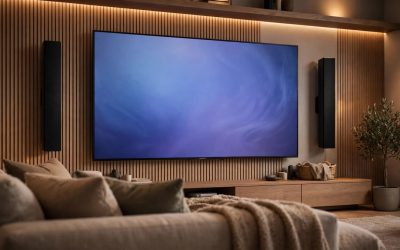
An in-wall speaker hides the hardware and keeps the sound. The driver sits flush inside the wall cavity, the grille paints to match the wall, and nothing stands on the floor. For a home theater, that matters: the front channels can sit at ear height beside the screen, and surrounds can live in the side walls instead of on stands.
The five speakers below cover the range a home theater needs, from a single budget speaker to a premium three-way model. Every pick is a true in-wall model, not a surface-mounted on-wall speaker or a round in-ceiling speaker. Each one runs from a separate amplifier or receiver, so plan for speaker wire before cutting drywall.
As an Amazon Associate, we earn from qualifying purchases.
Quick Answer
For most home theaters, the Polk Audio RC85i is the safest first choice: an 8-inch pair with moisture-resistant build and an aimable tweeter. The Klipsch R-5502-W II suits a louder front stage, and the Polk 265-RT is the premium three-way choice. On a tighter plan, the Micca M-CS covers the center channel and the M-6S adds channels one at a time.
Polk Audio RC85i
The RC85i is the workhorse here: an 8-inch two-way in-wall pair with a moisture-resistant build, useful in a living room, a kitchen zone, or a covered porch. The larger woofer gives fuller low-end response than the 6.5-inch models, so a room without a subwoofer still gets body in movie sound and music.
The 0.75-inch silk dome tweeter sits in a swivel mount, so it can be aimed at the listening position after install, which helps when studs fix the location. The grille is paintable, a mounting template is included, and Polk rates the pair for 20 to 100 watts RMS per channel at 8 ohms.
Two details deserve attention. The listing sells a pair, so a five-channel setup needs three pairs, with one speaker left over. And the round in-ceiling sibling, the RC80i, is a different model: confirm the listing says RC85i and shows a rectangular frame.
Specs
| Feature | Detail |
|---|---|
| Woofer | 8-inch polypropylene |
| Tweeter | 0.75-inch swivel silk dome |
| Frequency response | 30 Hz to 20 kHz |
| Recommended power | 20-100 watts RMS |
| Impedance | 8 ohms |
| Sensitivity | 90 dB |
| Sold as | Pair |
| Model number | AW0085-A |
Klipsch R-5502-W II
The R-5502-W II is the loudest and most theater-focused speaker here: a left, center, or right channel model with dual 5.25-inch Cerametallic woofers and a 1-inch titanium compression driver behind a pivoting Tractrix horn. High sensitivity means it plays loud on modest power, and the dual woofers keep dialogue full at theater volume.
This is the pick for a dedicated front stage: three make a matched front row with identical voicing across the screen. The pivoting horn aims high frequencies at the seats, which matters when the center sits below the screen.
One conflict needs a note. Klipsch material describes the horn as both 90 by 90 degrees and 90 by 60 degrees; the manual and spec sheet describe a 90 by 90 square Tractrix horn, and this article follows that figure. Power handling also varies: the spec sheet states 75 watts RMS with a 300-watt peak, while one manual mirror states higher figures. Confirm the listing says R-5502-W II, since the original R-5502-W without the Mark II suffix is an older model.
Specs
| Feature | Detail |
|---|---|
| Woofers | Dual 5.25-inch Cerametallic |
| Tweeter | 1-inch titanium driver, pivoting Tractrix horn |
| Frequency response | 46 Hz to 20 kHz |
| Power handling | 75W RMS / 300W peak |
| Impedance | 8 ohms |
| Sensitivity | 92 dB |
| Sold as | Each |
| Model number | R-5502-W II |
Polk Audio 265-RT
The 265-RT is the premium three-way speaker here, and the most detailed for music as well as movies. Two 6.5-inch woofers handle bass and midrange, a dedicated midrange driver covers voices, and a 1-inch dome tweeter handles the top end. That layout keeps dialogue clear when effects and music play together.
Polk Power Port venting extends low-end response from a shallow cabinet, and a port plug is included for rooms where the bass needs taming. It is timbre matched to Polk Legend, Reserve, and RTi series speakers, so it blends with those lines in a mixed system.
Watch the listing variants. The single and pair listings are separate, with different codes and UPC values, and a bundle pairing one 265-RT with a 70-RT in-ceiling speaker is a third listing. Confirm the listing matches the quantity needed. The listing also notes the speaker fits a ceiling or a wall; it is an in-wall speaker that can mount in a ceiling.
Specs
| Feature | Detail |
|---|---|
| Woofers | Dual 6.5-inch Dynamic Balance polypropylene |
| Tweeter | 1-inch silk and polymer dome |
| Frequency response | 30 Hz-27 kHz; 45 Hz-25 kHz (-3 dB) |
| Recommended power | 10-200 watts |
| Impedance | 8 ohms |
| Depth | 3.56 inches |
| Grille | Paintable |
| Sold as | Each |
| Model number | 265-RT |
Micca M-CS
The M-CS is the budget way to build a proper center channel: two 5.25-inch poly woofers flanking a 1-inch pivoting silk dome tweeter, in the MTM layout that suits dialogue. Mounted horizontally it serves as a center channel; mounted vertically it works as a front or surround channel, so one model can cover the front row.
One speaker covers the center channel without the cost of a premium LCR model, and 90 dB sensitivity means it needs no powerful amplifier to keep up with louder front speakers. The 12 dB crossover keeps the transition smooth.
The listing sells one speaker, so a full front row needs three. It shows two UPC values, a catalog quirk worth noting when matching the exact listing. The M-CS is the rectangular in-wall center model; the round M-8C and M-6C are in-ceiling models with different listings.
Specs
| Feature | Detail |
|---|---|
| Woofers | Dual 5.25-inch poly-mica |
| Tweeter | 1-inch pivoting silk dome |
| Frequency response | 60 Hz to 20 kHz |
| Power handling | 120 watts |
| Impedance | 8 ohms |
| Sensitivity | 90 dB |
| Outer width | 15.4 inches |
| Sold as | Each |
| Model number | M-CS |
Micca M-6S
The M-6S is the cheapest way into this roundup and the most flexible for staged builds: a single 6.5-inch two-way in-wall speaker with a high-excursion poly woofer and a 1-inch pivoting silk dome tweeter. It sells individually, so a buyer can add channels over time.
The cutout is modest at 7.3 inches wide by 10.7 inches high, and the 2.9-inch mounting depth fits shallow walls where deeper speakers will not. At 87 dB it plays a little quieter than the other picks; that is fine for surrounds and background zones, and less ideal as a main front speaker in a large room. Drywall-gripping tabs mean no separate bracket is needed for retrofit work.
The main trap is the model family. The M-6C is the round in-ceiling version, and the M-8S is the larger 8-inch rectangular version; both have their own listings. Confirm the listing says M-6S and shows a rectangular frame, and count the channels needed, since the listing includes one speaker.
Specs
| Feature | Detail |
|---|---|
| Woofer | 6.5-inch poly-mica |
| Tweeter | 1-inch pivoting silk dome |
| Frequency response | 50 Hz to 20 kHz |
| Power handling | 80 watts |
| Impedance | 8 ohms |
| Sensitivity | 87 dB |
| Cutout | 7.3 x 10.7 inches |
| Mounting depth | 2.9 inches |
| Sold as | Each |
| Model number | M-6S |
How to choose
Begin with the wall, not the speaker. Measure stud spacing, cavity depth, and any pipes or wires inside the wall. Standard studs sit 16 inches apart, leaving about 14.5 inches of clear width; a wider speaker needs framing work. A speaker deeper than the cavity will not sit flush.
Next, match the speaker to its channel. The front three carry dialogue and most of the action, so they deserve the strongest models with matching voicing. Surrounds carry effects and ambience, so a smaller model works well there. A center channel should be a horizontal LCR or MTM design, not a standard vertical two-way turned sideways.
Then check the amplifier. All five picks are passive and need a separate receiver or amplifier; none has a built-in amplifier or wireless connection. Confirm the receiver has enough channels and that its impedance rating covers the speakers: most handle 8-ohm models, while a 6-ohm model needs a receiver rated for it.
Finally, plan the wire before cutting. Run speaker wire to each location, leave slack at both ends, and keep it away from mains power lines. A pre-construction bracket makes the cutout clean and the speaker secure; for retrofit work, a cardboard template and a drywall saw do the job.
Who should skip
Renters should skip in-wall speakers: installation means cutting drywall that must be patched and repainted later. An on-wall or bookshelf speaker gives similar sound without permanent changes.
Buyers who want a quick setup should look elsewhere. In-wall speakers need a receiver, wire run through walls, and a drywall cut for each speaker, so the install takes an afternoon at least.
Shallow or unusual walls can rule out in-wall models too. Metal studs, concrete block, or very shallow cavities may not accept a speaker needing nearly 3 inches of depth, and pipes or ducting may force it to move. Measure first; if the cavity will not fit, pick a shallower speaker.
Frequently Asked Questions
Do in-wall speakers need a separate amplifier?
Yes. Every speaker here is passive, with no built-in amplifier and no power cord. Each one connects by speaker wire to a home theater receiver or a separate amplifier.
Can an in-wall speaker go in the ceiling instead?
Some can. The Polk 265-RT is listed as fitting a ceiling or a wall, and the round Micca M-8C and M-6C are built for ceilings. A rectangular in-wall model in a ceiling will still play, but its dispersion is designed for a vertical wall, so sound may not spread as intended. Use a ceiling-rated model when the ceiling is the plan.
How much wall depth does an in-wall speaker need?
It depends on the model. The Micca M-6S needs 2.9 inches of depth, while the Polk 265-RT needs about 3.56 inches. Standard walls with two-by-four studs give roughly 3.5 inches of cavity depth, so most models here fit, but measure the actual cavity first.
Should the front three speakers match?
Ideally, yes. The front three channels carry most of the sound in a movie, and matched speakers keep voices and effects consistent as sound moves across the screen. Three identical LCR models, or three from the same series with the same tweeter design, give the most even result.
Final verdict
The Polk RC85i is the best first choice for most home theaters: a proven 8-inch pair with moisture resistance, an aimable tweeter, and enough bass for smaller rooms without a subwoofer. A louder dedicated theater suits the Klipsch R-5502-W II for the front stage or the Polk 265-RT for the most detailed three-way sound. On a tighter plan, the Micca M-CS covers the center channel and the M-6S adds channels one at a time. Measure the stud spacing and cavity depth first, confirm the listing, and run the wire before cutting the wall.